💡 TL;DR
- A virtual hackathon runs entirely online, from registration through to judging, with no venue or travel costs
- AngelHack’s virtual hackathon platform covers registration, team formation, submissions, rubric-based judging, prize payouts, and analytics
- Hosting runs in seven steps, from defining the program to following through after submissions close
- You can choose end-to-end delivery or a specific scope, depending on what you need help the most from AngelHack
A virtual hackathon runs the entire competition online, from registration and team formation through to building, submission, and judging. There’s no venue to book and no travel budget to approve, which puts a global developer pool within reach at a minimum cost.
Two things decide how well that goes. The first is the platform running the event. The second is the team supporting it once registrations start arriving.
AngelHack does both. We’ve run hundreds of hackathons across 100+ cities for 200+ clients over 15+ years, and we host virtual events on our own platform.
How AngelHack team helps you run a virtual hackathon
Most hackathon platforms are self-serve. You get the tooling, then your team writes the challenge brief, produces the creatives, recruits the judges, runs the marketing, and staffs support through the build window. In contrast, with the AngelHack Platform, we plan and launch the hackathon with you end-to-end.
Program design
We help shape the challenge statement, the tracks, the judging criteria, and the participant journey from registration to post-event. Every element gets built backwards from the outcome you want, whether that’s product adoption, prototypes you can pilot, or a pipeline of technical talent.
Hackathon promotion
Your hackathon goes live to our on-platform developer community and gets promoted within our network of 500,000+ developers, plus 300+ community partners globally. Organic and paid campaigns are run alongside, giving you a registration base on day one rather than a cold start.
Production & operations
Beyond the platform, we cover the work that keeps a virtual program running:
- Creative production for the event page, social, and announcement assets
- Guides for participants, mentors, and judges
- A dedicated Discord channel with support ticketing through the build window
- Organic and paid marketing to drive registrations
- Live events: launch session, mentor hours, and winner announcement
Dedicated support
Your program gets its own program manager, marketing manager, community manager, creative specialist, and platform manager. Your team stays focused on the strategy while ours handles the day-to-day running of the event.
What the AngelHack Platform handles
The platform covers the operational layer of the event, so organisers aren’t reconciling registrations in one tool, submissions in another, and judging scores in a spreadsheet.
| Feature | How it helps |
|---|---|
| Registration and team formation | Participants sign up, form teams, and manage their profiles in the same place they’ll later submit |
| Eligibility and applicant vetting | Set entry rules and review applicants, so a curated audience stays possible without closing off open sign-up |
| Rubric-based judging | Judges review submissions, leave feedback, and score against published criteria, without full organiser permissions |
| Prize distribution | Cash, crypto, tech and gadgets, and certifications reach winners wherever they’re based |
| Analytics dashboard | Track registrations, submission rates, and engagement so you can see where participants drop off and where they stay |
Without a single system, organiser time goes into administration during the exact week it should be going into participants.
How to host a virtual hackathon on the AngelHack Platform
Step 1: Define the program
Before anything gets built, decide what the hackathon has to produce. That means naming the business outcome it feeds, the participant profile you want, the theme and challenge statement, the timeline from registration to winner announcement, and how the budget splits across prizes, marketing, and operations.
We work with you at this stage, advising on format options and challenge design so the structure matches the outcome rather than working against it.
Step 2: Set up the hackathon page
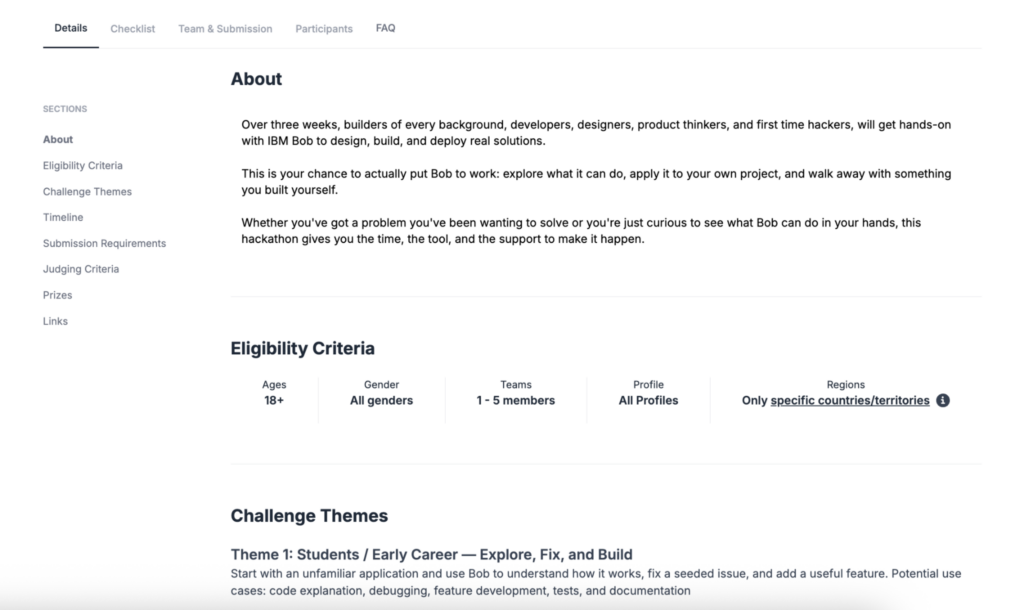
Setup runs off a single brief covering the event overview, eligibility criteria, challenge themes, timeline, submission requirements, judging criteria, prizes, mentors and judges, and an FAQ for participants.
Our team builds the page from that brief. Once it’s live, your hackathon appears on the platform events listing where our developer community can find it, and registration opens immediately.
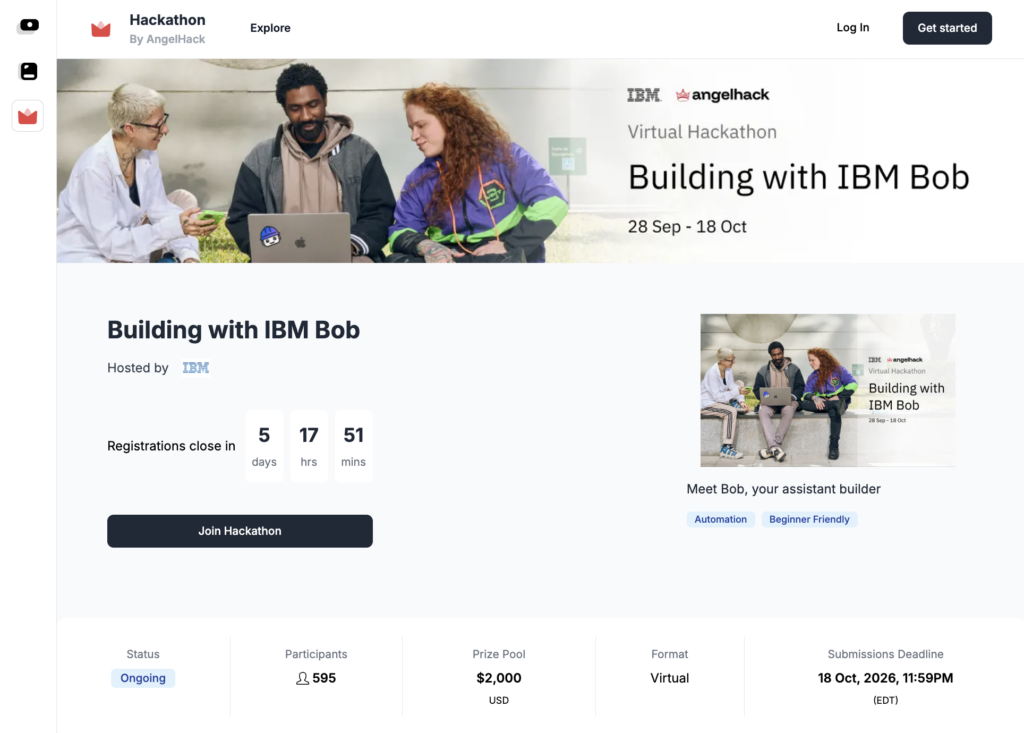
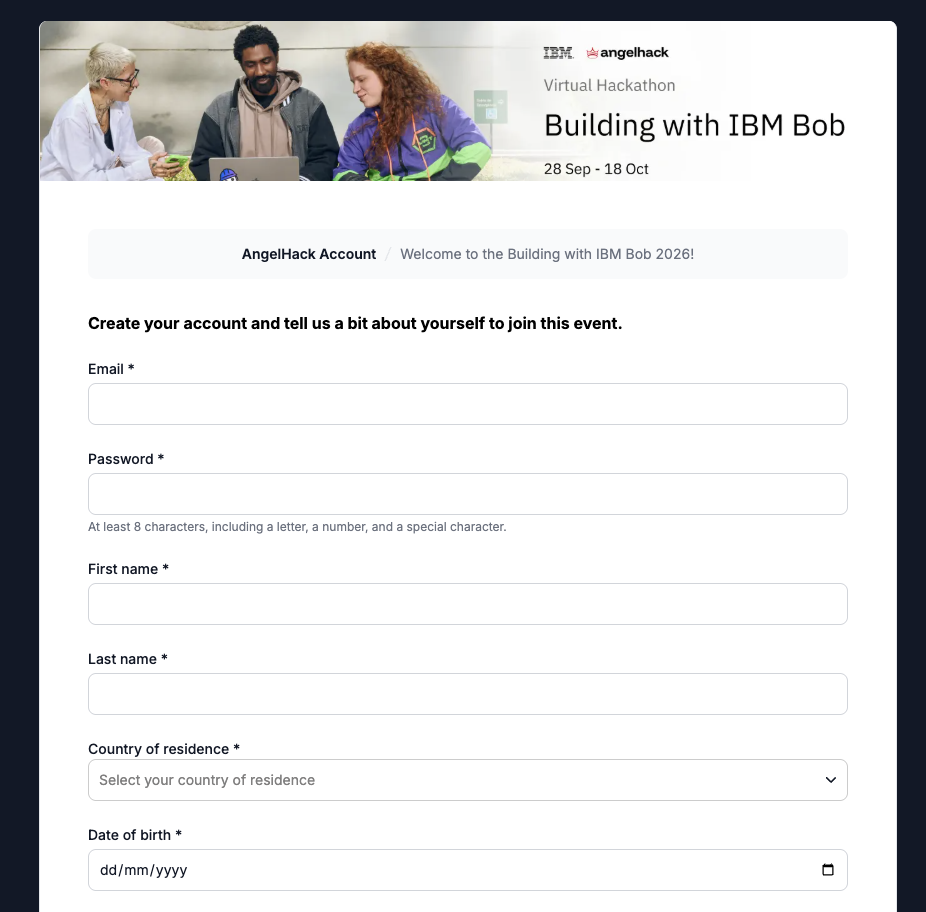
The registration form is yours to configure, so you collect the participant details your program needs from the first sign-up.
Step 3: Prepare before launch
Preparation happens before promotion, not alongside it.
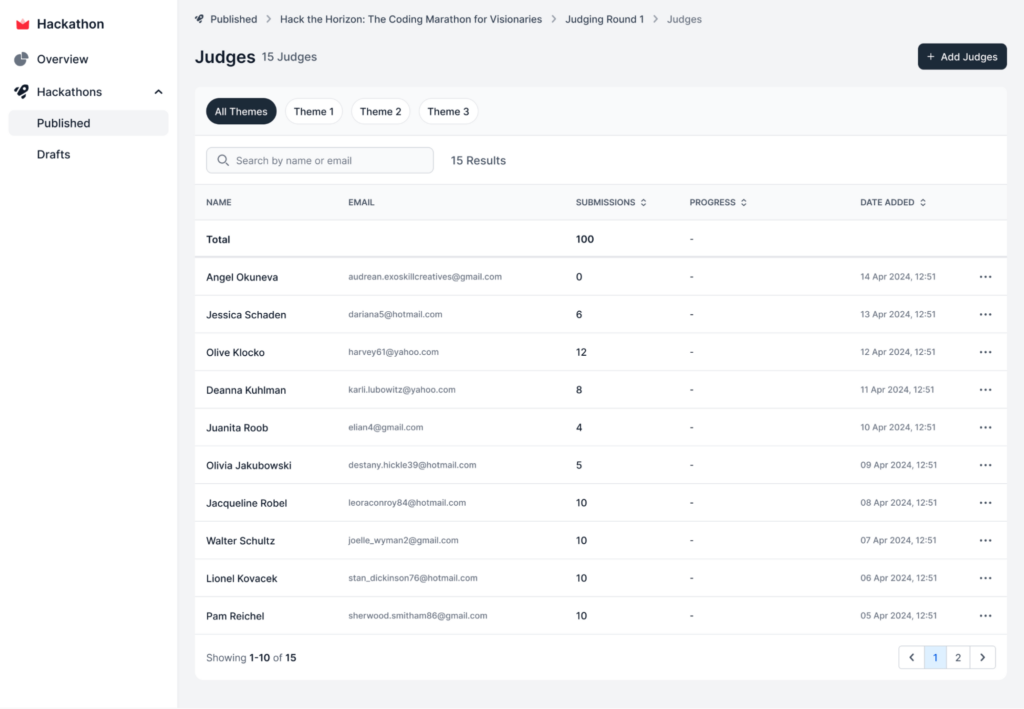
- Onboard mentors and judges to the platform and assign their roles
- Walk judges through the scoring rubric before submissions open, so evaluation is consistent
- Run test sessions on registration, submission, and communication flows
Step 4: Market to the right builders
Promotion starts with the audience already on the platform. We announce your hackathon to our 500,000+ developer community and activate the 300+ community partner network for wider reach, then run paid, email, social, and organic channels together rather than in sequence.
Registration builds faster when there’s something to engage with before the build window opens. Teaser challenges, AMAs or office hours with judges, early-bird prize tiers, referral incentives, and partner newsletter placements all give developers a reason to sign up early.
We offer both consultation on the campaign and full execution of it, depending on how much of the promotion your team wants to run.
Step 5: Manage participant support and submissions
Support during the build window is what turns registrations into submissions.
- Mentor hours and workshops scheduled across time zones
- A single participant guide covering rules, tooling, and process
- Real-time discussion and support on Discord
- Submission reminders that restate the judging criteria and the deadline
Step 6: Judge, announce, and distribute prizes
All submissions land in one place and get scored against the rubric you published. Judges review, comment, and rank without leaving the platform.
Results go out across the platform, email, social, and community channels. We produce the announcement content that goes with them, including posts, recap articles, and highlight videos. Prizes are then paid out to winners in any region.
Step 7: Follow through post-event
The work that determines long-term value happens after submissions close.
- Survey participants, mentors, and judges
- Pull analytics on registration-to-submission conversion and drop-off points
- Publish winner spotlights and participant stories
- Decide which working prototypes get a pilot path inside the organisation
Skip this step and the program produces excitement instead of outcomes. For a deeper walkthrough of the operational side, read our step-by-step guide to running a virtual hackathon.
Success story: Databricks Generative AI World Cup
Databricks partnered with us to host the Generative AI World Cup, a global competition built around its Mosaic AI technologies. The requirement was specific: reach a worldwide audience of AI engineers and data scientists, and verify that everyone competing had that expertise.
How it’s done
- Selective vetting: Only developers with data backgrounds were accepted, keeping the standard of submissions high.
- Global marketing: A targeted campaign across our developer network, social, and email reached data professionals in 18 countries.
- Platform hosting: Registration, team coordination, and project submissions all ran on the platform.
The results
- 1,500 data professionals engaged across 18 countries in three regions: APJ, AMER, and EMEA.
- Working prototypes in biotechnology, food and beverage, telecommunications, legal tech, and construction, built on Mosaic AI.
- Grand prize to Exyte for ReguBEAM AI, a compliance assistant that automates regulatory checks in building design using BIM models and regulatory documents.
Final words
Hosting a virtual hackathon gets easier when the platform and the team behind it are the same. One system carries the event from registration to payout, and one team handles setup, promotion, live operations, judging logistics, and reporting.
That leaves the organising team on the parts that matter: the challenge, the participants, and what happens to the prototypes afterwards. Everything else is covered.
Let’s Talk Partnership!
Contact us today to build impactful programs, lasting developer partnerships, and revolutionary tech solutions – together.
TALK TO USFrequently asked questions
How long does it take to get a hackathon live on the AngelHack Platform?
Most programs go live 2 to 3 months after contract signing. We use that time to plan the program with you, build your marketing materials, and set up a registration page that’s ready for sign-ups on day one.
Can I set restrictions on who can participate in the virtual hackathon?
Yes. Eligibility criteria limit entry by profession, experience level, region, or industry. Where a higher bar is needed, we add a manual vetting step before acceptance, as we did for Databricks. Internal hackathons restricted to your own employees run the same way.
How customizable is the AngelHack Platform?
The banner, your listing page content, and the registration form can all be set up around your program and brand. For a fully branded experience beyond that, we can build a dedicated hackathon site for you instead.
What drives the cost of running a virtual hackathon?
Costs fall into four main items: platform fee, marketing spend, management fee, judge and mentor sourcing. The prize pool is budgeted separately and paid to winners, not to us, though a stronger pool does draw more qualified developers.