
AI hackathons are one of the fastest ways for business leaders to turn broad AI ambition into a focused portfolio of tested use cases, owned by the people who will actually run them. At a time when most enterprises use AI somewhere but few have scaled it effectively, a well‑designed hackathon becomes a practical bridge from “we should use AI” to “here are the 5–10 concrete AI solutions hitting the pilot next quarter.”
The New AI Reality
Enterprises are no longer asking whether to use AI – they are wrestling with how to make it stick in the business. Most large organizations now report using AI in at least one function, yet only a tiny minority describe themselves as truly mature in deploying it at scale with clear, repeatable outcomes. Deloitte says worker access to AI tools jumped around 50% in 2025, with twice as many companies expecting 40%+ of projects to hit production soon.
But here’s the real tension – ambition vs execution:
- Budgets and pilots explode, yet only a third of top use cases ever reach full production.
- Enterprises juggle hundreds of AI tools, but under one in three employees even know how to use what’s already there.
- Analysts estimate generative AI’s value at up to $4.4 trillion annually, yet most organizations aren’t structured to capture more than a sliver of that potential.
AI hackathons step directly into this gap. They take AI out of abstract roadmaps and into focused, time‑boxed execution: framing specific business problems, mobilizing cross‑functional teams, and compressing the discovery – prototype – decision cycle into days instead of months.
Why AI Hackathons Work
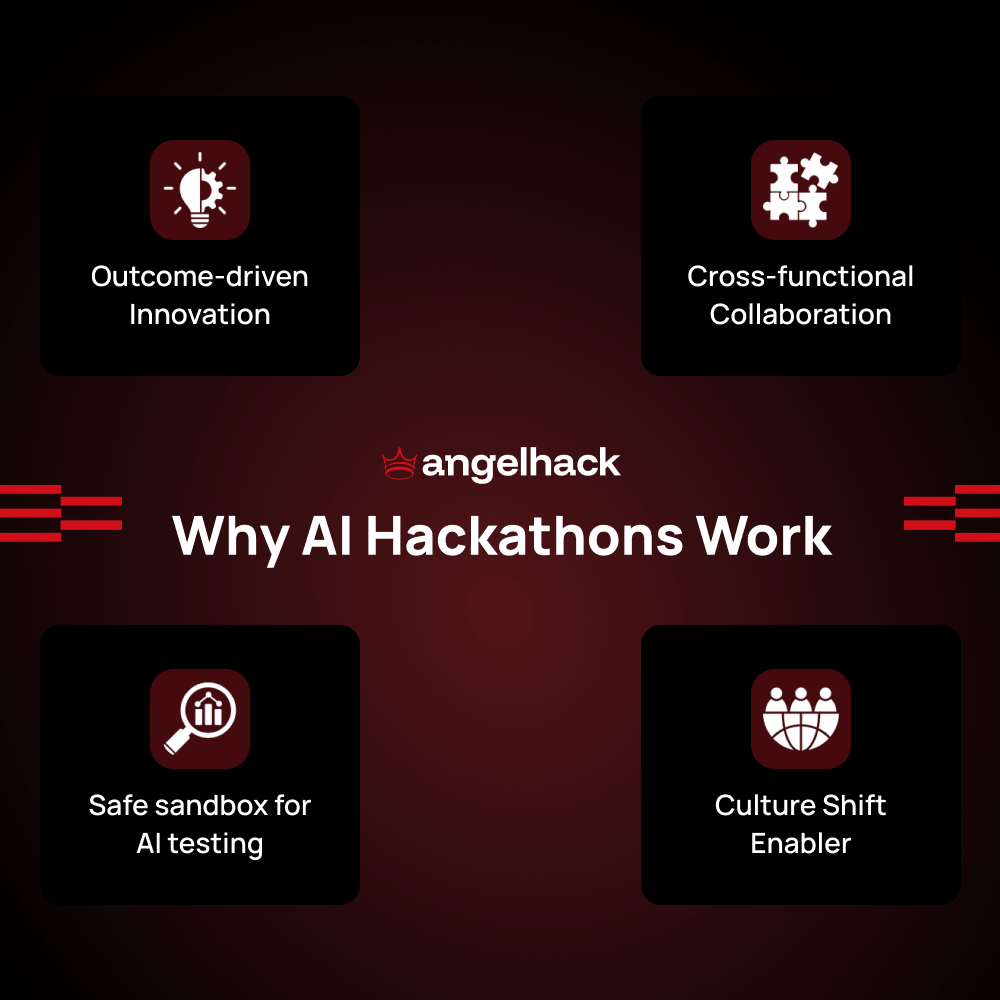
They spark real, outcome-driven innovation. Short, intense sprints push teams to actually build and demo working AI agents, copilots, or automations – not just talk about them in slides. Business-specific challenges like slashing manual work, sharpening decisions, or upgrading customer experiences, delivering measurable value fast.
They bring cross-functional teams together seamlessly. Business leaders, data experts, product folks, and engineers huddle up side-by-side, spotting real-world roadblocks early and keeping ideas grounded in your actual operations – not pie-in-the-sky tech experiments – while creating ownership that lasts.
They offer a safe sandbox for AI testing. Hackathons let teams freely experiment with models, prompts, RAG setups, or full agents in a contained space, using fake or anonymized data that feels real but keeps you compliant and secure – so no production disasters.
They shift your culture. Hackathons send the message loud and clear: ‘test ideas, learn as you go, no penalties.’ Team wins build momentum and stories, turning AI into something organic that everyone buys into, rather than a directive from above.
Choosing the Right Hackathon Format: Offline, Online, or Hybrid
Think of format as a strategic call, not just logistics. You want it to match your goals, your geographical locations, and the kind of collaboration you’re aiming to build.
Offline hackathons work best when you need deep engagement. They’re perfect for bringing stakeholders together with in-person kickoffs and demo days that really show AI is a priority. he downside is a smaller reach and higher costs from travel and venues, although engagement is the highest from face-to-face interactions.
Online hackathons shine for broad reach and efficiency. You can pull in talent from anywhere without travel hassles, run them often to keep ideas flowing, and test themes the economical way. Just plan carefully to keep energy up and avoid that common drop-off after a strong start.
Hybrid setups give you the best of both worlds. Picture a central in-person spot for key teams and sponsors, plus remote participants on a shared platform with fair rules for everyone. This brings great visibility, includes far-flung locations, and scales easily across regions.
Lessons from Successful AI Hackathons
Successful AI hackathons do more than generate demos; they create assets, talent, and narratives that persist long after the event ends.
Databricks’ Generative AI World Cup brought together data professionals from around the world to build on the Databricks and Mosaic AI stack. Over the course of the competition, teams produced production‑ready concepts in domains such as biotech, construction, and legal tech, giving Databricks concrete stories of real‑world impact while deepening how participants engaged with its platform.
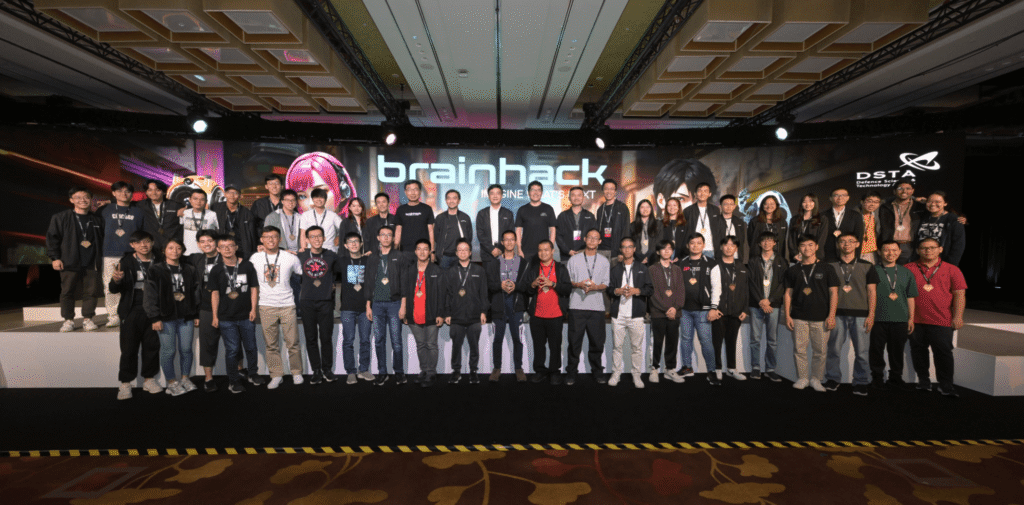
In Singapore, DSTA’s BrainHack – and particularly its AI‑focused TIL‑AI track – used a series of tiered challenges in areas like speech recognition, computer vision, OCR, and reinforcement learning to grow a national pipeline of digital defence talent. Participants didn’t just learn concepts; they built hands-on AI solutions at scale, strengthening both technical capability and confidence.
Together, these stories show what well‑designed AI hackathons can unlock:
- Product adoption and ecosystem growth
- Talent development and capability building
- Strategic positioning as an AI leader in your space
The Hard Part: Running an AI Hackathon
Running an AI hackathon that truly shifts how your organization works is way tougher than just announcing one. The idea seems simple, but making it scalable and high-impact takes real structure and discipline across the board.
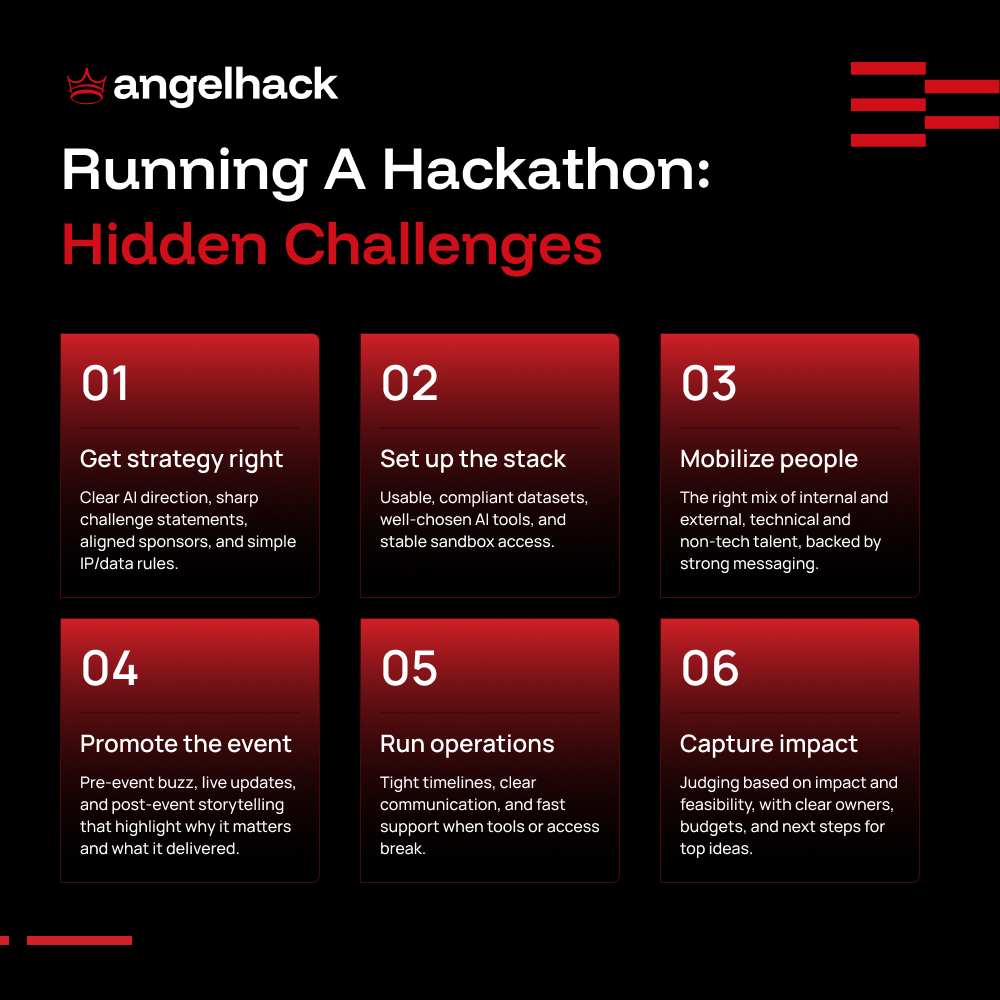
Get the strategy right
Rookie mistakes to avoid: Going with vague, trendy buzzword themes or skipping sponsor buy-in upfront. That just leads to scattered energy, ideas that go nowhere, and no one feeling accountable for what comes next.
Our advice:
- Define a clear AI direction and a small set of themes that truly matter to the business.
- Craft sharp challenge statements linked to real KPIs or pain points.
- Identify sponsors who can make post‑event decisions and set simple rules for IP, data use, and confidentiality.
Set up the tech stack
Rookie mistakes to avoid: Rolling out untested logins, credentials, or tool setups on launch day. It burns hours of precious time right away and totally kills the early excitement and flow.
Our advice:
- Provide usable, compliant datasets that reflect real scenarios, even if synthetic or masked.
- Decide which AI tools, platforms, and models teams will use, and standardize access.
- Test environments, credentials, and permissions before day one so teams can focus on solving problems, not fighting infrastructure.
Mobilize the right people
Rookie mistakes to avoid: Stacking teams with only techies or forgetting to sell the personal benefits. You end up with poor turnout or prototypes that feel disconnected from real business needs.
Our advice:
- Bring together a balanced mix of internal and, where useful, external contributors.
- Ensure teams combine technical and non‑technical roles, including operations and customer‑facing staff.
- Communicate clearly what participants gain – skills, visibility, and influence on future initiatives – so they can justify the time and effort.
Promote the event
Rookie mistakes to avoid: Staying quiet before launch or only talking about the winners afterward. That misses the chance to create hype, sustain interest, and prove the value for future rounds.
Our advice:
- Run pre‑event campaigns that explain why the hackathon exists and how it links to broader priorities.
- Share live updates during the sprint to keep interest and momentum high.
- Tell post‑event stories that focus on concrete outcomes, not just who won, to build credibility for future editions.
Run operations smoothly
Rookie mistakes to avoid: Vague timelines or judges who aren’t aligned. It breeds confusion, frustration, and a sense that things aren’t fair.
Our advice:
- Design a clear schedule with checkpoints, mentoring slots, and submission deadlines.
- Provide responsive support channels for issues with tools, data access, or environments.
- Align judges, mentors, and organizers on expectations so teams get consistent guidance.
Capture the impact
Rookie mistakes to avoid: Skipping assigned owners or any follow-up plan. Even the best ideas end up forgotten in a folder, gathering dust instead of turning into real results.
Our advice:
- Define evaluation criteria that balance impact, feasibility, and strategic fit.
- Make sure every top idea leaves the event with a named owner, an outline budget, and a next‑step timeline.
- Share a short post‑event summary so people see how the hackathon supported broader goals like culture, skills, and pipeline.
Without this structure, hackathons become one-off excitement with no lasting payoff. With it, they turn into a reliable way to find, test, and advance AI that shapes your roadmaps, budgets, and daily work.
From Event to Impact – And How AngelHack Can Help
Designing and running a serious AI hackathon is a heavy lift, especially for teams already stretched with day‑to‑day operations. That’s why so many organizations team up with specialists who can:
- Handle all the ops from start to finish, freeing the team to focus on strategy, decisions, and making sure winning ideas actually launch.
- Bring battle-tested tools, formats, and playbooks that skip the trial-and-error headaches and cut risks.
- Work with them to shape themes, challenges, and metrics that hit exact business goals and KPIs.
- Take care of promotion and pulling in the right crowd, whether internal teams or devs from around the world.
- Make sure the best ideas don’t die on the demo floor, with clear next steps into pilots, products, or programs.
AngelHack is a developer relations and ecosystem expert, with more than 15 years of experience running high‑impact hackathons and developer programs for enterprises, startups, and governments around the world. Our teams know how to design AI‑focused challenges, run fair and efficient judging, build post‑event pathways, and tap into a global network of 300,000+ developers when you need external talent or fresh thinking.
Our AngelHack AI Sprint is a focused 48–72 hour program designed to move AI from “big announcement” to “working prototype.” It combines custom challenge design, structured onboarding, and a demo day where teams present real solutions that are ready for the next step. For organizations planning their 2026 innovation roadmap, an AI sprint or hackathon can be the spark that turns strategy into shipped AI solutions and activates the developer ecosystem around them.