🎯 TL;DR
- Team size: Check the event’s team cap first, then keep the team small enough to decide quickly. Add members only when they bring a skill the team is missing.
- Roles: Cover four roles before adding headcount: a builder for the core product, a designer for the interface, a pitch lead for the story and timeline, and a domain expert for the problem itself.
- Finding teammates: Coming solo is normal. Post your skills in event channels, attend team formation sessions, and prioritize teams that need what you bring.
- Collaboration: Agree on one core feature, a decision rule and a shared set of tools before the build starts. Then freeze features early enough to rehearse the demo.
A hackathon team is a small group of builders, designers and problem owners who take one idea to a working prototype within a fixed timeframe. The right team gets you more than a demo: teammates you’ll build with again, feedback from mentors, and a project worth putting in your portfolio. How that group is formed shapes every decision that follows, from what gets built to how it is presented. This guide covers the qualities of a strong team, how to size it, which roles to fill, where to find teammates, and how to collaborate once the build begins.
What makes a good hackathon team?
Before recruiting anyone, it helps to know what you are building toward. Strong hackathon teams share four qualities:
1️⃣
Complementary skills
Each member covers a different part of the work, so the team can build, design and present without gaps.
2️⃣
Clear ownership
Each person has their own responsibility and handles the decision-making for that part of the work. Big decisions that affect everyone go to a team vote.
3️⃣
Clear ownership
Each person has their own responsibility and handles the decision-making for that part of the work. Big decisions that affect everyone go to a team vote.
4️⃣
A shared definition of done
Everyone agrees on what the finished demo should show, so effort goes toward the same result.
5️⃣
Open communication
Members flag blockers early, ask for help without delay, and give honest feedback on ideas before time goes into building them.
Chemistry helps, but coverage of the work matters more. A team that skips these foundations can have every skill in place and still miss the deadline. With the qualities defined, the next decision is how many people the team needs.
How many people should be on a hackathon team?
Team size determines how much work you can cover and how quickly you can make decisions. Start with the rules: each event sets its own team cap, and some allow solo entries, so check the participant guide before you recruit.
Within that cap, size is a trade-off. Smaller teams decide quickly and divide work cleanly, but each member carries more of the load. Larger teams can cover more skills, though they spend more time aligning on direction and sharing updates.
| Team size | Pros | Cons |
|---|---|---|
| Solo | Full control, fast decisions | Every role falls on one person |
| 2 to 3 | Quick decisions, core skills covered | Little cover if someone drops out |
| 4 to 5 | Broader skills, room for a domain expert | More time spent coordinating |
A practical rule is to add a member only when they bring a skill the team does not yet have. Size sets the limit, and roles decide how you fill it.
Which hackathon team roles do you actually need?
Roles give each member a clear area of responsibility, which reduces duplicated work and makes gaps visible early. Four roles cover what a hackathon project needs, from the code to the stage. In a smaller team, one person may hold two.
- Builder: owns the core logic, the integrations, and every feature that has to work live during the demo. On a larger team, this role can split into front-end and back-end.
- Designer: owns the interface and user flow, so judges can understand the product without extra explanation.
- Pitch lead: owns the problem statement, the demo script and the timeline, and keeps the team’s work aligned with the judging criteria.
- Domain expert: brings knowledge of the problem area and the people it affects, which keeps the solution realistic and helps the team answer questions from judges.
The rookie mistake is a team made entirely of developers. The product may work, but no one owns the demo, and the pitch is assembled at the last minute. The fix is to assign every role at the start, even when one person holds two, and to confirm who will present.
| Role | What they own | When they matter most |
|---|---|---|
| Builder | Core logic, integrations | Throughout the build |
| Designer | Interface, user flow | Early wireframes and the demo |
| Pitch lead | Story, script, timeline | Scoping and judging |
| Domain expert | Problem knowledge | Choosing the idea and Q&A |
Once the roles are mapped, the team knows exactly which skills it still needs to recruit.
Where do you find teammates when you are coming solo?
Arriving without a team is a normal way to start a hackathon, and it leaves you free to join a group that needs your skills. The goal is to find teammates whose strengths complement yours. Three channels help:
- Event community channels: Post in the event’s Discord or community channel before the event starts. Share your skills, the tools and languages you work with, the type of problem you want to solve, and the role you want to fill.
- Team formation sessions: Attend idea pitches and team formation sessions where the event offers them. Listen for teams that describe a gap matching your skills, and introduce yourself with a clear summary of what you can contribute.
- Social media and tech communities: Reach out on LinkedIn, X, Reddit and local developer groups. A short post with your skills, the event name and the role you want makes it easier for the right people to respond.
When choosing between offers, prioritize the team that needs your skills over the one you feel most comfortable with. Expect some adjustment with new teammates, since people need time to learn how each other works. A short introduction at the start, covering skills, working styles and goals for the event, shortens that adjustment period.
How do hackathon teams work well together?
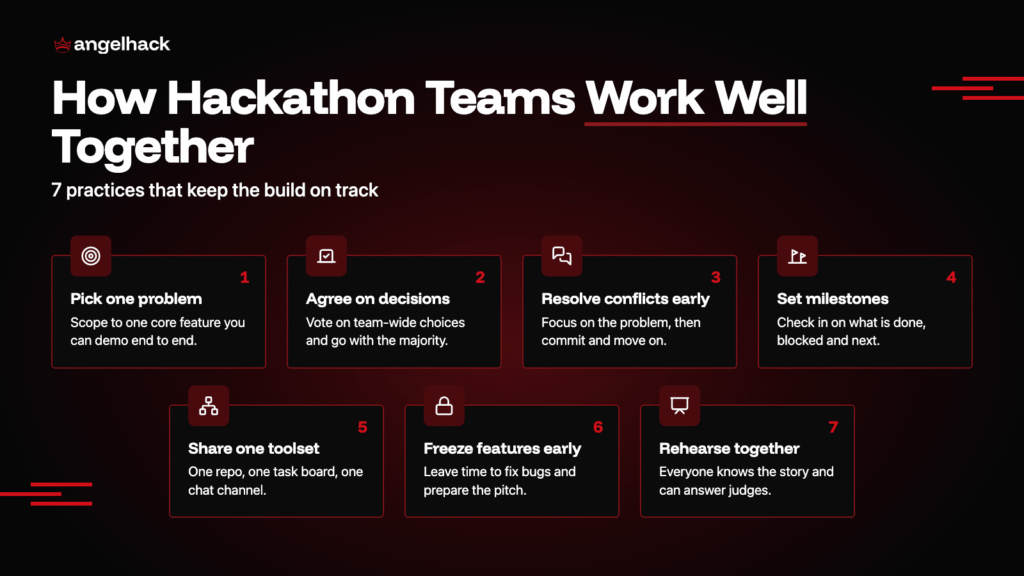
Once the team is formed, the way teammates work together determines whether the prototype is finished and presented well. These six practices give the build a clear structure, whether teammates have worked together before or met at the event.
🔍 Agree on one problem and one core feature: Define the problem in a single sentence and choose the one feature that demonstrates your solution. Scope the build to what you can demo end to end, and record other ideas for after the event.
✅ Agree on how decisions are made: Discuss the options, put team-wide decisions such as scope and design to a vote, and go with the majority. With an even number of members, agree in advance who casts the deciding vote.
🗣️ Resolve conflicts early: Keep the discussion on the problem, give each side a chance to explain their reasoning, and refer back to the team’s goal and voting process to settle it. Once a decision is made, everyone commits to it and moves on.
💬 Set a timeline with clear deadlines & milestones: For example: a working prototype, a feature freeze and a pitch rehearsal. At each milestone, hold a short check-in on what is done, what is blocked and what comes next, so problems surface while there is still time to fix them.
⚙️ Work from one set of tools: Use one repository, one task board and one chat channel, and agree on naming and file structure early. A shared setup keeps updates visible and makes handoffs between members faster.
🕐 Freeze features before the deadline: Set a point after which no new features are added, and use the remaining time to fix bugs and prepare the pitch. A smaller feature set that runs reliably gives the presenter a stable demo.
🚀 Rehearse the demo as a team: Run through the full pitch more than once, with someone keeping time. Every member should understand the story well enough to answer a judge’s technical or product question.
Without these practices, even a well-balanced team risks ending the event with an unfinished product. Once the build is on track, our guide on how to win a hackathon covers scoping the demo and preparing a pitch judges remember.
💡 Take Pandamonium as an example:
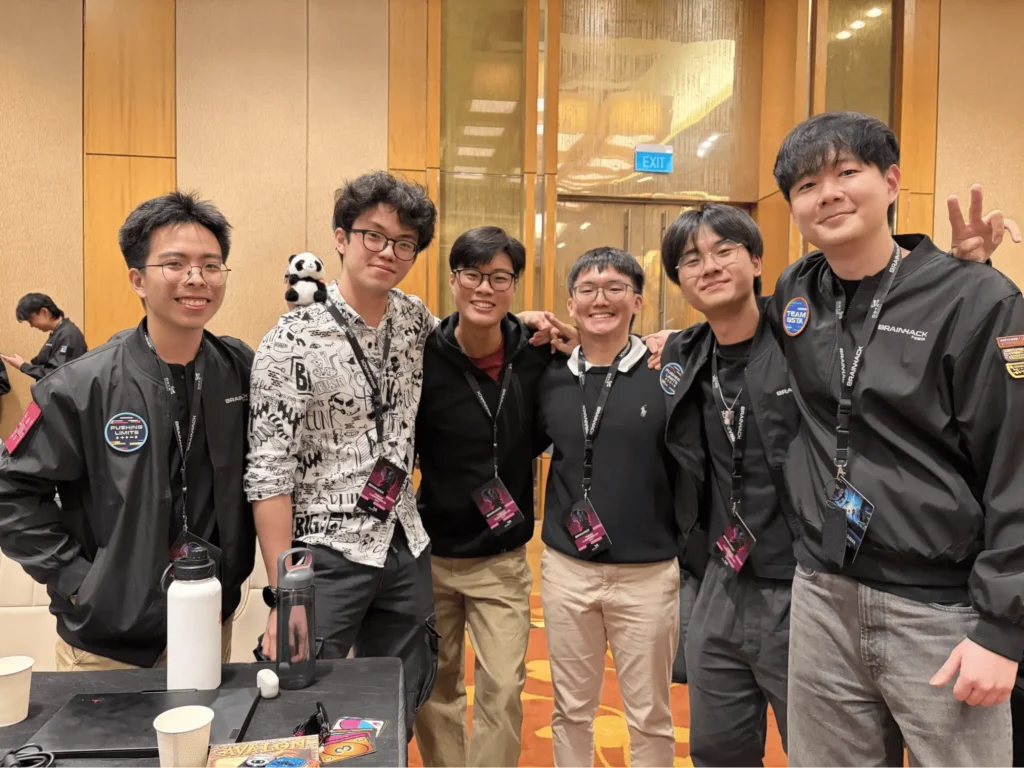
Pandamonium, a team of five National University of Singapore students, won the Novice track of DSTA BrainHack’s TIL-AI competition on their first attempt at machine learning. The team split the five AI modules by who was strongest where, and staggered their schedules so work continued from morning into the early hours. Communication was the hardest part. After the initial discussion, each member worked on their own task and lost sight of what the others were facing. As the team put it, “What fixed it was writing things down.” They began logging progress, current problems and everything already tried, so anyone stepping in had the full context and more time went into debugging.
Final Words
A strong hackathon team is built with intent: the right size for the event, every key role covered, and clear agreements on how the team will work. Get those foundations right, and more of your time goes into what matters most: building, testing and presenting an idea you believe in.
Your next team could be one event away. AngelHack has run hundreds of hackathons for a community of 500,000+ developers worldwide. Browse upcoming hackathons and register early, so you have time to share your skills, meet potential teammates and start building with the right people.

FAQs
How many people should be on a hackathon team?
A team of 3 to 4 people is ideal: enough to cover building, design and the pitch, and small enough to decide quickly. Check the event’s team cap first, and add members only when they bring a skill the team does not already have.
Can you join a hackathon without a team?
Yes, if the event allows solo entries or open team formation. You can compete solo or find teammates through event channels, team formation sessions and developer communities.
Can non-coders join a hackathon team?
Yes. Design, pitching, project management and domain knowledge all influence how a project is judged, and a non-coder can fill the gaps a developer-only team leaves open.
How do remote hackathon teams stay coordinated?
Use one chat channel, one repository and one task board, and hold short check-ins at agreed times. Clear written updates let teammates in other time zones pick up work without waiting for a reply.
Can you switch teams during a hackathon?
It depends on the event, so check the participant guide or ask the organizers first. If a change is allowed, tell your current team early so they can adjust their roles and scope.