
As developer programs grow, the question shifts from what your developer relations team should do to how it should be structured to do it well. The model you choose determines how fast you can move, how consistent the developer experience feels, and whether your program can scale without losing focus. The three primary structures, centralized, embedded, and agency-led, each carry distinct trade-offs across consistency, speed, cost, and developer trust. This guide walks you through each model, the framework we use to evaluate them, and the diagnostic questions to help you make a deliberate decision.
The Core Functions of Developer Relations
Developer relations, or DevRel, is the function that builds and sustains the relationship between a technology platform and its developer community. Unlike typical customers, developers want to understand how things work, build with your tools, and know that the platform they are investing time into actually listens to them. A DevRel program serves that relationship across five core functions:
- Developer Education and Enablement: documentation, tutorials, SDKs, and onboarding flows that help developers go from curious to capable.
- Community Building: forums, events, and ambassador programs where relationships and loyalty develop over time.
- Product Advocacy and Feedback Loops: representing developers internally and surfacing their needs to product teams.
- Developer Marketing: content, conference talks, and brand presence that attracts the right builders to your platform.
- Ecosystem Partnerships: integrations and relationships with partner developers that extend your platform’s reach beyond what your internal team can cover alone.
These functions do not show up with equal intensity at every stage, so understanding which ones matter most for your context is where any structural decision has to start.
The Three Developer Relations Models
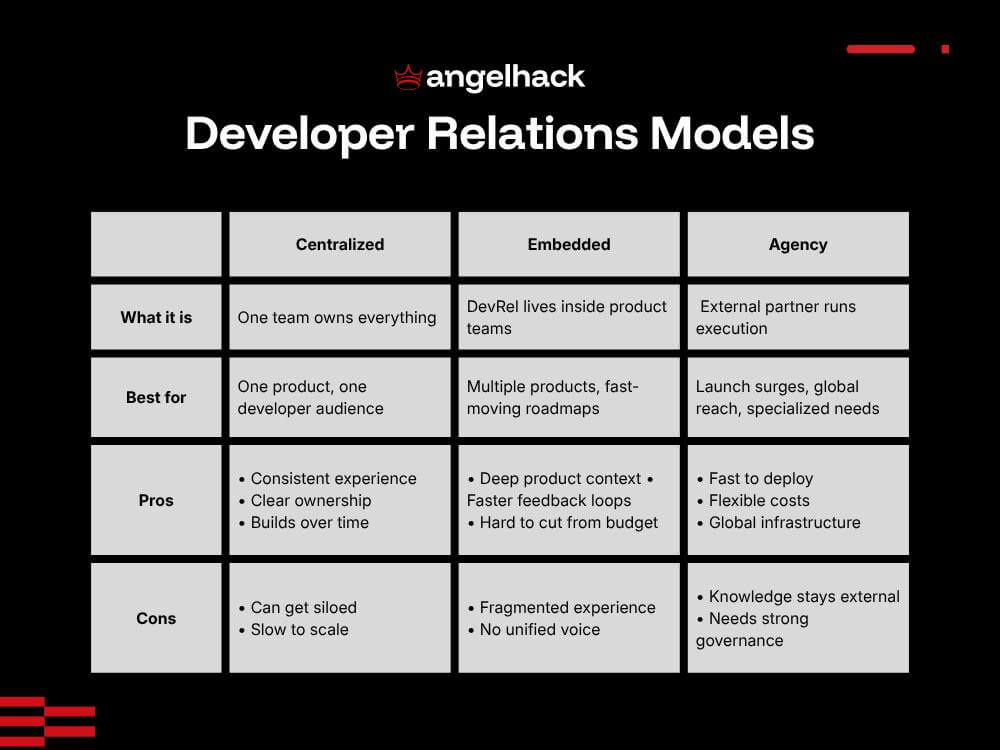
Most DevRel programs fall into one of three structural approaches. The goal is not to find the universally best model but to find the one that fits your current reality.
Centralized
A dedicated DevRel team owns all functions under a single leader, typically sitting within Product, Marketing, or Engineering. Stripe and Twilio are the most cited examples, both treating developer experience as a core pillar of growth with documentation, education, evangelism, and community unified under one function.
Embedded
DevRel practitioners sit inside specific product or engineering teams rather than a central group. Google operates this way at scale, with Developer Advocates embedded in product areas like Firebase and Google Cloud rather than a single DevRel organization.
Agency or Outsourced
External partners own execution of specific DevRel functions, with internal oversight providing strategic direction. This model is common for geographic expansion, launch surges, or specialized functions that are hard to build from scratch. AngelHack is one of the most established agencies in this space, trusted by Fortune 500 companies and high-growth tech companies worldwide.
Pros and Cons of Each Developer Relations Model
Centralized
A centralized model gives your developer program a single, unified home with clear ownership and a consistent voice across all functions.
✅ Pros:
- Consistent developer experience and brand voice across all touchpoints
- Institutional knowledge builds and stays within the team over time
- Clear ownership when something in the developer experience breaks down
- Cross-functional alignment comes more naturally with a dedicated team
❌ Cons:
- Can become siloed from engineering and product over time
- Vulnerable to budget cuts since it is often treated as a cost center
- Scaling means growing headcount, which is slow and expensive
Embedded
An embedded model brings DevRel closer to the product, trading cross-program consistency for deeper day-to-day context.
✅ Pros:
- Deep product knowledge from working alongside the teams building it
- Faster feedback loops between developers and product roadmaps
- Harder to cut as a discrete budget line since the role is woven into the team
❌ Cons:
- Developer experience can feel fragmented across different products
- No unified developer voice to bring to leadership
- Practitioners risk losing their DevRel identity as they get absorbed into adjacent roles
Agency or Outsourced
An agency model trades in-house control for speed and specialized capability, making it a strong fit when you need to move fast or reach further than your internal team can.
✅ Pros:
- Specialized capabilities like event production and community infrastructure from day one
- Flexible cost structure through project-based or retainer arrangements
- Useful for geographic expansion, launch surges, and hard-to-build functions
❌ Cons:
- Institutional knowledge does not stay in-house
- Developer trust is harder to maintain through an external team
- Requires strong internal governance to prevent misalignment and dependency
How to Choose the Right Developer Relations Model
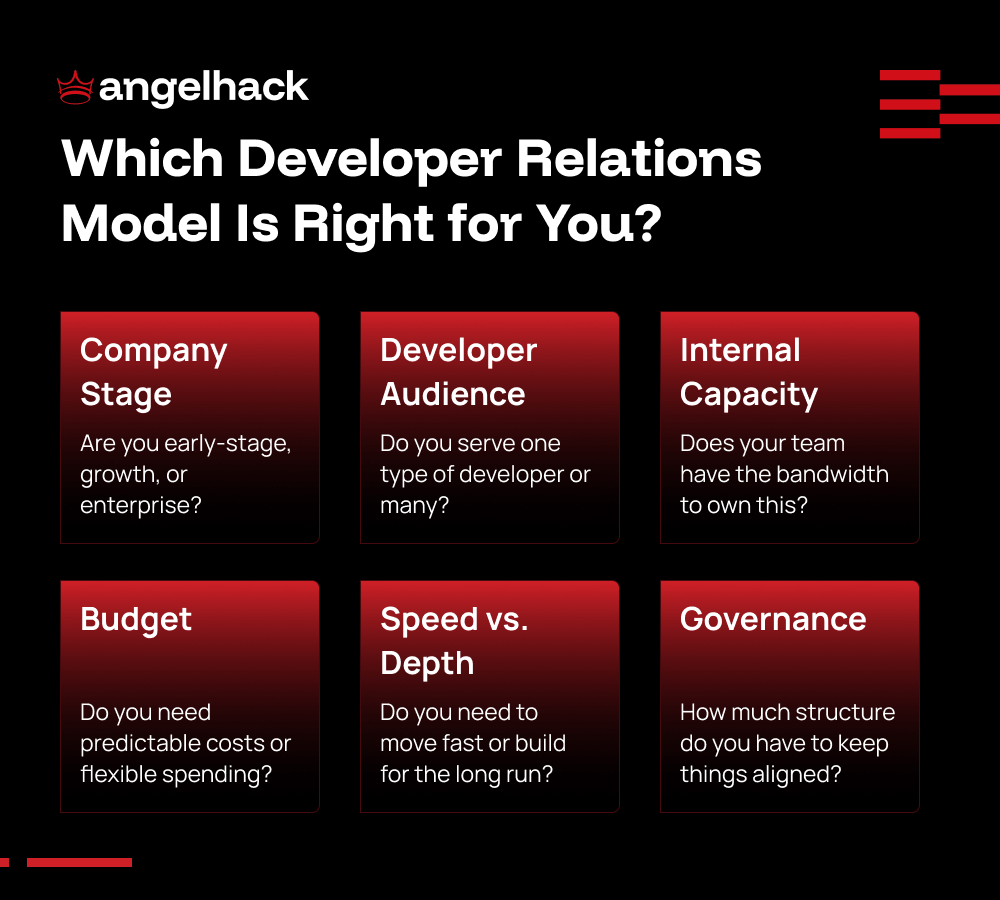
These are the six variables that matter most when choosing your model.
Company and product stage
Early-stage companies with one product rarely need a centralized team yet. Growth-stage companies should centralize before things get fragmented. Enterprise companies with multiple product lines typically need a hybrid, with a central team setting strategy and embedded specialists handling specific products.
Developer audience
The more different your developers are from each other, the harder it is for one central team to serve them all well. A single API with one consistent developer type is straightforward. A platform serving both enterprise engineering teams and independent builders needs a more flexible structure to speak to both audiences effectively.
Internal capacity
An embedded model only works if your engineering and product leaders genuinely want to co-own the developer experience. If those leaders see DevRel as someone else’s job, embedded practitioners end up without direction or support. Be honest about whether that organizational will is actually there before committing to this model.
Budget
A centralized team means predictable headcount costs. An agency gives flexibility to scale up or down but requires management time to govern well. An embedded model spreads costs across team budgets, which can make it difficult to see what DevRel is actually costing or delivering to the business.
Speed vs. depth
If you need to move fast or activate a community around a launch, agencies and embedded models get things going quicker. If your goal is a program that compounds over years, a centralized model builds deeper institutional knowledge and a stronger foundation for long-term ecosystem growth.
Governance
The more you distribute or outsource, the more structure you need to keep everything aligned. Without shared goals, regular reporting, and documented processes, distributed programs tend to drift. Good governance is not bureaucracy. It is what keeps a flexible program from becoming a fragmented one.
Diagnostic Questions: Work through these to narrow down which model fits your situation best.
1. Do you have a single, well-defined developer audience?
Yes: Centralized or Agency
No: Embedded or Hybrid
2. Is developer trust a core competitive differentiator?
Yes: Centralized
No: Agency or Hybrid
3. Do you have internal bandwidth to govern an agency engagement?
Yes: Agency
No: Build internal capacity first
4. Are you expanding geographies or surging for a launch?
Yes: Agency or Hybrid
No: Evaluate internal models first
5. Is your product portfolio growing or likely to fragment?
Yes: Embed alongside a central team
No: Centralized is likely sufficient
However, most DevRel programs do not stay in one model forever. The most common path is to start embedded or with an agency for speed, centralize once the scope justifies it, re-embed specialists as the product portfolio grows, and use agencies for surge capacity or geographic expansion while keeping strategy internal.
Common Transition Pitfalls and How to Solve Them
As transitions between models are inevitable – the teams that handle them well are the ones that plan for the pitfalls before they happen.
If you exit an agency without a handoff plan, institutional knowledge walks out the door with them. Before signing any agency contract, require playbooks, community contacts, and content libraries as deliverables, and build knowledge transfer milestones into the transition period from the start.
Centralized teams can drift away from the product over time, making their advocacy feel disconnected from what developers actually experience. Quarterly rotations where DevRel members spend time with product and engineering squads keep the team grounded, and co-owning feedback rituals with PM leads makes the connection structural rather than accidental.
Embedded practitioners often lose their DevRel identity as they get pulled into adjacent engineering or product roles. A shared community of practice across embedded roles, with common OKRs and regular peer learning sessions, gives practitioners a professional home even without a formal central team.
Moving from agency to in-house too quickly leaves gaps in execution that are hard to recover from. Run a parallel period where internal hires shadow the agency before taking over, and only cut the contract once internal capability has been proven through real work, not just stated intention.
How to Measure Developer Relations Success
The model you choose shapes how you track and demonstrate the impact of your DevRel program.
- Centralized: The strongest setup for end-to-end measurement. Track developer activation rates, time to first build, community growth, and retention with one team owning the full picture.
- Embedded: Naturally aligned with product team goals, making it easy to tie DevRel work to product adoption and feature usage. Make sure to also track cross-program metrics so the overall DevRel contribution stays visible to leadership.
- Agency: Well suited for tracking campaign-level outcomes like event attendance, developer sign-ups, and community growth. The best engagements go further and tie those numbers to activation and ecosystem contribution, not just output volume.
Regardless of model, outcome-based measurement is what earns sustained investment: developer activation rates, community engagement depth, quality of product feedback influencing roadmaps, and ecosystem contributions over time. These metrics require deliberate governance to surface, but they are the ones that tell a real story.
Success Story: Hedera and AngelHack
Hedera, a public blockchain network, partnered with AngelHack to build a multi-stage developer program that moved builders from first contact all the way through to real ecosystem contribution, engaging more than 5,000 developers and advancing 370+ participants through three connected stages.
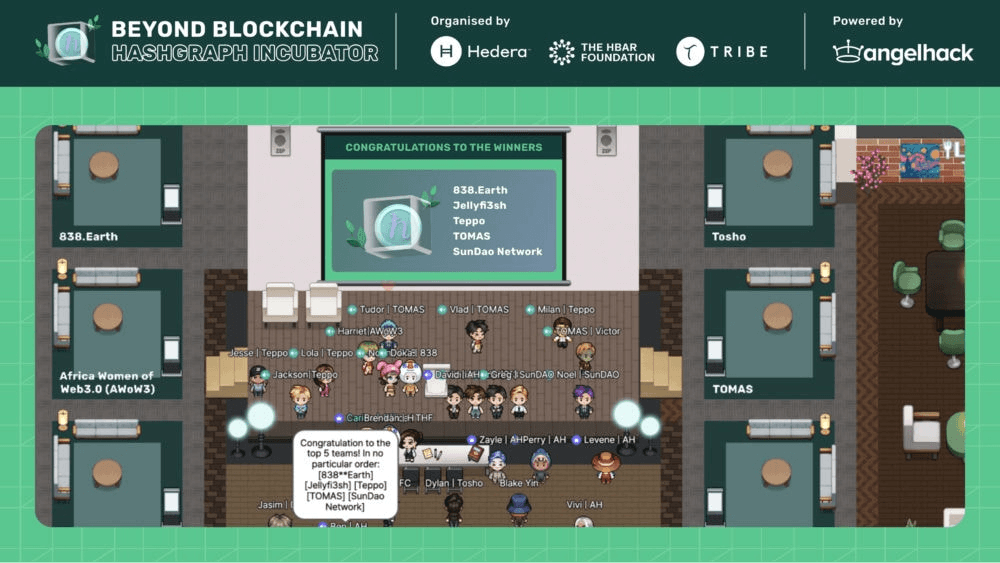
- Learn-and-earn campaign: Developers completed structured learning tasks to build familiarity with Hedera’s technology and earn rewards for their progress.
- Hackathon: The strongest performers moved into a hackathon where they built real projects on the Hedera network.
- Incubator: The top seven projects were selected for a structured incubator with mentors from Google Cloud, Fireblocks, and Swirlds Labs.
Read the full case study here →
How AngelHack Can Help
AngelHack has been a trusted partner in developer relations and innovation programs since 2011. With a community of more than 500,000 developers across 100+ cities, we have worked with clients like Mastercard, Google Cloud, IBM, Circle, and Cisco to design and run programs that go beyond events to become thriving ecosystems.
For organizations where an agency or hybrid model fits, we offer:
- Hackathons and Developer Events in virtual, in-person, and hybrid formats
- Community and Ambassador Programs for long-term engagement and community building
- Developer Quests and Education with structured learning journeys, milestones, and rewards
- Ecosystem and Partnership Programs for developer and partner recruitment and activation
- 3 to 6 Month Incubator Programs to turn community projects to real products
AngelHack works best as a partner to internal DevRel teams, not a replacement. Every engagement is built with shared OKRs, regular reporting, and documented playbooks so your team stays informed and in control.
Final Words
Every developer relations program is different, and there is no single model that works for everyone. However, all great programs start with an honest look at where you are and what your developers actually need. Use this guide as your starting point, choose the model that fits your reality, and evolve it as you grow.
And if you want a partner to help you get there faster, we would love to be part of the journey. Talk to our team and let’s get started.
Work With AngelHack to Build a DevRel Strategy
That Sticks
Whether you’re starting from scratch or scaling what’s already working, our team brings the frameworks, community expertise, and global reach to get you there faster
Frequently Asked Questions About Developer Relations
What is developer relations and why does it matter?
Developer relations is the function that builds and sustains the relationship between a technology platform and its developer community, spanning education, community, advocacy, marketing, and ecosystem partnerships. It matters because developers are often the primary adopters and advocates for technical products, and a strong DevRel program directly influences adoption, retention, and ecosystem growth.
What is the difference between centralized and embedded developer relations?
A centralized model puts all DevRel functions under a single team and leader, creating consistency and clear ownership. An embedded model distributes practitioners across product or engineering teams, creating deeper product context at the cost of cross-product consistency. The right answer depends on your product complexity, audience, and where the organization will actually sit.
When should a company use an agency for developer relations?
An agency is a strong fit when you need speed to market, global reach, or specialized capabilities that would take years to build in-house. The key condition is having internal bandwidth to govern the engagement, including setting clear OKRs and managing knowledge transfer so your program does not become dependent on external execution.
How do you measure developer relations success?
The most meaningful DevRel metrics track outcomes rather than outputs: developer activation rates, community engagement depth, quality of product feedback influencing roadmaps, and ecosystem contributions over time. Output metrics like events run or content published have a place in operational tracking but should not be the primary accountability mechanism.
How does AngelHack support developer relations programs?
AngelHack designs and executes developer programs across hackathons, community building, education, and ecosystem partnerships, with a community of more than 500,000 developers and experience in over 100 cities. Reach out to us to explore how we can support your program.