You’ve probably heard the assumption already: “we’ll just run it ourselves to save money.” It’s the most common starting point for first-time business hackathon organisers, and on paper, the cash budget really does look small. The real cost shows up later, once you count internal hours, the work that happens after the event ends, and what you’re actually getting for the investment.
Three things determine the cost picture: the format you choose (online or in-person), who your audience is (internal employees or external participants), and which model you use to execute (in-house or agency).
Let’s break it down.
What an Online Business Hackathon Really Costs
Online hackathons look like the budget-friendly option on the surface. You skip the venue line entirely, and participants join from any location. The cash flows mostly to the platform, program design, and the operational layer keeping everything running remotely.
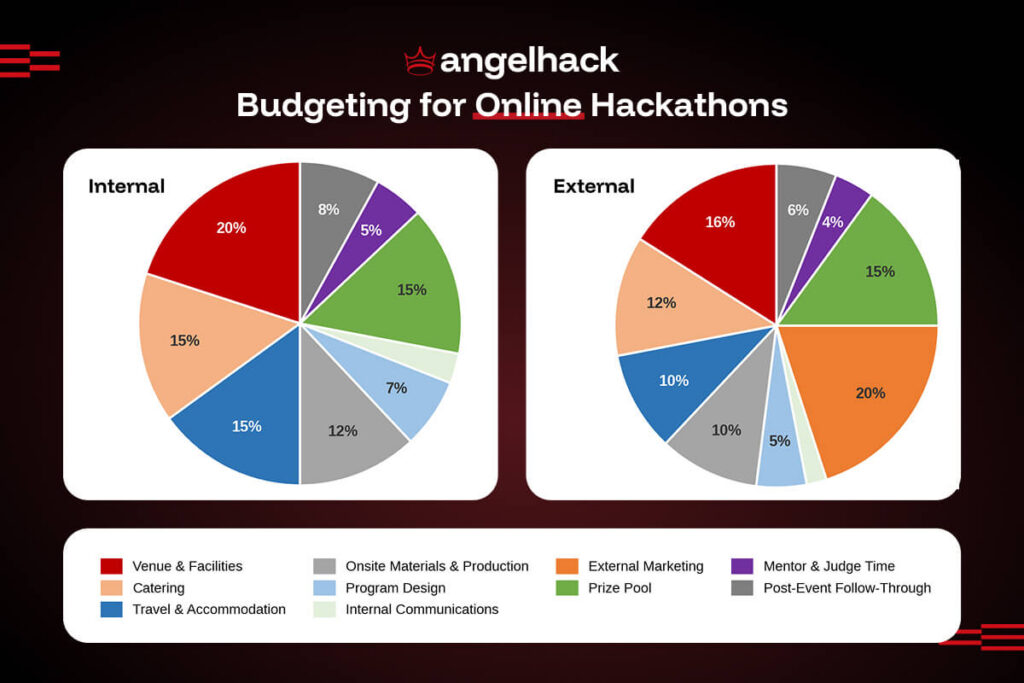
The bigger cost driver than format is your audience. Internal programs run leaner because communications stay inside the company (intranet, email, internal channels) and you don’t need paid recruitment to fill seats. External programs add a substantial marketing and creative layer to attract participants from outside the company: paid social, content marketing, community outreach, and PR. That marketing layer often inflates the total budget.
Here are the line items in a typical online business hackathon budget
| Item | Detail | Internal % | External % |
|---|---|---|---|
| Platform & Participant Support | Registration, team formation, project submissions, judging dashboard, live support, dedicated community channel (Slack, Teams, or Discord) | 25% | 20% |
| Program Design | Challenge briefs, scoring criteria, judge and participant briefings, legal review of IP and participation rules, run sheet | 10% | 8% |
| Internal Communications | Launch emails, intranet announcements, team briefings, channel updates | 5% | 3% |
| External Marketing | Paid social, content marketing, community outreach, PR, audience recruitment campaigns | — | 25% |
| Branding & Digital Assets | Event identity, microsite or landing page, slide templates, email banners, kickoff promo video | 10% | 12% |
| Prize Pool | Cash prizes, career development credits, mentorship sessions, conference tickets, branded merchandise | 30% | 22% |
| Mentor & Judge Time | External judges or technical mentors, internal mentor hours, onboarding materials, recognition gifts | 10% | 5% |
| Post-Event Follow-Through | Demo day production and livestream, winner case studies, pilot agreement drafting, impact reporting | 10% | 5% |
| TOTAL | 100% | 100% |
The total budget depends on your scale and audience.
👥 For internal programs:
- Small (under 100 participants): $5K–$15K
- Mid-size (100–300 participants): $15K–$30K
- Large (500+ participants): $30K–$80K
🌐 External programs (with marketing and creative layer):
- Small (under 500 participants): $30K–$80K
- Mid-size (500–2,000 participants): $80K–$200K
- Large (2,000+ participants): $200K–$500K+
What an In-Person Business Hackathon Really Costs
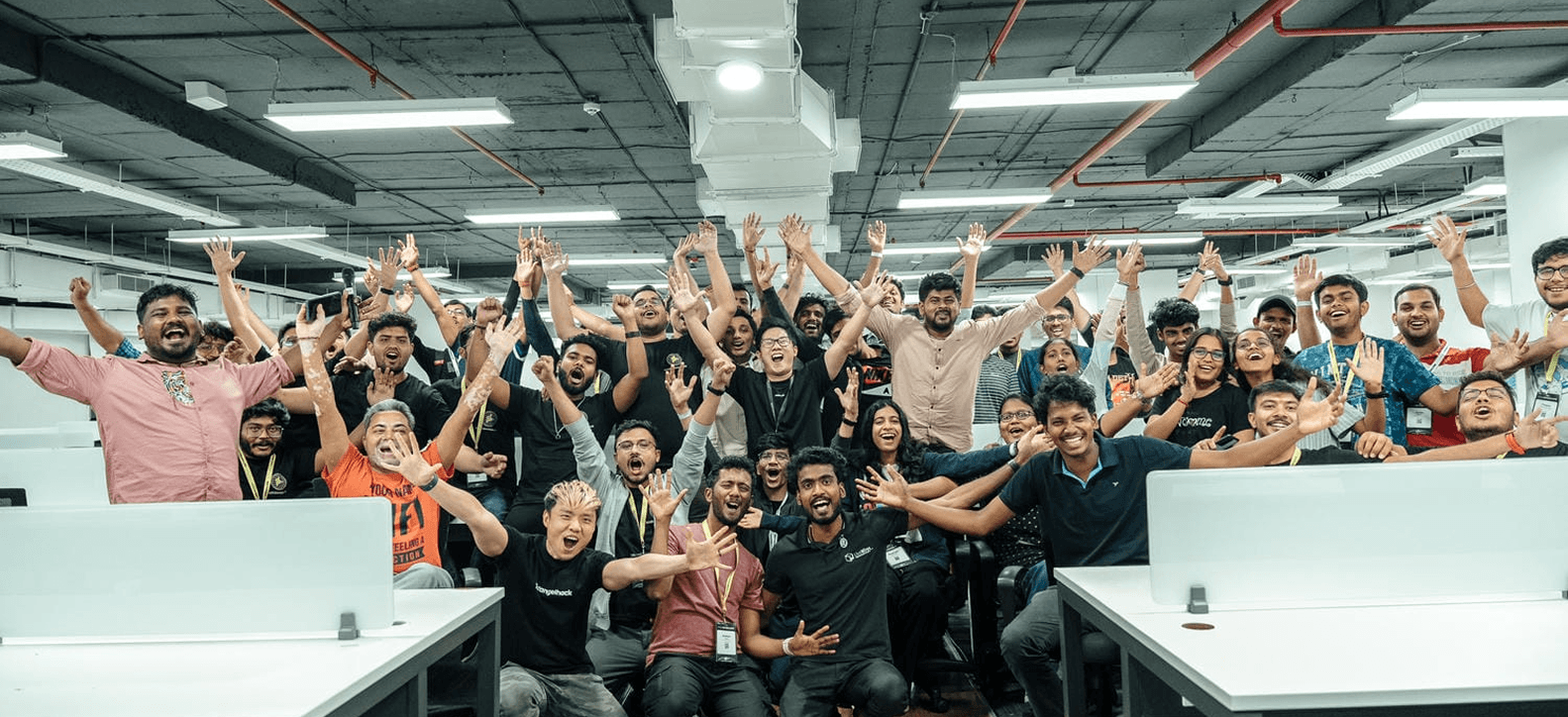
In-person hackathons feel completely different from online ones. You get stronger team dynamics, sharper presentations, and a culture moment that virtual events just can’t replicate. The platform cost shrinks, and everything physical grows in its place.
Like online, the audience type matters more than the format itself. External programs need the full marketing and creative layer to attract participants from outside the company. Internal programs skip that layer and run significantly leaner at the same scale.
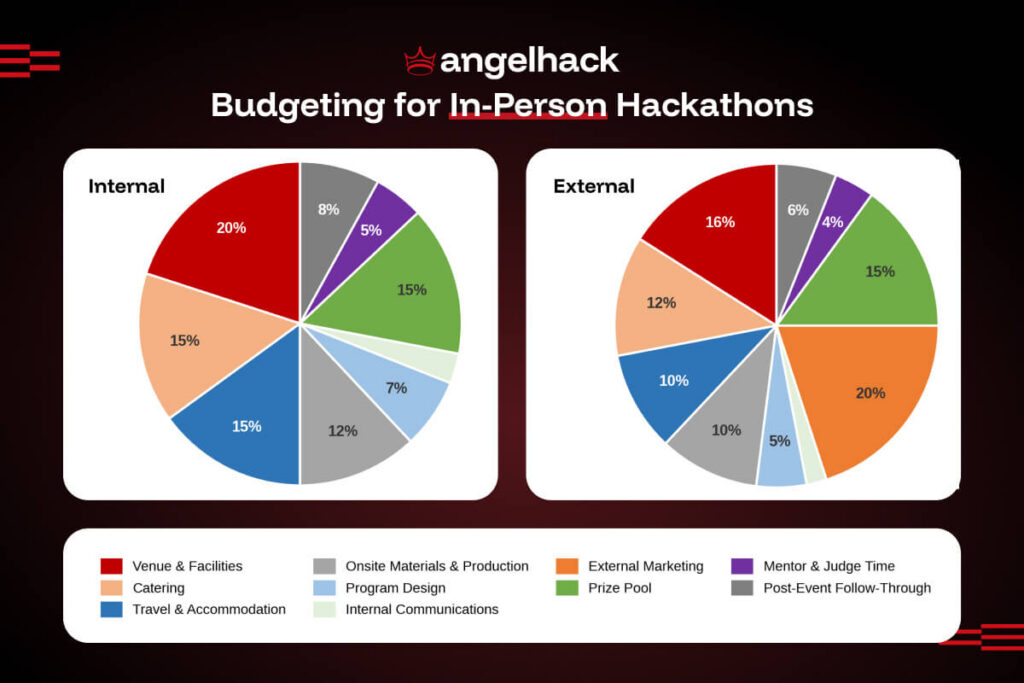
Here are the line items in a typical in-person business hackathon budget
| Item | Detail | Internal % | External % |
|---|---|---|---|
| Venue & Facilities | Venue rental, AV equipment, internet setup, on-site security and tech support, furniture, after-hours access | 20% | 16% |
| Catering | Two to three days of meals, all-day snacks and drinks, dietary accommodations, late-night refreshments | 15% | 12% |
| Travel & Accommodation | Flights or ground transport for out-of-town participants, hotel bookings, daily allowances | 15% | 10% |
| Onsite Materials & Production | Signage, banners, participant kits, equipment kits, event managers, registration desk, on-the-day tech support, photographer | 12% | 10% |
| Program Design | Challenge briefs, scoring criteria, judge and participant briefings, legal review, run sheet | 7% | 5% |
| Internal Communications | Launch emails, intranet announcements, team briefings, channel updates | 3% | 2% |
| External Marketing | Paid social, content marketing, community outreach, PR, audience recruitment campaigns | — | 20% |
| Prize Pool | Cash prizes, career development credits, mentorship sessions, conference tickets, branded merchandise | 15% | 15% |
| Mentor & Judge Time | External judges or technical mentors, internal mentor hours, on-site catering for judging panels | 5% | 4% |
| Post-Event Follow-Through | Demo day production, winner case studies, pilot agreements, impact reporting | 8% | 6% |
| TOTAL | 100% | 100% |
The total budget here also tracks with program scale:
👥 Internal programs:
- Single location: $20K–$30K
- Multi-location (2–3 locations): $40K–$90K total, including cross-location coordination
- Large internal (4+ locations or company-wide): $100K+
🌐 External programs (with marketing and creative layer):
- Regional (under 300 participants): $60K–$150K
- Mid-size (300–1,000 participants): $150K–$400K
- Flagship (1,000+ participants): $400K–$1M+
Two costs that almost always get cut from the first draft, and shouldn’t: a 5 to 10% contingency reserve accessible on event day, and storage and movers for materials that arrive before the event.
Get the Hackathon Budget Calculator
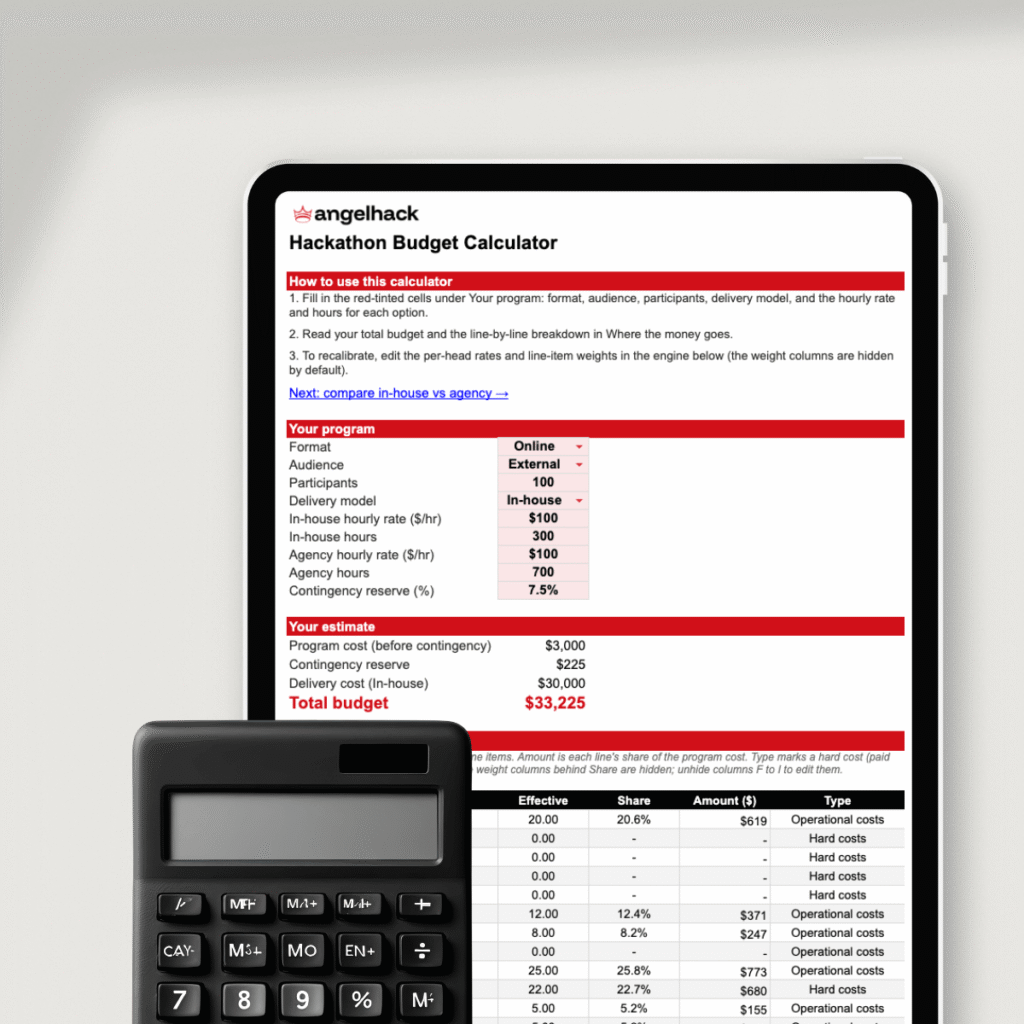
Line items shift fast once you change the format, audience, or headcount. So we built a calculator that runs the math against your specific program, not the general ranges in this article. Use it to set a budget, pressure-test a quote, or make the build-versus-buy call.
What’s inside the spreadsheet:
- Format, audience, and headcount inputs that size the full budget automatically
- A line-item breakdown across platform, design, marketing, venue, prizes, mentors, and production
- An in-house versus agency comparison that splits hard costs from operational costs for a true all-in cost
- Adjustable settings to recalibrate the rates and fee calculations to your own programs
♦️ Download the Hackathon Budget Calculator →
What It Really Takes to Run a Hackathon In-House
Now you’ve got the numbers. The bigger question is who runs the program, because that’s what determines where your real cost shows up.
Some programs genuinely belong in-house. You keep full control of the brand, the IP, and every decision. No external agency fee shows up on the budget line.
This works best for internal programs with an experienced organiser, an executive sponsor willing to back the winning prototype, and a small enough audience that you don’t need external marketing reach. For external programs, the equation gets harder fast. You’re competing for participants against every other public hackathon, and that takes marketing budget, community partnerships, and operational infrastructure most internal teams don’t have ready to deploy.
The hidden budget catches first-time programs off guard:
- 200 to 400 hours of internal staff time, around $20,000 to $40,000 of opportunity cost
- A coordination gap when no single team owns the program end-to-end
- Post-event follow-through, where most submissions never reach a pilot conversation
- For external programs: building participant reach from scratch, which means months of community work or significant paid acquisition
The cash savings on paper translate into real delivery work, which is only a fair trade if your team has the bandwidth to handle it well.
What an Hackathon Agency Actually Adds to the Budget
That covers running it yourself. Now for what an agency brings.
The headline fee is bigger, but the total cost often lands in a similar range once internal staff time is properly counted. What you’re paying for is time, capability, and confidence of delivering outcomes on schedule.
An agency service fee covers the operational layer end-to-end: program design, platform setup, 24/7 participant support, communications, judging, prize fulfilment, and post-event support through to pilot. For internal programs, expect $15,000 to $50,000, plus another $20,000 to $30,000 for in-person production. For external programs, the fee scales further as the agency takes on marketing, community outreach, and audience recruitment, typically $50,000 to $200,000+ on top of direct event costs.
What that fee buys that internal teams can’t easily replicate:
- A purpose-built platform with a team trained to run it under pressure
- Outcome accountability tied to participation, submissions, and working prototypes
- Freedom for your internal team to focus on stakeholders and pilot pathways, not event logistics
- For external programs: developer communities, marketing infrastructure, and audience reach that takes years to build from scratch
An agency makes the most sense for any external program, for internal programs under 10 weeks, or when the program is tied to a business outcome with a deadline.
At AngelHack, we’ve delivered 450+ hackathons over 15+ years for enterprise, government, and tech ecosystem clients, with a focus on faster setup, fewer surprises, and accountability on outcomes through to pilot. Pick on outcomes and time-to-pilot, not on the headline fee.
In-House vs Agency: An Honest Comparison
For internal programs, total cost between the two models is usually close once you count internal staff time. For external programs, agencies almost always win on total cost because of the marketing, community, and operational infrastructure they bring. The real choice comes down to where your team spends their energy.
| In-House | Agency | |
|---|---|---|
| Pros | You keep full control of the brand, the IP, and every decision No external service fee on the budget line Your team picks up experience they can reuse next time Direct access to your internal experts and leadership | Operational know-how built across hundreds of programs A ready-to-go platform and a team who runs them for a living Faster setup, often around 8 weeks instead of 12 to 16 Outcome accountability is baked into the fee Established developer communities and marketing reach for external programs |
| Cons | 200 to 400 hours of internal staff time across the program Coordination can slip when no one team owns it end-to-end First-time runs usually take 20 to 30% longer than planned Post-event follow-through tends to fall through the cracks Limited reach for external programs without pre-built community network | The agency fee sits on top of your direct event costs Miscommunication or misalignment between what you want vs what the agency delivers Time & effort to source and vet for a good agency that you can trust You’ll still need to coordinate with internal stakeholders |
How to Decide The Right Model for Your Business Hackathon
Once the budget conversation is out of the way, you’re left with the actual decision. The right model depends on factors specific to your team, audience, and timeline. Ask your team these three questions to settle it.
Is your audience internal employees or external participants? Internal hackathons can run in-house if you have the team, since the operational lift is lower and your audience is already on the payroll. External hackathons almost always benefit from agency support because they need marketing reach, community connections, and recruitment infrastructure. For anything public-facing, an agency typically pays for itself on reach alone.
Do you have a dedicated, experienced hackathon team? First-time organisers consistently take 20 to 30% longer than planned. If your team hasn’t run one before, part of the agency fee covers that learning curve.
What’s the timeline? Anything under 10 weeks pushes you toward an agency by default. Internal programs typically need 12 to 16 weeks of lead time. External programs need 14 to 20 weeks regardless of model because of the marketing runway. Agency-run programs compress those timelines to just 8 weeks.
Final Words
Most business hackathon budgets get planned backwards. Teams pick a number first, then work out what fits inside it. The better approach is the other way around: start with the outcome you need, then build the budget that gets you there.
Ready to plan yours? Book a free strategy call with AngelHack. Tell us what you’re trying to achieve and what you’ve got to work with. We’ll give you an honest read on whether you need an agency or whether your internal team can pull it off. No pitch deck, no pressure.
Start to Plan & Budget for
Your 2026 Hackathon Program
AngelHack, with 15+ years of experience in hackathon and developer marketing services and a community of 500,000+ developers worldwide, is happy to guide you through the process. Reach out for a free consultation today.
Consult with AngelHackFrequently Asked Questions
How much does a business hackathon cost in 2026?
Internal online hackathons run $5,000 to $80,000 depending on scale, with mid-size programs typically $15,000 to $30,000. Internal in-person events run $20,000 to $30,000 per location. External programs typically run three to five times higher than the equivalent internal program because of marketing and creative production.
Is it cheaper to run a hackathon in-house?
On paper yes, but once you count internal staff time at fully loaded rates, the gap closes. For small internal programs with experienced teams, in-house often wins. For external programs of any scale, agencies usually win because they bring marketing reach and community infrastructure that’s prohibitively expensive to build from scratch.
What’s the biggest hidden cost of running internally?
Post-event follow-through. Most internal programs produce strong submissions but never build the next-stage support that turns those into working prototypes.
How long does it take to plan a business hackathon?
Agency-run programs can launch in 8 to 10 weeks. First-time internal programs need 12 to 16 weeks. External programs need 14 to 20 weeks regardless of model.