💡 TL;DR
- Hackathons give tech companies five measurable outcomes: brand awareness, product adoption, faster innovation, stronger developer relations, and a talent pipeline.
- Each outcome maps to a program we’ve run: Hedera, Circle, Databricks, Consensys, and Microsoft.
- The programs that pay off are designed backwards from a business decision.
- Want a program scoped and executed to your goal? Book a consultation with AngelHack.
Thousands of developers building on your product against the clock. Press watching the demos. Your recruiters quietly taking notes on who ships and who leads. A well-run hackathon does all of that at once, and each thread pays off long after the closing ceremony. It’s how tech companies win five things in a single program: brand awareness, product adoption, faster innovation, stronger developer relations, and a fuller talent pipeline.
This article breaks down all five outcomes, each with a program we’ve run and the results it produced.
Why do hackathons matter more for tech companies in 2026?
Three shifts make hackathons more useful in 2026 than two years ago:
- AI moved from roadmap to pressure. A time-boxed program surfaces real use cases and working prototypes in days.
- Developer attention got harder to win. A well-run program earns hands-on product time, not another dead sign-up.
- Hiring shifted toward proof of skill. A hackathon shows how people build under pressure, which beats a resume.
How do hackathons build brand awareness?
Hackathons put your technology in front of thousands of builders and the press in one concentrated window. Run consistently, they mark a company as setting the pace, and reach compounds as participants share their builds. A single program produces months of proof: demos, judge commentary, and developer stories to reuse.
How a hackathon builds awareness:
- Press and social coverage around the event and its winners
- Developer word-of-mouth as participants show off what they built
- Reusable proof: case studies, talks, and demo footage your team keeps using
Case study: Hedera’s Hello Future Hackathon
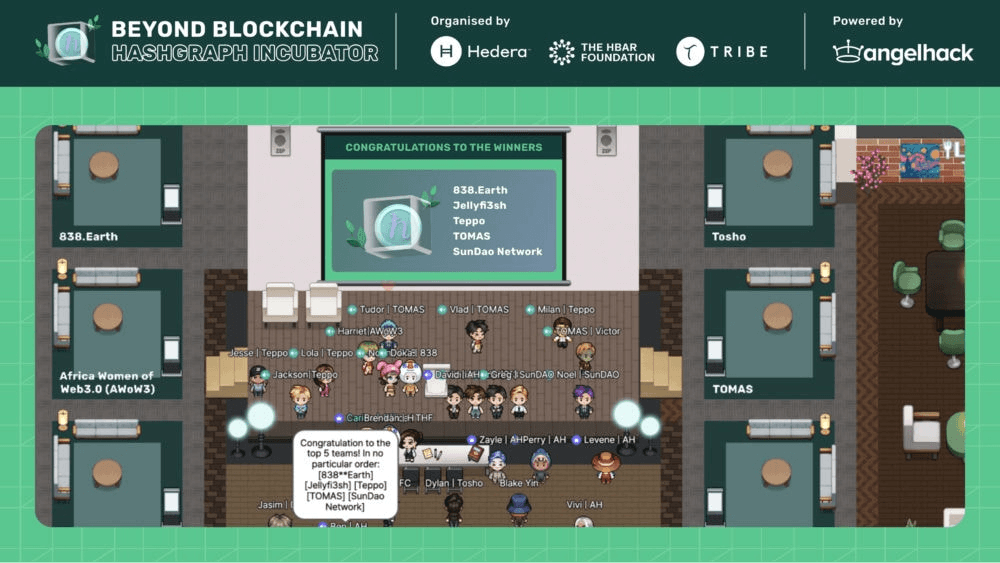
Hedera wanted to grow its standing with enterprise developers, so it ran the Hello Future program with AngelHack. The multi-stage build paired a learn-and-earn campaign with a hackathon, moving developers from first exposure to working deployments on the network. Participants tackled problems in finance, supply chain, and healthcare, the sectors Hedera wants to win.
The results:
- 5,000+ developers engaged across the program
- 7 high-potential projects incubated with mentors from Google Cloud, Fireblocks, and Swirlds Labs
- Substantial press coverage positioning Hedera in enterprise blockchain
The program gave Hedera category credibility backed by real projects, and those developers go on to adopt the product.
How do hackathons drive product adoption?
Nothing drives adoption like getting developers to build with your product under a deadline. They try features in real conditions, hit real limits, and surface use cases your roadmap missed. It also turns passive doc-readers into active users who have shipped something real. That first build is the hardest step in the funnel, and a program clears it in a weekend.
Where adoption shows up:
- First hands-on usage from developers who had never touched the product
- Direct feedback on rough edges and missing features
- New use cases your team can fold back into the roadmap
Case study: Circle’s USDC and Programmable Wallets campaign
Circle ran the Getting Started with USDC and Programmable Wallets campaign with AngelHack to expand adoption of its Web3 Services and Programmable Wallet API. Developers moved through four guided quests that had them create wallets, recover them, and transfer USDC, then applied the skills in two build bounties on the AngelHack platform. Each action left a measurable trace, so Circle could watch adoption happen rather than infer it.
The results:
- 2,600+ developers engaged
- 15,000+ API calls made
- 2,000+ on-chain transactions
Those are adoption metrics a product team can take straight to a board deck, and the same hands-on building produces brand-new prototypes.
How do hackathons speed up innovation?
Traditional R&D takes months. A hackathon compresses the first cycle into days. Teams ship a working prototype, you gather real feedback, and you see which ideas deserve investment before committing headcount. The value is range as much as speed: dozens of teams on one brief surface directions your roadmap would never prioritize, so you leave with a portfolio, not a single bet.
What you get in days, not quarters:
- Working prototypes instead of slide decks
- A read on technical feasibility under real constraints
- A shortlist of ideas worth moving to pilot
✨ Read more: The Role of Hackathons in Corporate Innovation
Case study: Coupang’s hackseoul 2025

Coupang, the Fortune 150 e-commerce company, ran hackseoul 2025 with AngelHack for the second year running to see what Korea’s builders could ship on a deadline. Over 24 hours at Coupang’s Seoul headquarters, teams built AI products under the theme AI for Real-World Impact, with mentors from Twelve Labs, VESSL AI, and Moloco on hand.
The results:
- 120 participants in a 24-hour build sprint
- ₩10,000,000 prize pool across the finalists
- Winning team Yorigo turns any cooking video into a shoppable recipe with one-tap grocery checkout
Yorigo continues to work with Coupang’s corporate development team on collaboration and investment, turning one weekend into a lasting relationship.
How do hackathons strengthen developer relations?
Developers reward companies that show up with real challenges and real support. A hackathon builds that relationship because you work alongside them rather than market at them. Over a program, your engineers answer questions in real time, your mentors unblock teams, and your brand becomes a name developers associate with help rather than hype. That goodwill is hard to fake, and it turns a one-time participant into a repeat contributor.
How the relationship deepens:
- Direct contact between your team and active builders
- A reason for developers to join your community and stay
- Advocates who keep contributing long after the event
Case study: Canton Network’s Core Academy
Canton Network, the public blockchain built for institutional finance, needed more than a one-off hackathon. Building on Canton means learning Daml, a language most developers have never used, so Canton ran the three-phase Canton Core Academy with AngelHack: guided lessons, an ideathon, and a four-week mentorship that carried top teams from first lesson to a finished finance app.
The results:
- 25,861 developers joined the Learn & Earn, and 1,613 completed the full path
- 938 ideathon sign-ups produced 45 submissions across five finance themes
- 6 teams were selected to keep building on Canton’s developer network
Several ideas are now live on Canton’s network, and the program left behind a core of active builders rather than a one-weekend spike. An engaged community like that is also a hiring pool, which is the final outcome.
How do hackathons build a talent pipeline?
Resumes tell you what a candidate claims. A hackathon shows how they build, under time pressure, on a team. It fills a pipeline with developers who already know your stack, because they just spent a weekend using it. You also see what a resume hides: how someone scopes a vague problem, handles a late-night blocker, and lifts the people around them.
Why it beats a resume screen:
- You see real skills demonstrated, not described
- You watch how people collaborate under pressure
- You meet talent early, even before they’re ready to move
⭐ Read more: How Hackathons Win Young Talent Recruitment
Case study: DSTA’s BrainHack TIL-AI 2026
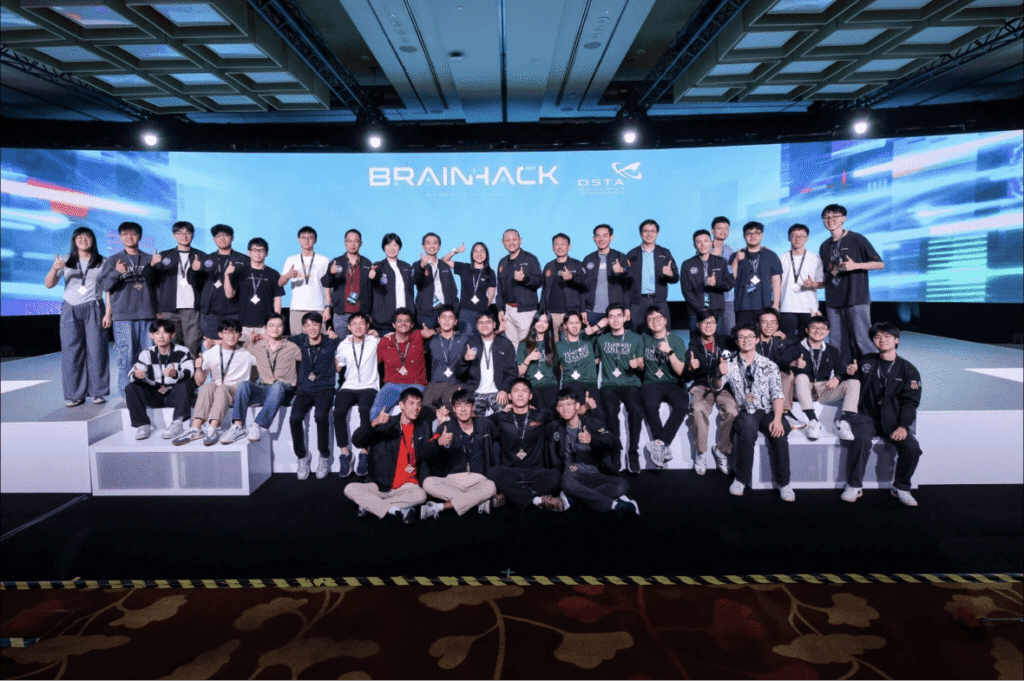
Singapore’s Defence Science and Technology Agency wanted to find high-potential AI talent, so it ran the TIL-AI track inside BrainHack 2026 with AngelHack, the third year running. Student teams faced four tasks drawn from real defence problems, speech recognition, computer vision, language models, and autonomous agents, each one a live test of how they build under pressure.
The results:
- 774 participants across 68 teams from JCs, polytechnics, and universities
- 40 teams reached the in-person finals at Marina Bay Sands
- 11 winning teams, plus a shortlist of observed talent for DSTA to recruit
DSTA gets what a job posting can’t: a ranked view of how the strongest builders actually perform under pressure.
From hackathon benefits to measurable outcomes
A hackathon can produce all five results above, but not in one program. The ones that pay off commit to a single primary outcome and design around it. So work backwards from the business decision the event is meant to inform. Two questions settle which outcome to chase:
- What decision will this feed? A launch, a hiring round, a roadmap call. The decision names the outcome.
- What stage are you in? Early ecosystems need awareness and adoption first. Mature products gain more from innovation and developer relations. A hiring push points straight at talent.
Pick one primary outcome and, at most, one secondary. Chasing all five at once usually delivers none of them well.
Then name the metric before the event. A good one maps to a business action you’d defend in a board deck, not a vanity count:
- Tie it to the decision. If adoption is the goal, count API calls or deployments, not sign-ups.
- Set a baseline and a target, so the number means something.
- Make sure you can capture it, the way Circle logged every API call by design.
Get this right and the metric becomes your design brief: who to invite, what to build, how to judge. Skip it and you get a fun weekend with a report nobody reads.
Use this table as a quick reference once you know the outcome you’re after:
| Hackathon benefit | Business outcome | How to measure it |
|---|---|---|
| Brand awareness | Category leadership, reusable content | Media pickups, impressions, content produced |
| Product adoption | Active usage of your product | API calls, accounts created, deployments |
| Innovation | Validated prototypes | MVPs shipped, ideas advanced to pilot |
| Developer relations | Engaged community | New members, repeat participants |
| Talent pipeline | Recruiting reach | Candidates identified, submissions, hires |
Final words
For tech companies, what separates a hackathon that delivers from one that fades is design. Booked as an event, it produces a weekend of activity. Designed as a program, it produces working prototypes, adoption metrics, and a community that outlasts it.
Your Next Breakthrough Starts With a Hackathon
AngelHack has run 450+ hackathons across 100+ cities for 200+ clients, end-to-end or in part. Tell us the outcome you need and we’ll design the program to reach it. Book a consultation.
TALK TO USFrequently asked questions
Why are hackathons important for tech companies in 2026?
AI adoption, developer engagement, and technical hiring all reward hands-on proof over theory. A time-boxed program surfaces working prototypes, real product usage, and how people build under pressure.
What are the most common hackathon themes for tech companies in 2026?
AI and generative AI lead, followed by AI agents, developer tooling, fintech, and sustainability, with workplace culture and smart recruitment rising for internal programs. We break down the options in 12 hackathon themes to innovate your business.
How much does it cost to run a hackathon?
The cost depends on format, scale, and prize pool, so virtual runs lighter than in-person while hybrid sits between. We scope to your budget and goal, and break down 2026 ranges in what a hackathon actually costs.
Virtual, in-person, or hybrid, which format should we choose?
The format follows the goal. Virtual maximizes reach, in-person builds community and recruiting, and hybrid combines both, unpacked in interesting hackathon types and formats.