
Running a great AI hackathon takes more than a strong challenge statement and a registration link. It takes a plan that connects every decision, from tool access to judging criteria, back to a specific business outcome. The organizers who get that right don’t just run a good event, but build a program that compounds.
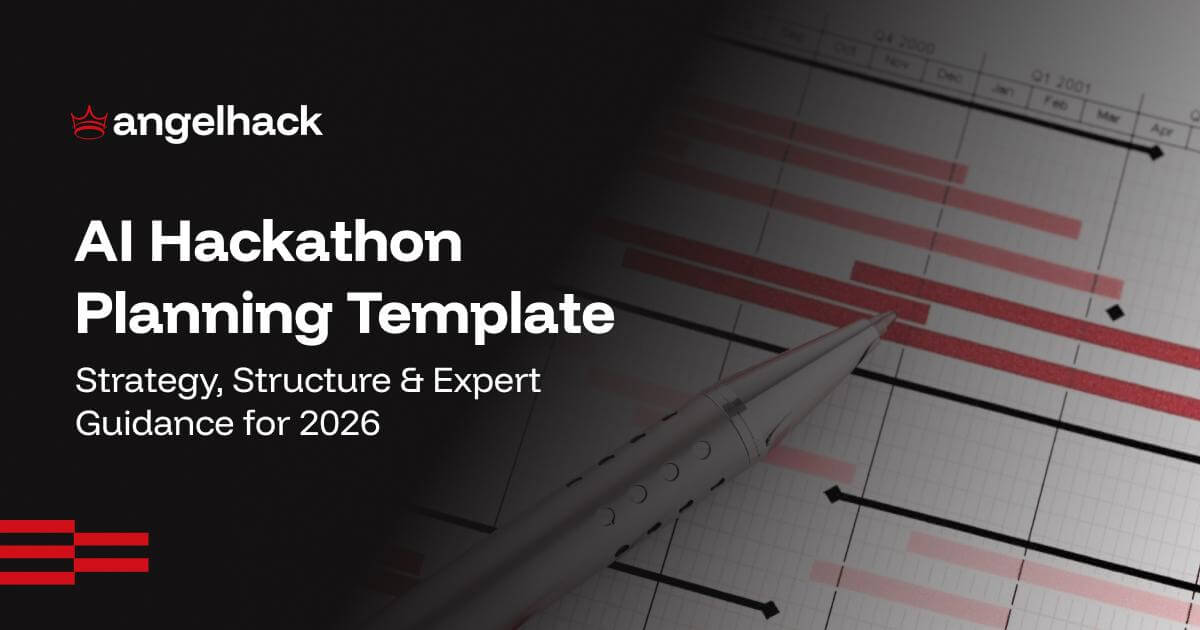
This guide walks you through five planning phases built around a single downloadable planning tool: the AI Hackathon Master Planning Template, a 12-week end-to-end timeline covering every function, every task, and every milestone from internal kick-off to winner announcement.
Phase 1 – Strategic Kickoff
Every successful AI hackathon starts with one honest question: why are you running this? The answer shapes every decision that follows.
Anchor your program to a specific business decision before anything else. Common objectives include:
- Building internal AI capability across teams
- Recruiting technical talent into your pipeline
- Driving product ideation or validating new use cases
- Accelerating platform and API adoption
Once locked, set AI-specific success metrics: models deployed, APIs integrated, datasets consumed, or prototypes advancing to funded pilots. Then three decisions follow in sequence:
- AI Hackathon theme: generative AI, ML ops, responsible AI, or domain-specific applications
- Audience profiles: AI practitioners, ML engineers, data scientists, domain experts, and mentors each need distinct messaging and onboarding
- Hackathon Format: offline, online, or hybrid based on reach, timeline, and geography
For a deeper guide on choosing the right format and theme for your event, see: The AI Hackathon Guide for Teams Who Want Real Results.
The mistake most organizers make is picking the format before locking the outcome. Without a defined outcome, you’ll design a weekend of activity instead of a program with lasting payoff.
🚀 Deliverables: Internal kick-off, discovery questionnaire, planning phase sign-off, key visual brief, hackathon name, marketing plan.
Phase 2 – Audience Recruitment & Outreach
Recruitment quality and diversity directly correlate with submission quality. Broad outreach fills seats, but it won’t fill the submission queue with working prototypes.
Build four to five personas before writing a single outreach email. Each group has distinct motivations:
- AI/ML engineers: lead with model access, compute credits, and technical depth
- Data scientists: lead with dataset quality, tooling, and participant caliber
- Domain experts: lead with the real-world problem and who will see the results
- Non-technical innovators: lead with the pathway from idea to pilot
- Mentors: lead with visibility, community, and influence over what gets built
Map channels to match: Hugging Face, Kaggle, and Discord for technical builders; LinkedIn and partner networks for domain experts; campus AI labs for student and early-career participation. Start your campaign at least 10 to 12 weeks out. Track every channel against registrations driven, not just clicks.
Embed diversity and inclusion as a design principle here. Inclusive outreach expands your talent pool and consistently improves the range and quality of solutions produced. If your registration breakdown is skewing homogenous at week four, you still have time to adjust. At week nine, you don’t.
🚀 Deliverables: Launch checklist, branding toolkit, website and landing page, social kit, marketing launch, registration phase, Discord setup, participant dashboard, stakeholder onboarding.
Phase 3 – Event Structure & Agenda Design

Teams with protected focus time and clear milestone check-ins consistently produce more polished prototypes than those left to figure it out on their own. Your agenda is your single biggest lever for submission quality.
Open every format with a context-setting session covering available tools, datasets, APIs, and responsible use guidelines. Share the judging rubric with all participants at this session. Teams that know how they will be scored consistently produce better work. Layer in AI-specific blocks throughout:
- Prompt engineering workshops
- Model fine-tuning labs
- Responsible AI briefings
- API onboarding sprints
Match mentors to teams proactively across three touchpoints:
- Early: problem framing and scope definition
- Mid-event: technical unblocking
- Pre-demo: presentation polish
Build your judging rubric before the event launches, not the night before demos. Five criteria, maximum 25 points total: technical feasibility, model performance, responsible AI adherence, real-world impact, and demo quality. Brief judges and mentors from the same rubric 48 hours before the event. Aim for teams of 3 to 4 people. Smaller teams lack bandwidth; larger ones spend too much time coordinating instead of building.
🚀 Deliverables: Participant dashboard (tested), LTM dashboard (live), Discord channels, mentor and speaker onboarding, judges onboarding, ideation window.
Phase 4 – Logistics, Production & Experience
Poor infrastructure derails teams before they’ve written a line of code. That failure lands on your program’s reputation, not on the venue or the platform.
Plan for 60 to 75% of registered participants to show up at in-person events and 40 to 55% for free virtual events. Build that gap into headcount, catering, and compute allocation from day one.
For offline formats:
- Prioritize high-bandwidth network infrastructure. Model training and API calls are bandwidth-hungry.
- Pre-load AI sandbox environments with approved APIs, datasets, and starter kits
- Staff your check-in desk with at least three people. Peak arrival happens in the first 30 minutes.
- Build accessibility in from the start: accessible pathways, high-contrast signage, dietary accommodations, and quiet zones
For online formats:
- Set up a central digital hub: Discord, Slack, or a dedicated platform such as Devpost or HackerEarth
- Pre-distribute AI starter kits before the event opens: API keys, cloud credits, approved model lists, sample datasets
- Set up and test a backup submission channel. Announce it at the opening ceremony so participants already know it exists.
- Schedule three live touchpoints: kickoff call, mid-event AMA, and final demo session
🚀 Deliverables: Submissions quality check, judging phase, event day operations, participant support, winners selected.
Phase 5 – Continuity & Impact Tracking
Most programs underperform here. The event ends, the energy evaporates, and no one can point to what actually changed. A structured post-event plan is what separates a one-off activation from a program that builds compounding value.
Flag promising prototypes early for fast-track review. After the event, manage submissions through a structured repository covering:
- Model cards
- Code repositories
- Demo links
- Responsible AI documentation
Track two layers of outcomes:
AI-specific metrics:
- Models deployed post-event
- APIs adopted during and after the program
- Datasets reused across teams or cohorts
Program-level metrics:
- Pilots launched
- Partnerships formed
- Talent hired from the participant pool
Run post-event surveys at three intervals: within 48 hours of the closing ceremony, at 30 days, and at 90 days. A 250-person corporate AI innovation challenge across three office locations generated prototypes used to justify next-stage investments. The post-event structure was what made those outcomes visible and actionable. Without it, the results would have evaporated with the event energy.
🚀 Deliverables: Winner’s announcement, post hack landing page, feedback form, post hack site, post-event report, prize disbursement, budget sign-off.
What This Looks Like in Practice
Databricks Generative AI World Cup was an online hackathon designed to validate Mosaic AI as a cross-industry platform, not just prove it could power a hackathon. Run entirely online, the program was built around that outcome from day one.
How it was structured:
- Selective vetting kept submission standards high across a global field
- StackUp’s 200,000+ developer network drove reach across 18 countries
- Teams built on Mosaic AI tools: Model Serving, Vector Search, Databricks Notebooks, and Databricks Apps
The result: 1,500+ data professionals across 18 countries, with winning solutions spanning biotech, legal tech, construction, and food and beverage. Not a single vertical. A proof point across all of them.
BrainHack TIL-AI by DSTA Singapore was an in-person hackathon designed to build a defence-focused AI talent pipeline with a clear path from student participation to real capability development. A two-tier structure (Novice and Advanced) kept the program accessible to newcomers while stretching experienced builders.
How it was structured:
- Four progressive AI tasks simulated real defence scenarios: Automated Speech Recognition, Computer Vision, OCR, and Reinforcement Learning
- Workshops, mentorship sessions, and peer learning woven throughout the program
- Cloud-based automated scoring kept evaluation consistent and objective across all submissions
The result: 800 registrations, 32 teams at in-person finals, six winning teams, and a second consecutive DSTA partnership with a measurable AI upskilling pipeline to show for it.
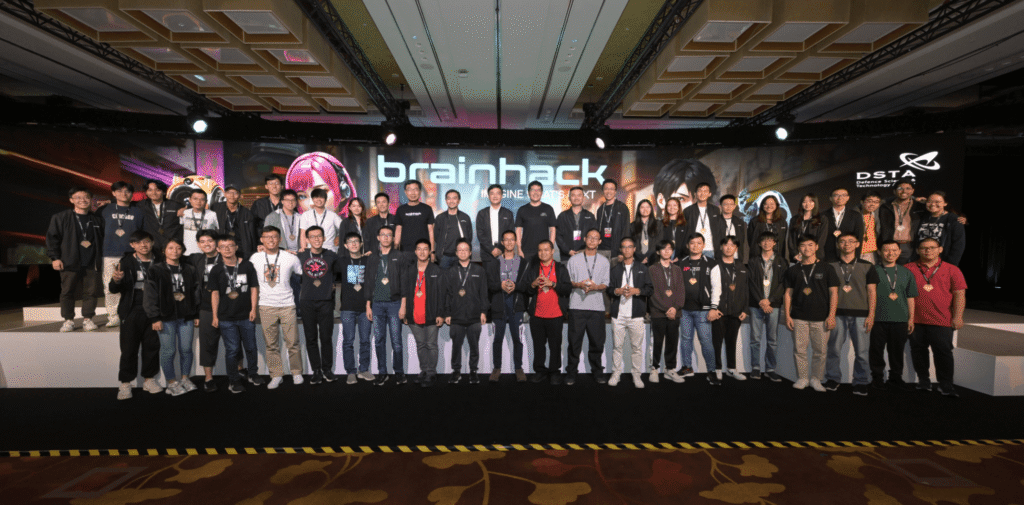
Different outcomes. Different designs. The same planning structure underneath.
From Plan to Launch — Download the Template
Five phases. One file. Everything you need to run an AI hackathon that produces real outcomes, not just a weekend of activity.
The AI Hackathon Master Planning Template is a single Google Sheets file with every task from this guide mapped across a 12-week end-to-end timeline. To use this template:
- Count back 12 weeks from your event date. That is your Week 1 anchor.
- Assign a named owner to every function area before Week 1 begins.
- Use the Phase column to stay oriented as multiple phases run simultaneously.
- Update the Status column weekly so the whole team knows what is moving and what is stuck.
Some pro tips:
- Colour-coding by phase (pink, amber, green, blue, purple) helps when your team is juggling multiple phases at once
- Blocked needs an action and a named owner before the week ends. It is a warning, not a label.
- Share with every function lead on day one and keep it as the single source of truth
Plan to Organize an AI Hackathon
That Attracts Top Talent?
AngelHack has run 500+ hackathons globally, designs programs backwards from a specific business decision, and brings a network of 300,000+ developers to every program we run. Tell us the outcome you need. We’ll design the program that gets you there.
Consult with AngelHack