Promoting a hackathon isn’t a reach problem. It’s a sorting problem. You don’t need more people seeing the event. You need the right people deciding to show up, form a team, and build through to submission. That’s a different kind of campaign, with channels, copy, and success criteria built around fit rather than volume.
This guide covers the four moves that sort properly: diagnose the blind spots, define the builder, pick the right channels, run the right tactics. Each one decides whether your event produces working prototypes or just a registration page that looks good in a dashboard.
🚧 Common mistakes in hackathon promotion
A hackathon promotion campaign goes wrong for a small number of repeatable reasons. Naming each one is more useful than counting empty seats after the fact.
Optimising for the wrong metric
Clicks, RSVPs, and registration totals are easy to measure and fill a marketing dashboard quickly. The metrics that actually matter take more discipline to track: submission rate, prototype quality, and team strength.
Writing one piece of copy for every audience
Teams draft a single message and push it across every channel and every city. Senior builders, domain experts, students, and solo registrants each respond to different cues, so generic copy reaches everyone and converts no one.
Building the campaign forward from channels rather than backwards from people
Plans that start with “what channels can we afford?” try to fit the audience into the channels. Plans that succeed start with “who do we need?” and build the channel mix to reach them.
Treating registration as the finish line
Registration is the start of the participant journey, not the end. A plan that stops at the signup page leaves the path from kickoff to submission unsupported, where the largest dropoffs occur.
The fix begins with the participant profile and works backwards to the channels, the copy, and the calendar. Define the people you need to attract first. Then identify the channels that actually reach them.
Define the builder before you write the ad
Persona work is the first step of the promotion campaign. It defines who you are trying to reach, which in turn shapes channel selection, copy, incentive design, and the calendar. Skipping this step makes the rest of the campaign read as generic to everyone.
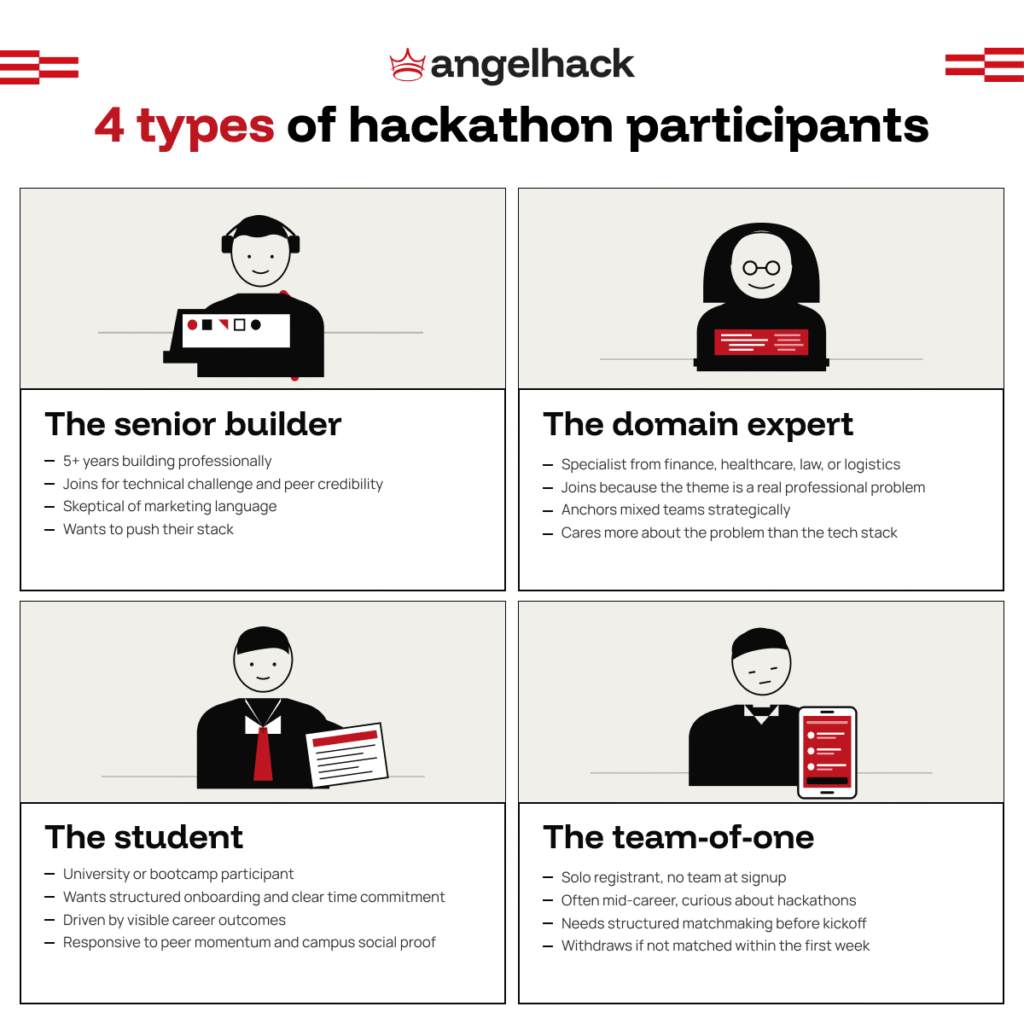
Start with four working profiles:
👨💻 The senior builder
A working developer with five or more years of experience. Joins for technical challenge, a credible prize, and the chance to push their stack against peers at their level. Skeptical of marketing language and corporate framing.
🧑💼 The domain expert
A subject matter specialist from finance, healthcare, law, or logistics. Participates because the hackathon theme intersects with a real professional problem. Often joins as the strategic anchor of a mixed team, focused on the problem space more than the tech stack.
🧑🎓 The student
A university or bootcamp participant earlier in their career. Wants structured onboarding, a clear time commitment, and visible career outcomes. Responds strongly to peer momentum and on-campus social proof.
🙋 The team-of-one
A solo registrant who needs structured matchmaking before kickoff to form a viable team. Often a mid-career professional curious about hackathons but without obvious teammates. Will withdraw if not matched within the first week of registration.
Each profile responds to different cues, so your copy needs to match the one you’re targeting in any given channel.
The rookie mistake here is writing one piece of copy and pushing it across every channel and every city. Different channels naturally carry different expectations, and different audiences read different cues. A Discord post functions differently from a LinkedIn carousel, a campus poster, or a five-minute pitch at a meetup.
Here’s what good copy looks like for each persona:
Senior builder. Lead with technical specificity and credible peer signals: “Build a multi-agent system on our API in 48 hours. $20,000 prize pool. Judges include the engineers who built the platform.”
Domain expert. Lead with the professional problem, not the tech: “If you’ve spent five years fixing supply chain bottlenecks, spend one weekend prototyping the AI tools that could replace half of them. Mixed teams, cash prizes, pilot opportunities for the strongest builds.”
Student. Lead with time commitment, team support, and career outcomes: “Two days. Free food. Mentors from leading companies. Sign up solo or with friends. Past participants now work at the firms judging this round.”
Team-of-one. Lead with the matchmaking process and quiet social proof: “Don’t have a team? 40% of registrants come in solo. Pre-event matchmaking and team formation calls run before kickoff, so by the time you’re building, your team is in place.”
Geography, too, compounds the issue. A message that lands in Singapore rarely lands the same way in Berlin or Mexico City without adjustment for local conventions, references, and cultural cues.
The remedy is to write to the channel and to the city, then audit every asset for one consistent core message. Once you know who, you can decide where.
The promotion channels that actually convert
Promotion channels are not interchangeable. Some pull qualified builders almost effortlessly while others fill a signup list with registrants who never return after the confirmation email. Rank channels by what each delivers in submission-quality participants, not headline impression numbers.
Generally, a blended approach produces the strongest outcomes. Online channels deliver scale and speed; offline channels deliver depth and credibility in your priority cities.
Online channels:
- Targeted developer communities. Discord servers, Slack groups, and subject-specific forums aligned with your theme. These produce the highest signal at the lowest cost, provided you contribute valuable content to the community before introducing any promotion.
- Sponsor and partner amplification. Sponsor newsletters, partner social posts, and co-branded landing pages allow you to borrow established trust from organisations the participant already follows. The credibility transfer drives conversion in ways paid ads cannot replicate.
- Short-form video and developer-led content. Builder-creators on YouTube, X, and LinkedIn outperform brand-owned channels for technical audiences. Simply put, technical audiences trust other practitioners more readily than corporate marketing teams.
- Search and event aggregators. Hackathon listing sites and your SEO-optimised event page capture intent already in motion. Indeed, a builder searching “AI hackathon 2026” is already halfway through the registration decision.
Offline channels
- Local tech meetups and user groups. Five minutes at the front of a relevant meetup converts better than a week of paid posts. Select meetups by theme relevance. Audience size is a secondary consideration.
- University campus presence. Information sessions in computer science departments, partnerships with student development societies, and posters in engineering buildings deliver strong leverage when your event welcomes student participants.
- Co-working spaces and hacker houses. A flyer board, a community Slack, a sponsored coffee morning all reach builders who already invest their time in technical communities.
- Industry events and side activations. Co-located side events at conferences your participants already attend cost less than building independent reach. They work particularly well for AI, fintech, and developer tools verticals.
| Persona | Best online channels | Best offline channels |
|---|---|---|
| Senior builder | Targeted developer communities, developer-led video, partner amplification | Industry side events, hacker houses, co-working spaces |
| Domain expert | Sponsor newsletters, industry publications, LinkedIn thought leaders | Vertical conferences, professional association events |
| Student | Search aggregators, campus social channels, ambassador referrals | University campus presence, student dev society events |
| Team-of-one | Discord servers, developer-led video, sponsor amplification | Local meetups, pre-event mixers |
An example of a promotion mix in action: Databricks ran their Generative AI World Cup with us specifically to attract verified data professionals at scale. The promotion ran in parallel across the Databricks blog, partner channels, and the AngelHack developer community. As a result, over 1,500 data scientists and AI engineers from 18 countries produced working prototypes across healthcare, finance, biotech, and legal tech.
12 tactics to turn attention into qualified signups
Channels tell you where to show up. Tactics tell you what to do once you’re there.
What follows is our working playbook at AngelHack, refined across 500+ hackathons over the past 15 years. Select the tactics that match your participant profile, your event format, and your timeline.
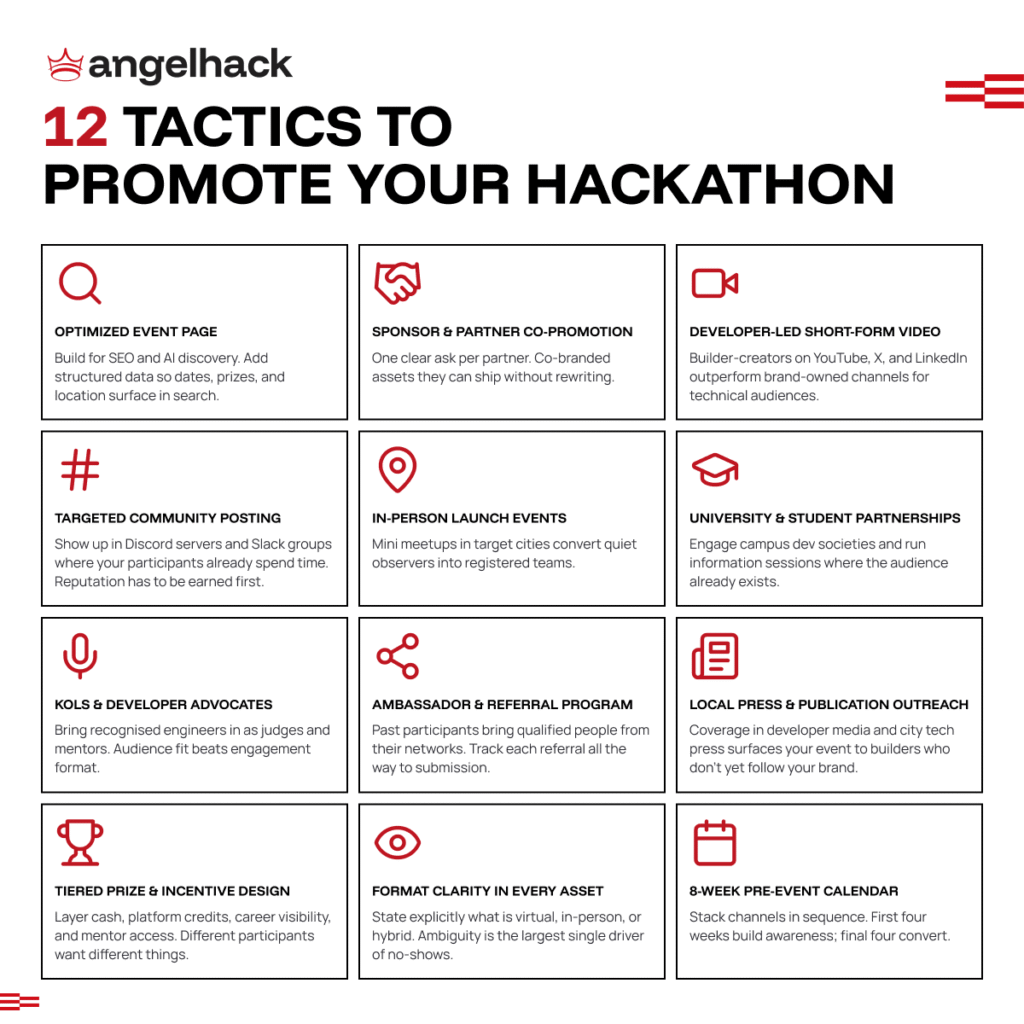
1. Optimized event page
Build the page for both search engines (SEO) and AI discovery (GEO). Host the event on your own domain, with content written for event-specific keywords and AI-friendly visibility. Add structured data so search engines and AI platforms can accurately surface key details like dates, prize amounts, and location. Check out IBM’s Call for Code as a concrete example for this.
2. Sponsor and partner co-promotion
Give each partner one clear ask and provide co-branded assets they can ship without rewriting. Tap community partner networks for global scale. For instance, AWS ran their Global Hackathon Series with us across more than 25 cities, including Silicon Valley, Paris, Delhi, Beijing, and Singapore. Each city operated on local partner amplification, reaching developer mindshare that paid advertising could not have produced.
3. Developer-led short-form video
Builder-creators on YouTube, X, and LinkedIn consistently outperform brand-owned channels when the audience is technical. Pay creators properly, brief them thoroughly on the event, and preserve their voice in the final content. A sponsored segment from Fireship (3M+ developer subscribers) reaches a much better audience than a generalist tech channel with the same subscriber count.
4. Targeted developer community posting
Show up in the Discord servers, Slack groups, and subject-specific forums where your participants already spend time. Contribute valuable content before introducing any promotion. Reputation in technical communities has to be earned over time.
5. In-person launch events and information sessions
Mini meetups in target cities during the weeks before kickoff build local energy and convert quiet observers into registered teams. Face-to-face conversation removes the friction that often holds people back from committing online.
6. University and student club partnerships
Engage campus development societies, conduct professor outreach for credit-bearing student teams, and run on-campus information sessions with audiences that already exist. As a case in point, DSTA BrainHack hackathon ran their TIL-AI track with us across Singapore’s student community. The track produced 800 registrations on its own, with 32 teams advancing to the in-person semi-finals and finals. All of that reach came through student channels: campus partnerships, on-campus sessions, and student leader networks.
7. KOL and developer advocate partnerships
Recognised engineers, developer advocates, and technical content creators carry credibility that paid advertising cannot purchase. Bring them in as judges, mentors, or paid promoters. The fit between their audience and yours determines impact far more than the specific format of the engagement.
8. Ambassador and referral program
Past participants and well-known builders bring qualified people from their own networks. Provide them with clean co-branded assets and a tracking mechanism so each referral can be credited properly during post-event recognition.
9. Local press and developer publication outreach
Coverage in developer media and city-specific technology press surfaces your event to qualified builders who do not yet follow your brand. This works particularly well in cities with a well-defined local technology scene. Look for TechCrunch and Wired for global launches; Tech in Asia or KrAsia for Southeast Asia; or The Information for North American enterprise audiences.
10. Tiered prize and incentive design
Layer multiple incentive types into the prize structure: cash, platform credits, career visibility, and mentor access. Different participants respond to different incentives.
11. Format clarity in every asset
State explicitly what is virtual, what is in-person, what is hybrid, and what the realistic time commitment looks like. Ambiguity at signup is consistently the largest single driver of no-shows we have observed.
12. 8-week pre-event promotion calendar
Stack channels in deliberate sequence. Launching everything in week one creates campaign fatigue before it has had time to convert. Each persona should be reached at least twice across at least two channels before kickoff. The first four weeks build awareness; the final four convert it into registered participants.
Why teams partner with AngelHack
AngelHack has over 15 years of experience running and promoting hackathons, with 500+ programs across 100+ cities and a global community of 500,000+ developers and 300+ partners. We handle everything end-to-end – from targeted promotion and partner outreach to event execution and post-event follow-up – so you get the right builders to register, show up, and ship working prototypes. Whether it’s AI, blockchain, or enterprise innovation, we help turn hackathons into real results. Schedule a call with us, and let’s build your next hackathon together.
Need Agency Support to Promote Your Hackathon?
Reach 500k+ developers through a partner with 15+ years and 450+ events of proven experience. Book a consultation and we’ll map your goals, close the gaps, and build the structure that gets you there.
Schedule Your CallFrequently Asked Questions
What makes a good hackathon promotion plan?
A good hackathon promotion plan starts with the participant profile and builds backwards. Define who you need to attract, pick the channels where those people already spend time, and write copy that matches each persona. Layer an 8-to-12-week calendar that builds awareness first and converts it second, with structured engagement between registration and kickoff so registrants actually show up.
How early should I start promoting my hackathon?
The standard window is 8 to 10 weeks before kickoff, though the right number shifts with your context. Stretch to 10 to 12 weeks for global multi-city events that need localised promotion in each city, and compress to 6 to 8 weeks if you’ve already got an existing community in the target market. The first half of the calendar builds awareness, and the second half converts it.
What’s the right channel mix to promote a hackathon?
A strong hackathon campaign runs two layers in parallel rather than in sequence. Online handles scale: developer communities, sponsor newsletters, and search aggregators reliably deliver volume. Offline handles depth: local meetups, campus partnerships, and hacker houses reach the senior builders and domain experts that digital ads consistently miss.
How much does it cost on average to promote a hackathon?
Promotion spend scales too much with format and reach to land on a single average. Lean single-city virtual hackathons can run $2,000 to $10,000, while global multi-city programs typically need $30,000 to $100,000 or more. Expect 60-70% to go to community-led activity (events and partnerships) and 30-40% to paid channels and press.
How do I reduce hackathon no-shows between registration and kickoff?
No-shows usually come down to two failure points in the campaign, and both have clean interventions. The first is format clarity at signup, with explicit detail on the time commitment, the format itself, and what’s required of participating teams. The second is structured engagement in the window between registration and kickoff, through mentor matching, team formation calls, and weekly content drops that keep participants connected to the event.
What are the metrics I need to track and evaluate in the hackathon promotion plan?
Counting raw signups is the first instinct in most campaigns, and almost always the least useful one when you need to predict whether the event will actually land. Track three metrics together instead. The first is qualified signup rate, the registrants who match your participant profile rather than total signups. The second is kickoff intent, measurable through pre-event survey completion or team formation participation. The third is channel attribution at the signup form, so you can double down on what’s converting and retire what isn’t.
Do paid ads work for hackathon promotion?
Paid ads work well for top-of-funnel visibility, particularly in cities where you don’t yet have an existing community presence to lean on. They rarely deliver the senior builders or domain experts you’re most likely targeting, since those audiences respond to peer endorsement and community signals over sponsored content. Treat paid as a supplement to community-led promotion, not a replacement for it.