The typical 2025 AI hackathon ended with three deliverables: a chatbot prototype, a demo video, and a press release. An agent running in production was rarely on that list. That gap is why an AI agent hackathon in 2026 needs a different design.
The shift from generative to agentic AI changes what the format has to be. Agents plan, call tools, retrieve context, and operate over longer time horizons. The program has to be built for working prototypes that survive past the demo.
Why run an AI agent hackathon?
Generative AI has moved from experimental to operational across enterprise tech. ChatGPT Enterprise, Microsoft Copilot, and internal RAG deployments are now common line items. Agentic AI is what comes next, and an agentic AI hackathon is the fastest way to test whether your team can architect, evaluate, and deploy agents. Gartner forecasts that by 2028, agentic AI will autonomously make 15% of day-to-day work decisions, up from 0% in 2024.
A hackathon surfaces agent readiness faster than hiring rounds or vendor pilots. Time-boxed builds expose orchestration skill in days, not quarters. One program feeds talent, partners, and the internal roadmap at the same time.
What AI agents unlock for the business:
- End-to-end task completion. Agents can handle a full task from start to finish, like resolving a customer support ticket, drafting a sales email, or approving an expense report. A person only steps in when the agent flags something unusual, not for every small step along the way.
- Lower cost per workflow. Older automation tools break easily. If a form layout changes or a new type of input shows up, someone has to update the script. Agents are more flexible and can adjust to small changes on their own, which means less rework and lower maintenance costs over time.
- 24/7 throughput. Agents don’t need breaks. They can keep working overnight, on weekends, and across different time zones your team doesn’t cover. This is helpful for handling spikes in demand or running tasks where you can’t always have a person available.
- Cross-system orchestration. A single agent can pull information from your CRM, check your data warehouse, update your project tracker, and send a summary to Slack, all in one flow. Tasks that used to require three or four separate tools or scripts now happen in one place.
- Faster pilot validation. Building a small agent prototype helps you answer real business questions quickly. Is this task worth automating? How much will it cost? Where does it struggle? You get answers in a few weeks instead of waiting months for a full vendor evaluation.
- Compounding institutional knowledge. Every time an agent runs, it leaves behind a record of what it did, what worked, and what didn’t. Over time, this becomes a useful library your future agents can learn from, instead of disappearing like an old chat conversation.
How to design an AI agent hackathon
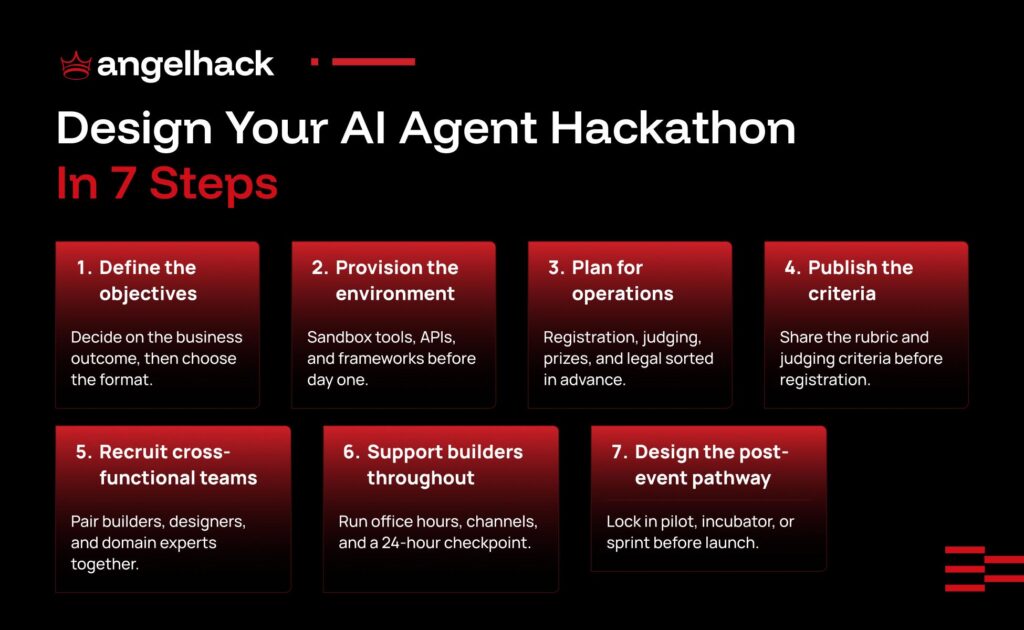
Seven decisions separate an AI agent hackathon that produces a deployable agent from one that produces a demo deck.
1. Start from the business objective, not the technology
Define the outcome first: customer support deflection, sales triage, ops automation, compliance monitoring. The agent capability follows from the decision. Write the brief as “we need to know if X is automatable by Q3,” not as a request to build something with AI.
Then pick the format that fits the objective.
- Internal vs. external. Internal programs surface talent and validate use cases inside the business. External programs build developer community, partner pipeline, and brand awareness.
- Online vs. in-person vs. hybrid. Online scales reach and lowers cost. In-person produces higher submission quality and tighter teams. Hybrid combines online qualifiers with an in-person final.
♦️ For broader format selection and event planning, see our AI hackathon planning guide.
2. Provision the agent’s environment ahead of time
Specify which tools the agent can call, what data it can access, and what actions it can take. Agents without an environment are LLMs with extra steps. Sandbox real APIs where possible, and mock them where the access doesn’t exist.
Provide the supporting stack on day one: agent frameworks, monitoring tools, judging criteria. Partner with the right vendors and have technical mentors on standby. Teams should be building on day one, not configuring on day one.
3. Plan the operational backbone before launch
The operational lift sits outside the build itself:
- Registration and comms. RSVPs, waiver flow, schedule emails, day-of cadence.
- Judging logistics. Judge recruitment, scoring sheets, deliberation schedule.
- Prize and IP. Cash prizes, sponsor swag, IP assignment language.
Inside the organization, you’ll need a program owner, vendor coordination, finance sign-off, and a security review for any production data exposure.
Build a single source of truth: project tracker, comms calendar, escalation path. Without that layer, build day gets eaten by coordination overhead instead of agent development.
4. Set evaluation criteria up front
Publish the rubric before registration opens. The standard agent eval rubric covers five metrics:
- Task completion rate. Percentage of test scenarios that end with the goal met.
- Tool-use accuracy. Whether the agent calls the right tool at the right step.
- Cost per run. Token spend and API costs per successful task.
- Latency. Time from prompt to completion.
- Hallucination rate. Frequency of false claims or fabricated tool calls.
These are the criteria enterprise AI teams use to judge agents in production, and the hackathon rubric should match. Provide a shared eval harness teams build against from day one. A public rubric helps builders self-select, which means more agents that actually clear the eval bar.
5. Recruit cross-functional teams
Builders, designers, and domain experts produce more complete agent submissions than all-technical teams. The domain expert frames the real problem, the designer shapes the human-agent interaction, and the builder makes it work end-to-end. Pure engineering teams over-index on technical novelty and under-index on whether the agent solves a real workflow. Make cross-functional composition a registration requirement, not a suggestion.
6. Support participants throughout the build
Stack four support layers before the build window opens:
- Office hours and mentor pods, staffed across time zones for the duration of the build.
- Dedicated Slack or Discord channels with named technical mentors on call.
- 24-hour technical checkpoint where mentors review traces and flag broken tool calls.
- Clear escalation paths for blocked builds, with named owners on standby.
The strongest submissions consistently come from teams that get unblocked fast.
7. Design the post-event pathway before launch
Decide before the event opens: internal pilot, customer pilot, incubator, or funded engineering sprint. A working agent on a developer’s laptop isn’t worth anything to the business. A defined pathway turns a winning prototype into a live workflow.
Without a defined pathway, winning prototypes end up archived in a Notion folder. With one, they get scoped, funded, and pushed into a real workflow.
AI agent hackathons in practice
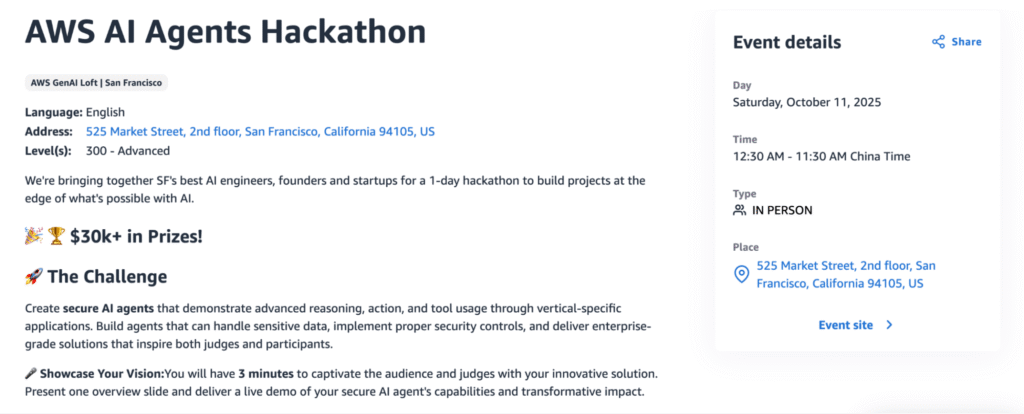
The AWS AI Agents Hackathon put security at the center of the challenge brief. Participants were asked to build AI agents demonstrating advanced reasoning, action, and tool usage through vertical-specific applications. The brief required handling sensitive data, implementing proper security controls, and delivering enterprise-grade solutions.
The one-day, in-person program ran at the AWS GenAI Loft in San Francisco. Level 300, invite or approval only. Each team had three minutes to present and demo. AWS partnered with Anthropic, Bugcrowd, Horizon3.ai, Semgrep, System Initiative, and Vanta to provide security-specialized tooling.
300+ AI builders, AWS customers, and SF-based developers participated, with $30k+ in prizes distributed.
Common pitfalls and how to avoid them
Five common pitfalls derail an agentic AI hackathon. Each has a fix that costs nothing if you plan for it.
1. Vague briefs
Teams asked to “build an AI agent” default to flashy demos that wow the room but don’t survive a real workflow test. The fix is to brief the business decision and the end user, then let the agent design emerge from that problem definition.
2. Inconsistent judging criteria
Without one, judges score videos and vibes. Whoever made the slickest demo wins, regardless of whether their agent actually worked. Provide an evaluation framework teams build against from day one, and score the trace logs.
3. Underestimating tool access
Real APIs hit rate limits and auth issues by hour 12. Provision sandboxed tool access ahead of time and keep technical mentors on call for the first 24 hours.
4. Promotional focus over technical depth
Heavy swag sometimes equals light technical depth. Sponsors love a good photo opp, but senior engineers read the signals fast and won’t show up if depth is missing. Design for builders first. Good marketing follows from strong builds.
5. No post-event pathway
Winning prototypes get a prize and a press release, then nothing. Define the pilot, incubator, or funded sprint before participants register, and communicate it in the brief.
Run the right hackathon for your innovation roadmap
Agentic AI is the next operational layer enterprises will build on. The teams who learn to design, evaluate, and deploy agents now will have the head start in 2027.
An AI agent hackathon is the fastest way to develop that capability inside your organization. It builds working prototypes, surfaces internal talent, and produces a tested pathway from idea to pilot.
Plan to Organize an AI Agent Hackathon?
AngelHack has run 450+ hackathons over 15 years with a 500,000+ developer community. Tell us the business decision you need to validate. We’ll design the AI agent hackathon that gets you there.
Consult with usFrequently asked questions
What is an AI agent?
An AI agent is a software program that plans, calls tools, and takes actions across multiple steps to complete a task. A chatbot responds to a single prompt. An agent works through a goal, calling APIs and adjusting as it goes.
How is an AI agent hackathon different from a regular AI hackathon?
The build is multi-step, so teams need sandboxed tool access, observability, and eval harnesses from day one. The judging rubric covers task completion rate, tool-use accuracy, cost per run, and latency, not just demo quality.
Who should participate in an AI agent hackathon?
Cross-functional teams of builders, designers, and domain experts. The domain expert frames the problem, the designer shapes the interaction, and the builder makes the agent work end-to-end.
How long should an AI agent hackathon run?
A 24 to 48-hour sprint fits internal proof-of-concept events. Multi-week formats produce more polished builds. Multi-stage programs combining online qualifiers with an in-person final fit ecosystem-building goals.
What does it cost to run an AI agent hackathon?
Hackathon costs vary by format, scale, and prize pool. Internal events can run from $20k for a small sprint to $200k+ for a multi-region program. We scope every program against the specific outcome you need.