Enterprises are spending heavily on AI in 2026, but very little of that spend is showing up in how people actually work. Deloitte’s State of AI in the Enterprise 2026 found that only 28% of organisations have moved at least 40% of their AI pilots into production, with the majority still stuck in experimentation mode.
An AI internal hackathon is one of the fastest ways to close that gap, turning AI ambition into measurable business outcomes. This playbook covers the six design decisions that separate AI internal hackathons that deliver from ones that don’t.
What an AI Internal Hackathon Actually Does
An AI internal hackathon is a time-boxed event, employees only, built around AI as the chosen technology. Teams come together for anywhere from 48 hours to a few weeks, work on a defined challenge, and present what they’ve built to a panel of judges and stakeholders.
The strongest programs are designed around one of three primary goals, each producing a different kind of outcome:
- Use case discovery: Teams produce working AI prototypes tied to specific business problems, ready for pilot scoping after the event.
- Tool adoption: Teams get hands-on experience with a new AI platform or stack across enough of the workforce to make the rollout stick, with builders who can champion it back in their own departments.
- Workflow redesign: Teams reimagine existing processes with AI and produce before-and-after evidence to back the change, with measurable time saved per workflow.
♦️ Related reading: Why AI Hackathons Should Lead Your 2026 Innovation
Six Decisions That Make or Break an AI Internal Hackathon
After running 450+ hackathons worldwide, one pattern stands out to us: Public hackathons that underdeliver usually have a participant problem. Internal hackathons that underdeliver almost always have a design problem.
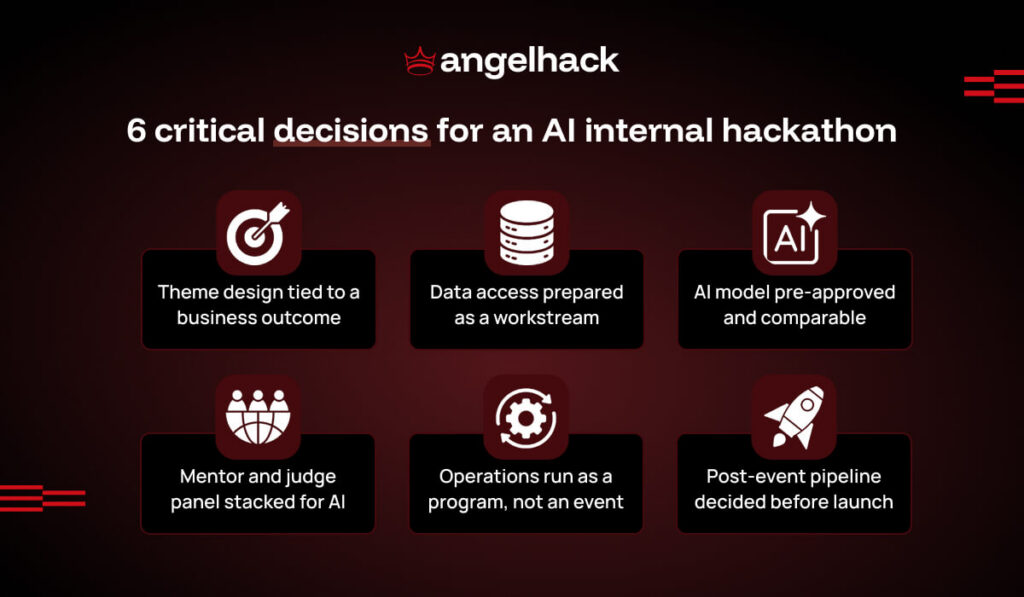
Six things change once AI sits at the center of the program, and each one becomes a decision the organizing team has to make deliberately rather than default into:
1. Theme design has to specify the business constraint, not the technology, or every team builds the same easy prototype.
2. Data access is the bottleneck, not compute, and gated internal data on day one breaks the entire event.
3. Model selection has to be opinionated, not open, because scattered submissions can’t be judged against each other fairly.
4. Mentor and judge mix decides whether outputs survive review, with three roles most events forget entirely.
5. Operations and orchestration decide whether teams actually build or get stuck wrestling with infrastructure for the first morning.
6. Post-event pipeline needs a follow-through structure matched to your goal, or even the best outputs lose momentum within weeks.
How to Pick a Theme for Your AI Internal Hackathon
The rookie mistake is themes like “build something with GenAI” or “AI for customer experience.” When the brief is that broad, every team converges on the same easy build (a chatbot, a summarizer, a search wrapper), the demos look identical, nothing differentiates one submission from another, and nothing moves to pilot afterward.
Specify the business constraint in the theme itself, and match the theme format to your hackathon goal. There are three theme formats that consistently work for AI internal hackathons, and each one is suited to a different goal.
🎯 Problem-based themes work best for use case discovery. You give participants a specific business problem to solve with no constraint on the tech stack, and the submissions tend to be focused, deployable, and directly useful.
Example: Cut Tier 1 support handle time by 30% without expanding headcount.
🛠️ Technology-based themes work best for tool adoption. You require participants to build using a specific platform, model, or API, which means submissions generate genuine product feedback while broadening fluency with the tool across the organization.
Example: Build a production-ready workflow on our new AI platform that handles at least three real customer service scenarios end-to-end.
🔄 Workflow-based themes work best for workflow redesign. You ask participants to pick an existing process they own and reimagine it with AI, with the requirement that submissions include before-and-after evidence the sponsor can act on.
Example: Pick one weekly process your team owns. Redesign it with AI. Show the before and after with measurable time saved.
Solve Data Access Before the Hackathon Launch Date
When internal data is gated, teams default to public datasets within the first few hours, and the outputs become unusable for any real deployment decision. Synthetic data tells you almost nothing about how a prototype will perform on production data, which makes data access the single biggest bottleneck of every AI internal hackathon.
Treat data access as a dedicated pre-event workstream, with four pieces in place by kickoff:
- Curate 3 to 5 anonymized datasets matched to each theme, ready in a sandbox environment that participants can reach without friction on day one.
- Assign a data steward with explicit permission to grant ad-hoc access during the event, so teams aren’t blocked waiting for tickets to clear.
- Pre-clear PII handling (personally identifiable information, like names, emails, or account numbers) with legal and compliance before the announcement, with documented guidelines participants can refer to themselves.
- Document the data dictionary in plain language so non-data-team participants can actually use what’s available without translation help.
Get this right and the first four hours of your hackathon go into building. Get it wrong and they go into requesting access.
Lock In AI Model and Tool Selection
“Use any model, any tool” sounds inclusive, but in practice it produces scattered submissions across five different model families, harder judging because nothing is comparable, slower security review because every approach needs separate sign-off, and no consistent path forward for the outputs that do show promise.
Pre-select 2 to 3 approved models and define your stance on AI coding assistants before the event opens, then communicate that stance clearly in the brief. Four things are worth specifying explicitly during the selection process:
- At least one open-weights option (models like Llama or Mistral, where the weights are publicly available and can run on your own infrastructure) for teams that need on-premise inference or work with sensitive data.
- At least one frontier closed model (the top-tier hosted models like GPT-4 or Claude Opus) for teams pushing capability limits and exploring what’s possible at the edge of current AI performance.
- A clear stance on coding assistants like Cursor, GitHub Copilot, or Claude Code, including whether they’re allowed, restricted to specific tasks, or required as part of the build.
- A common set of evaluation criteria so submissions can be compared fairly on the same prompts and metrics, rather than each team designing their own evaluation.
This also speeds up post-event security review by 30 to 60 days, because the approved stack is already cleared and the surface area for compliance questions is much smaller.
Stack Your Mentor and Judge Panel for AI
Internal hackathons usually run with a business, technical, and design mentor mix, which works for general hackathons but leaves critical roles uncovered for AI. The result is predictable: teams either avoid the harder problems, or they build prototypes that fail security review weeks after demo day.
A six-role mentor team covers the full surface area of an AI build:
- AI/ML technical mentor for model selection, prompt design, and evaluation methodology.
- Data steward for access, lineage, and PII handling during the build itself.
- Security/compliance mentor for regulated workflows, data residency, and model risk questions that surface mid-event.
- Business mentor for whether the build actually solves the problem the theme describes.
- Design/UX mentor for whether the output is demoable and usable beyond the hackathon environment.
- Domain expert specific to each theme, who can ground the build in the realities of the workflow being addressed.
The same rigor applies to the judging panel. Use a five-criterion rubric with weighted scoring, with weights adjusted to match the goal of your hackathon:
- Business impact: does the submission solve the theme constraint in a measurable way?
- Technical execution: does it work end-to-end on the data provided, or does the demo rely on cherry-picked examples?
- Path to adoption: can it move into pilot, rollout, or daily use within 90 days using infrastructure that already exists?
- Risk profile: how does the team handle hallucination tolerance, data lineage, and rollback feasibility?
- Demo clarity: is the build understandable to a non-technical sponsor who needs to approve next steps?
Judge calibration is also a must-have: running judges through the rubric together before the event, with sample submissions to score and discuss. This helps every judge interpret the criteria the same way, which means the rankings hold up to scrutiny from participants and stakeholders alike.
Run Hackathon Operations Like a Program, Not an Event
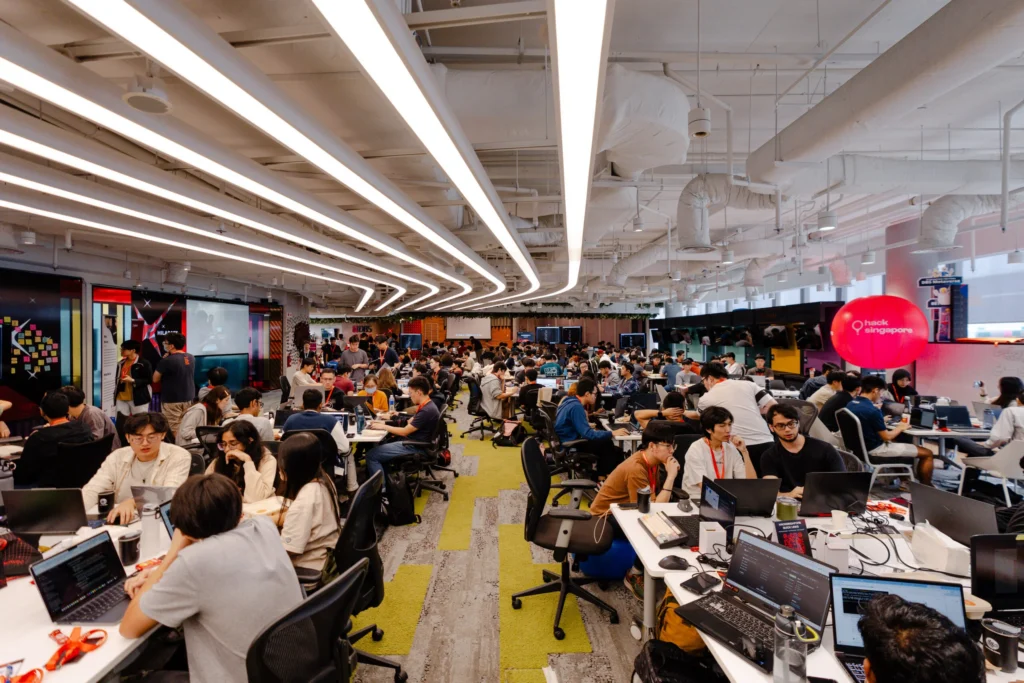
The rookie mistake is treating an AI internal hackathon as a 48-hour event when it’s actually a 12-week program with a 48-hour finale. When the program scaffolding isn’t built, event weekend pays the price: untested logins, mentors without briefings, judges who haven’t seen the rubric, or stakeholders who can’t approve next steps.
A structured pre-event plan covers five workstreams, each with named owners and weekly checkpoints leading up to kickoff:
- Stakeholder alignment: theme sign-off, budget breakdown, and post-event ownership decisions agreed before the announcement goes out.
- Technical infrastructure setup: data sandbox, model access, credentials, and end-to-end testing complete two weeks before the event.
- Mentor and judge onboarding: briefing decks distributed early, evaluation calibration sessions held the week before kickoff.
- Participant communications: announcement, FAQs, team formation support, and pre-event training delivered on a deliberate cadence.
- Logistics and operations: venue or platform, catering, schedule, comms channels, and support roles confirmed and rehearsed.
Download the AI Internal Hackathon Planning Template
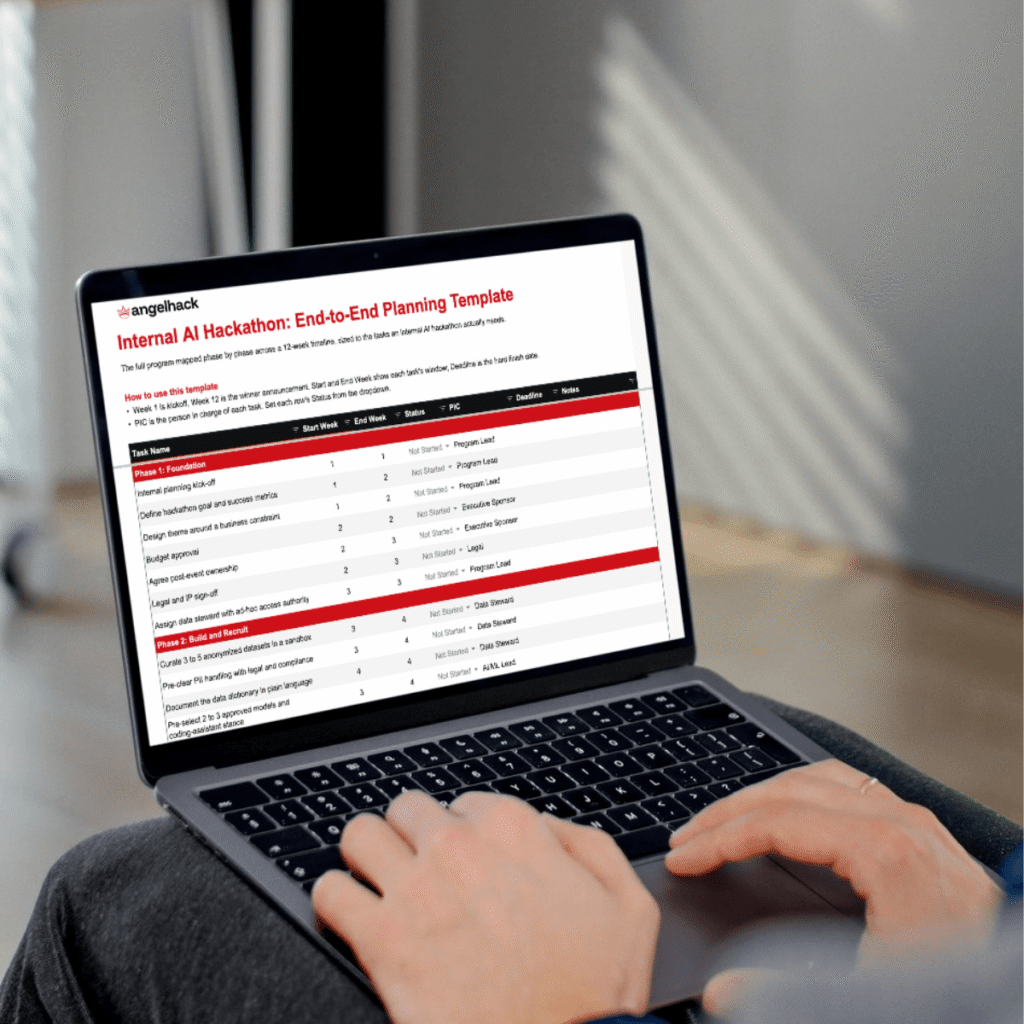
We’ve built a detailed Excel template that maps every phase of an internal hackathon for you, ready to drop straight into your tracker. It’s designed to save you weeks of build time and to make sure nothing critical falls through the cracks from kickoff to winner announcement.
- Editable Excel spreadsheet, so you can adapt it to your timeline and team structure
- 12-week timeline organized by phase, with a start and end week for each task
- Function, Status, and Deadline columns, so accountability is visible at a glance
- Adaptable for both small internal events and larger programs, with optional rows you can keep or remove
♦️ Download the AI Internal Hackathon Planning Template →
Design What Happens After Demo Day
AI hackathon outputs have a narrow window between demo day and the next budget cycle, and the gates are heavier than for general hackathon outputs. Model risk review, infrastructure costs, and data residency questions all add steps that don’t exist when the prototype is a website or a chatbot wrapper. Designing the follow-through before launch is what gets those gates cleared on time.
Match the post-event structure to your hackathon goal:
- Use case discovery → 90-day pilot pipeline. Track prototypes selected for pipeline, model risk reviews cleared, pilots scoped with named owners and budget, and live pilots launched with measurable success criteria by day 90.
- Tool adoption → enablement and measurement. Track active user count, tool usage by team, and adoption rate rate at 30 – 60 – 90 days, with quarterly check-ins to keep the curve climbing.
- Workflow redesign → rollout and capture. Track workflows moved into broader rollout, before-and-after time savings per workflow, and the number of teams that have adopted the redesigned process by quarter-end.
Pro Tip: Know When to Bring in a Hackathon Partner
Not every AI internal hackathon needs an external partner, and running it yourself is genuinely the right call in some situations. The decision usually comes down to scale, internal bandwidth, and whether you have a post-event pipeline structure to plug into.
Running it yourself works when
- The event is single-site, single-theme, and under 100 participants.
- Your internal data and security teams have the bandwidth to prepare the sandbox and clear approvals on time.
- Your existing innovation pipeline can absorb the post-event work without bottlenecking on any single team.
Bringing in a partner adds genuine value when:
- The format is multi-region or hybrid, with coordination requirements that scale faster than internal teams can absorb.
- Multiple themes need different data sandboxes, model approvals, and mentor pools running in parallel.
- There’s no existing post-event pipeline structure to plug into, and the program needs that scaffolding built alongside the event itself.
AngelHack has designed and run AI hackathons for Databricks, Microsoft and AI Singapore, with 15+ years and 450+ hackathons of operational experience behind every program we deliver.
Tell us the business decision your AI internal hackathon needs to inform. We’ll design the theme, data access, evaluation criteria, and 90-day pipeline that gets you there. Book a 30-minute scoping call with our team.
Plan to Organize an AI Hackathon
That Innovate Your Business?
AngelHack has run 500+ hackathons globally, designs programs backwards from a specific business decision, and brings a network of 300,000+ developers to every program we run. Tell us the outcome you need. We’ll design the program that gets you there.
Consult with AngelHackFrequently Asked Questions
What is an AI internal hackathon?
A time-boxed event, employees only, built around AI as the chosen technology. Formats range from 48-hour virtual sprints to multi-week part-time programs, with outputs depending on the goal: working prototypes, broader tool fluency, or redesigned workflows.
Who should participate in an AI internal hackathon?
Not just engineers. The strongest teams mix builders, designers, domain experts, and product thinkers, because non-technical participants often shape the use case more than the technical execution does. Set team composition guidelines that require at least one non-technical member.
How long should an AI internal hackathon last?
24 to 72 hours for sprint formats where teams focus exclusively on building. 2 to 3 weeks for part-time formats where participants balance the hackathon against their day jobs. Longer formats produce more polished outputs but require more coordination across the program.
What budget should we plan for?
Small internal events typically run $15K to $30K covering facilitation, catering, prizes, and platform costs. Multi-site programs run $50K to $150K and up. The line item that consistently matters most is post-event resources to develop winning ideas, not the prize pool itself.
How do we measure ROI on an AI internal hackathon?
It depends on the goal. Use case discovery is measured on pilot conversion rate. Tool adoption is measured on active user counts at 30, 60, and 90 days. Workflow redesign is measured on time saved per workflow rolled out. Secondary metrics include talent identified and participant satisfaction.