💡 Key takeaways:
- Companies are running internal hackathons to turn AI pressure into working prototypes, fast.
- The format now spans product, data, operations, and people teams in every industry.
- Internal hackathon pays off twice: in the tested ideas worth backing, and in the people who built them.
AI is forcing companies to rethink how work gets done, fast
AI is now a board-level priority: Companies worldwide plan to roughly double their AI spending in 2026, and two-thirds of CEOs now rank it a top-three priority (BCG AI Radar 2026). The pressure reaches the organisational chart too, with 41% of employers expecting to cut roles where AI can automate tasks (WEF Future of Jobs 2025). The money and the job cuts are moving faster than most teams can absorb.
But owning AI and using it well are different things. Only 34% of companies are truly reimagining how they work, and the skills gap is the biggest barrier to getting value from AI (Deloitte State of AI 2026). Nearly two-thirds have not even begun scaling AI across the enterprise (McKinsey 2025). Most teams have the tools – but far fewer have rebuilt a workflow around them.
All reports tracking the AI gap name the same fix: redesign workflows and invest in people. That is where an internal hackathon earns its place.
How internal hackathons solve the AI rollout problem
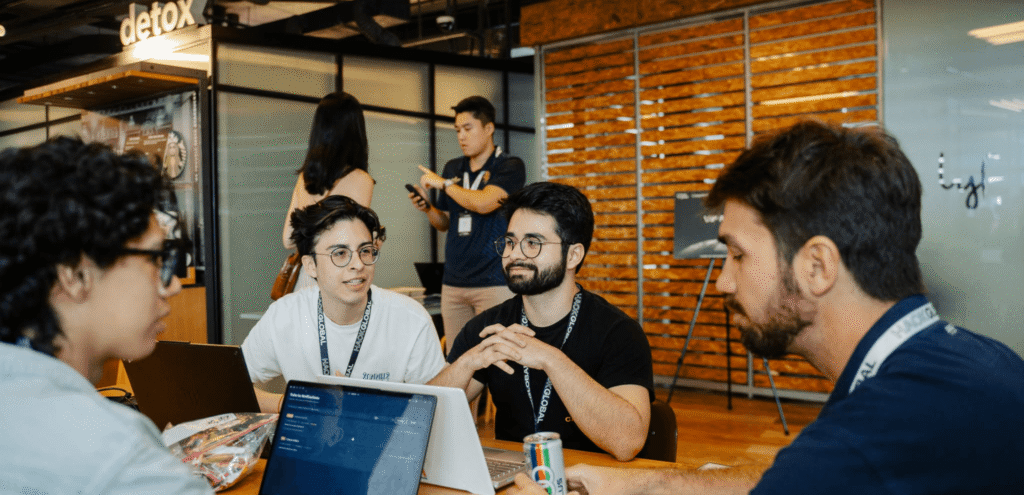
Internal hackathon is a time-boxed event where your own teams receive a scoped challenge and a fixed deadline, then build and test real use cases against their existing workflows, with mentors and field experts support throughout the process.
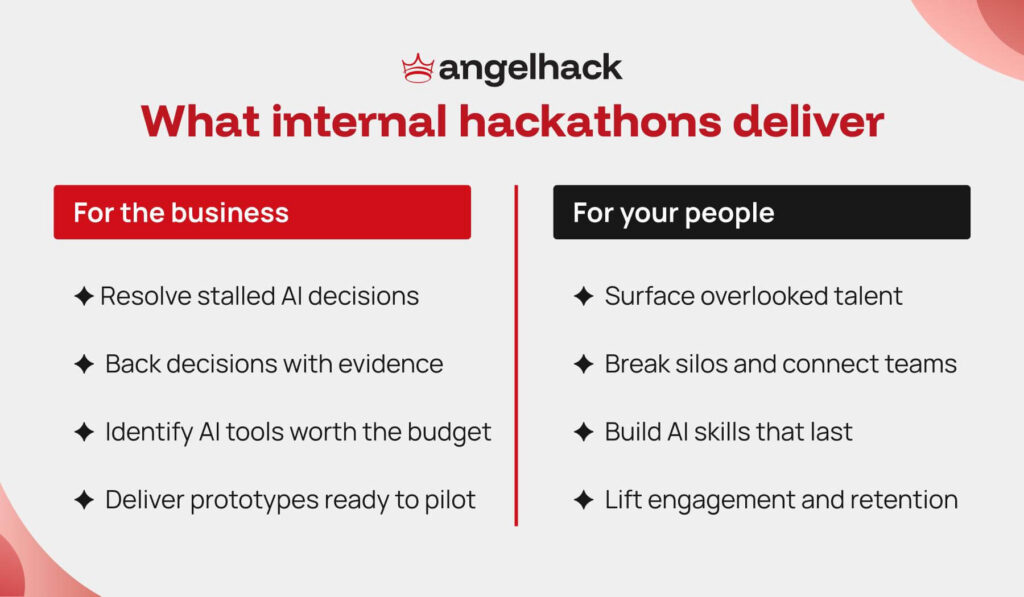
Done well, an internal hackathon takes a vague AI mandate and turns it into something concrete in days. Instead of another meeting about where AI fits, your teams build and test real use cases against the work they already do. You come out with working prototypes you can judge on the spot, not a deck of possibilities.
A well-run program produces:
- A portfolio of working prototypes tied to real business problems, ready to pilot, instead of a backlog of ideas to schedule
- A clear read on which AI tools change the workflow and which just add noise, before you commit budget to a contract
- The builders on your staff who can work with AI, surfaced under real conditions rather than in a performance review
- Cross-functional teams that break the silos slowing your rollout, with product, data, and operations solving one problem together
- On-the-job upskilling that closes the skills gap, because people learn AI faster by building with it than by sitting through another training session
There is also the cost factor. Hiring or bringing in consultants to build AI capability is slow and expensive; a hackathon turns the people you already employ into tested ideas in a weekend.
Internal hackathons are not just for engineering, or tech companies
This is concluded from our own experience: In the first half of 2026, the amount of enquiries for internal hackathons made to AngelHack has jumped over 350% compared to the whole of 2025. Surprisingly, those requests are not coming from the technology side alone.
Different functions run them for different reasons:
🚀
Product and marketing
clear new features, new products customers request stuck in the backlog and test new builds fast. Work that has waited months on spare capacity gets prototyped in a weekend, and the team learns which bets are worth real roadmap time.
💡
Innovation teams
pilot AI tools against real workflows before committing a budget. Instead of trusting a vendor demo, they see how a tool performs on their own data and processes, so the next license is a decision backed by evidence.
⚙️
Operations & back-office
redesign slow or manual processes around the new AI tools adopted. With low-code and no-code builds, the people who know the work best can fix it themselves, rather than waiting in line for engineering.
Whichever the goal is, a mixture of builders, designers, and domain experts consistently produce more complete outcomes than all-technical groups. Their combined expertise keeps the work grounded in real use, not just clean code.
The pattern also holds across industries, from finance and aviation to manufacturing and software. A few recent examples are:
- SaaS: Canva ran an internal hackathon that fed working ideas straight into its products.
- Aviation: Cathay Pacific built one into its operations, with employee teams shipping AI tools for frontline staff.
- Industrial: POSCO DX used one to move its workforce into agent-based AI and turn winning projects into internal services.
Beyond the tech: the people payoff
The business case is only half the story. An internal hackathon is also one of the most effective people programs you can run, because it develops, recognizes, and connects employees at the same time. In a few days it delivers what HR usually chases through separate initiatives:
♦️ Stronger cross-team relationships: Putting people from different functions on one problem builds working connections that outlast the event and reduce silos.
♦️ Hidden talent identified: It reveals capable builders and natural leaders that performance reviews overlook, and gives high-potential employees a visible win.
♦️ Upskilling through practice: Employees learn AI by building with it, which lasts far longer than another classroom session.
♦️ Higher engagement and retention: A real challenge with genuine recognition shows that the company invests in its people’s ideas, which is what keeps them committed.
Internal Hackathon Success Stories
Two programs AngelHack delivered for UBS and Discover show what an internal hackathon can produce: fundable ideas, stronger teams, and a clearer view of internal talent.
🏆 UBS Hackathon
UBS Innovate was the internal hackathon UBS, the global bank, ran to reignite engagement and surface new ideas across its global offices.
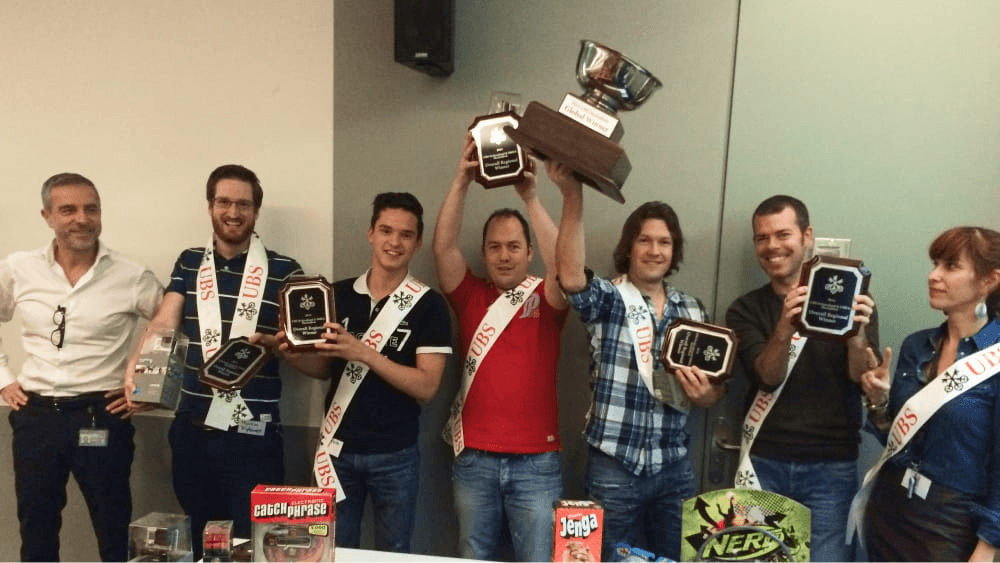
- The program ran as five simultaneous events in New York, London, Zurich, Singapore, and Hong Kong, linked by live video, with more than 500 employees working on cross-functional teams.
- Teams tackled open-ended business problems, and the winning ideas were presented to UBS executives, with the top teams entering a post-program accelerator with funding and access to leadership.
- The hackathon reduced silos across a workforce spread over five countries and lifted engagement, with the company reporting stronger morale and renewed purpose afterward.
🏆 Discover Hackathon
Discover’s Innovation Hack was the internal hackathon Discover ran to turn employee ideas into patents and new products.
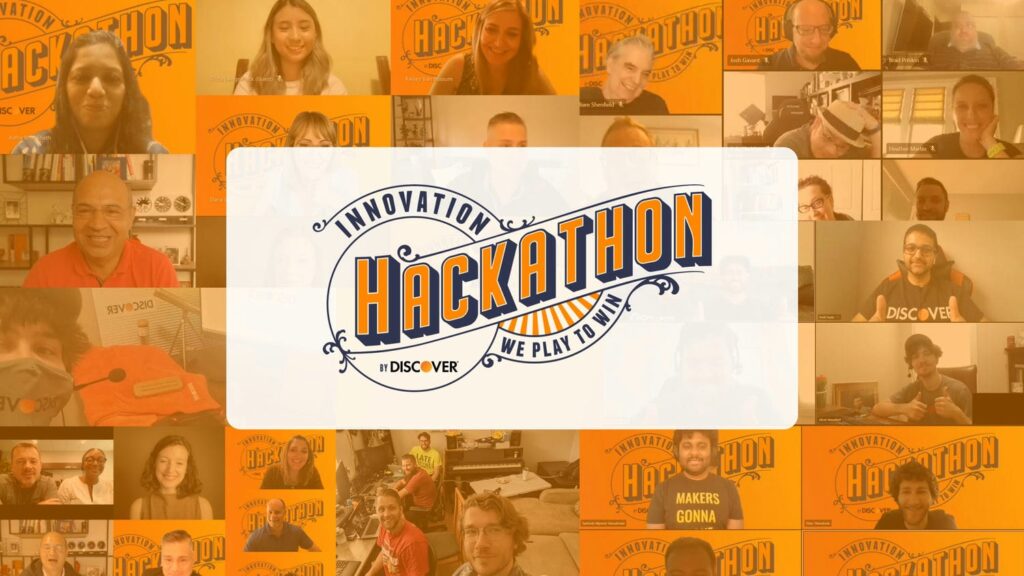
- The event brought together 614 employees from 35 states and 196 cities, collaborating across six tracks that included Open API, Banking, and Payments.
- Participants submitted more than 90 projects and filed one patent through the program’s workshop, with solutions addressing real financial challenges.
- It built a stronger internal community, with 65% of participants working alongside colleagues they had not met before.
How AngelHack Can Help
The difference between a hackathon that ships and one that fizzles comes down to program design. The ones that work are scoped into real challenge tracks, staffed with mentors, run to a tight deadline, and built backward from a decision so winning ideas have a clear path forward.
That structure is the hard part, and it is what AngelHack’s Internal Hackathon Service brings, alongside the expertise to run it. We plug in wherever you need us:
- Strategy and design. We define the objectives with you, then design the tracks, timeline, rules, and judging criteria around the decision you need to make.
- Comms and promotion. Internal campaigns, sign-up drives, branding, and registration sites that motivate employees and drive participation across teams and regions.
- Operations and platform. For in-person format: On-site facilitation, participant and submission management. For virtual and hybrid formats: end-to-end hackathon management on our StackUp platform.
- Expert network. Access to our global network of mentors, judges, and industry experts who guide teams and raise the quality of what they build.
Run Your Internal Hackathon with AngelHack
We have run hackathons and developer programs for UBS, Discover, and 200+ other organizations, with 15 years of delivery across 100+ cities. Tell us the change you want to see in your organization, we will design and run the right internal hackathon that gets you there fast in a few weeks.
TALK TO USFAQs
Why are more companies running internal hackathons right now?
AI is forcing fast changes to how work gets done. An internal hackathon is a low-risk way to test what works, upskill employees, and turn pressure into working prototypes in days.
How do internal hackathons help with AI adoption across teams?
They move AI from slideware to practice. Teams build and pilot real use cases against their own workflows, so adoption is driven by working prototypes and the people who built them.
Which teams and industries use internal hackathons, beyond engineering?
Product, data, operations, and people teams all run them, across multiple industries: technology, aviation, finance, manufacturing, and more. The common thread is cross-functional teams solving a real business problem on a deadline.
Do internal hackathons produce usable outcomes, or just prototypes?
Both, when there is a pathway. Define funding, ownership, or a pilot before launch, and winning builds reach production instead of stalling after the event.
How long should an internal hackathon run?
Most run from 24 to 48 hours. That is long enough to produce working prototypes and short enough to keep teams focused and the energy high.