Your next breakthrough is probably sitting three desks away, buried under someone’s actual job. Internal hackathons are how you dig it out. Give your people a weekend, a real problem, and permission to build, and a few of those prototypes will be worth funding.
An internal hackathon is a time-boxed event where employees form cross-functional teams and build solutions to real business problems. It’s employee-facing and ends in working prototypes, not a public competition. Below: six business problems these programs solve, how to run one that turns ideas into working prototypes, and proof it works.
The business challenges internal hackathons solve
Internal hackathons earn their keep when they fix things your normal operating rhythm can’t. Here are the six that come up the most.
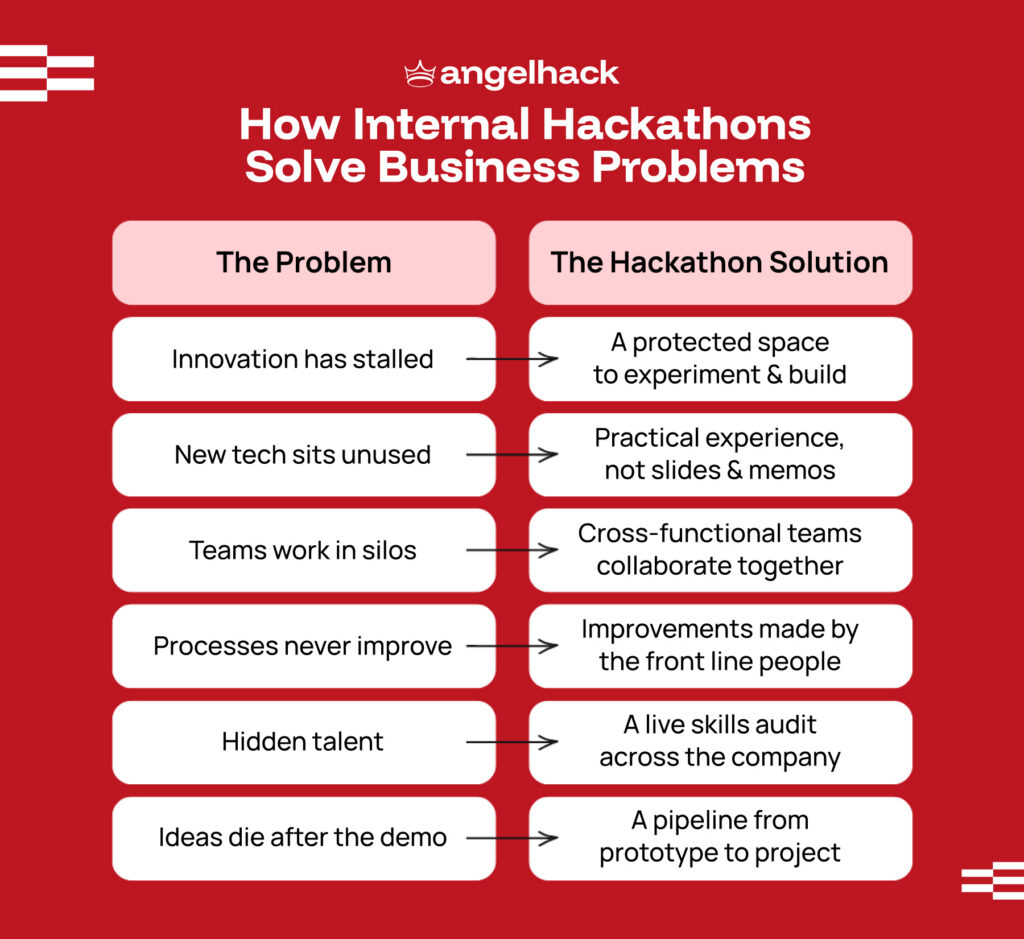
Slowdown in innovation
Everyone’s heads-down on delivery, so experimentation never makes the calendar. The roadmap fills with safe, incremental work while the bold ideas quietly die in someone’s notes app. An internal hackathon carves out a protected window where cross-functional teams chase one real problem with no sprint breathing down their neck. Innovation stops being a value on the wall and starts producing working prototypes.
New tech adoption stalls in slide decks
Leadership buys a shiny new platform, sends the launch email, and waits. Months later you’re still paying for tools nobody uses while teams stay on whatever they already know. A themed internal hackathon turns adoption into a sport. People have to build something real with the new tech in 48 hours, so they learn it the only way that sticks, by using it.
Lack of cross-functional collaboration
Your departments are polite strangers until a project forces them together. By then every cross-team effort opens with weeks of translation, turf, and “who owns this” before any real work happens. Internal hackathons put engineering, product, and domain experts on one team for the weekend, working toward a shared win. The relationships they build outlast the event, so the next big project doesn’t start from zero.
Little to no performance improvement
The people who feel a broken process every day rarely get to fix it. So the same friction tax gets paid over and over, and nobody’s measuring it. Internal hackathons hand that ownership back to the front line. When the people living the problem build the fix, you get process improvements that are realistic, adopted, and measurable, not a consultant’s slide deck.
You can’t see the talent you already have
Performance reviews don’t tell you which analyst can ship a working prototype over a weekend. So you hire externally for skills you already employ while your quiet high-performers stay invisible. A cross-functional hackathon doubles as a live skills audit. You’ll spot builders and problem-solvers in roles the org chart never flagged, then put them on the work that needs them.
Promising ideas stall before they ship
Good ideas die in the gap between “great demo” and “real budget.” You generate genuine enthusiasm and a pile of prototypes, then watch both evaporate by the following Monday. The fix is structure on both ends. A weekend gives you prototypes you can fund or kill on evidence, and a planned post-event pipeline carries the strongest few into real development with an owner and a budget.
How to run an internal hackathon that solves organizational challenges
Running an internal hackathon that turns into real projects, not just a morale bump, comes down to structure.
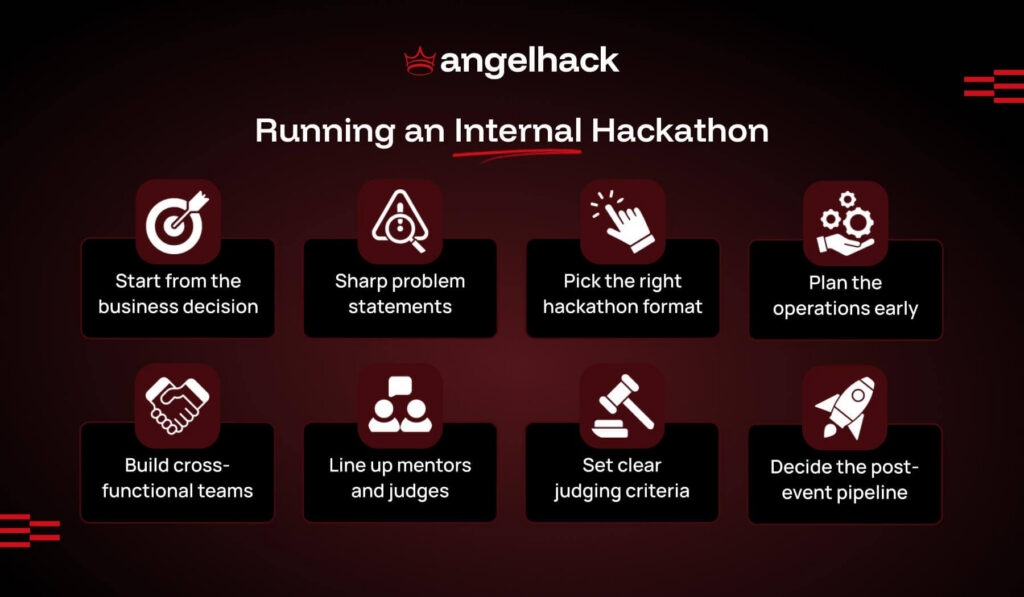
Start from the business decision
Define the outcome you need before anything else: a product bet, a process to fix, a tool to adopt. The theme, problem statements, and judging all flow from that one choice, and it also tells you who to invite and how to measure success afterward.
Write sharp problem statements
Keep them open enough for creativity and specific enough that teams know what a strong answer looks like. “Innovate with AI” gets you forty vague demos, while “cut our customer onboarding from five days to one” gives teams a real target. Tie each statement to a real internal pain point someone can name, and state the constraint that makes it hard.
Pick the format for your workforce
Format decides who can actually take part, so choose it for your people.
- Virtual suits distributed teams at the lowest cost
- In-person enables ideation and collaboration more effectively
- Hybrid balances both, at a higher operational load
Match duration to your goal: one day for focused fixes, two to three for working prototypes.
Plan the operations early
Sort the logistics well ahead of time so the day runs smoothly:
- Schedule, sign-ups, and team check-in
- Venue or virtual platform, wifi, and power
- Tools and access: repos, accounts, API keys, and any datasets
- Updates, support channel, and who answers questions during the build
- Submission process and judging setup
- Prizes, food, and a simple run-down of the day
Decide who owns each piece, and do a dry run of the tech before the event. Good planning here is easy to miss, but it keeps the day from going sideways.
Build cross-functional teams on purpose
A team of five engineers builds five versions of the same idea. Mix the people who see the problem differently:
- Engineering and product
- Design
- Domain experts who live the problem
Line up mentors and judges early
Mentors keep teams unblocked during the build, so pick people who can answer technical and business questions on the spot. Judges should include the leaders who can actually fund what wins.
Set evaluation criteria before registration opens
Decide what a winning project looks like, then publish the rubric so teams can build toward it. Score on the outcome that matters, business impact and feasibility, not demo polish. Clear criteria also keep judging fair and the results defensible.
Plan the post-event pipeline first
efore the event, decide who owns the winning projects, what budget they get, and how progress gets tracked. A prototype with a named owner and a next meeting becomes a real project.
Want the full playbook? Our 📕 comprehensive guide on how to organize a hackathon walks through every step. Skip the pipeline planning and even your best prototype stalls by Monday.
Success story: how Discover got 600+ employees innovating together
Discover put this to the test at company scale. The financial services firm wanted to break down departmental silos and get its people building together, so they ran the Discover Innovation Hack, an internal hackathon open to all departments across the business.
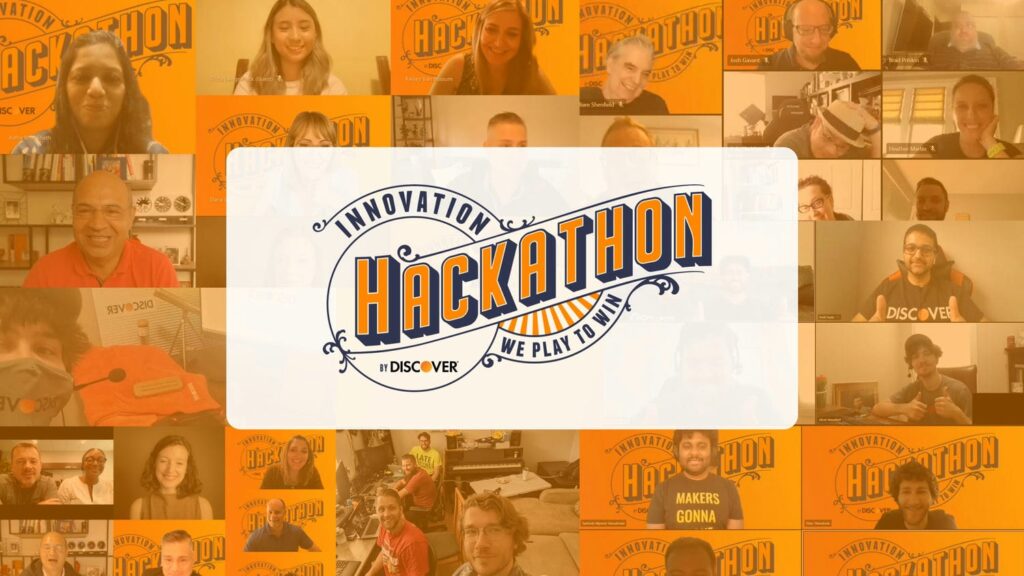
The 52-hour event pulled 600+ employees from 35 states and 196 cities into cross-functional teams, working through six challenge statements from Open API to payments. Mentors ran office hours, and a patent workshop ran alongside the build.
The results speak for themselves: Teams submitted 90+ projects, one strong enough to file as a patent. More importantly, over 65% of participants worked with colleagues they had never met, so the silos Discover set out to break came down in a single weekend. The company left with a backlog of working prototypes and a workforce that knew each other, having proven its best ideas were already in-house.
AngelHack: the internal hackathon partner enterprises trust
Most companies don’t struggle with internal hackathons for lack of ideas. They struggle because the program design, operations, judging, and follow-through land on top of everyone’s day job. That’s the gap we fill.
AngelHack works as a partner, not a vendor. Run the whole program with us, or hand off the one piece your team lacks the time or expertise for, from theme design and operations to judging and the post-event pipeline. We’ve done it end-to-end for Microsoft, Databricks, NASA, P&G, and UBS, across 450+ hackathons and 200+ organizations in 15+ years.
Conclusion
Internal hackathons reward structure. Without it, the company gets one good weekend and a folder of prototypes nobody opens again. With it, the talent already on payroll becomes a working pipeline the business can act on.
The companies that get results treat the program as a tool for one specific decision, then build backwards from it. That’s where the right partner earns its keep.
Tell AngelHack the outcome you need, and we’ll design the internal hackathon that gets the company there.
Plan to Organize an Internal Hackathon
That Innovate Your Business?
AngelHack has run 500+ hackathons globally, designs programs backwards from a specific business decision to every program we run. Tell us the outcome you need. We’ll design the program that gets you there.
Schedule Your CallFAQ
What problems do internal hackathons solve that regular meetings or workshops can’t?
Meetings discuss problems. Internal hackathons build solutions to them. In a time-boxed program, cross-functional teams produce working prototypes, surface hidden talent, and validate ideas in a weekend. Workshops rarely leave the room with something the business can fund or ship.
How long should an internal hackathon run?
It depends on the goal. One day suits focused process fixes. Two to three days give teams enough room to build working prototypes. Longer formats add a learning phase before the build. Match the duration to the outcome you need.
How do you measure ROI on an internal hackathon?
Define the metric before the event. Common measures include prototypes funded, processes improved, time-to-validation, and engagement scores. The clearest signal is how many ideas move into real development after the weekend ends.
Internal vs public hackathon, which fits our goal?
Internal hackathons solve company-specific problems and develop your own people. Public hackathons attract outside builders and grow external reach. Choose internal when the goal is cross-functional collaboration and innovation using existing resource, or when security and confidentiality is a big concern.