
Developer relations was built on a simple premise: earn developer trust, drive product adoption. That premise still holds. What’s changed is everything around it.
According to Stack Overflow, 51% of professional developers now use AI tools every single day. They’re not Googling your product or lurking in your Discord. They’re asking ChatGPT, and they’re getting an answer in seconds. The channels DevRel teams spent years building presence in are becoming less relevant by the quarter, and executives are asking harder questions about what any of it is actually worth.
The problems haven’t changed. Product adoption, community growth, pipeline. The approaches need a complete rethink.
How DevRel Has Changed in 2026
Three structural shifts have happened simultaneously, and most DevRel programs have only fully absorbed one of them.
Discovery has moved to AI
Developers now start product research on ChatGPT, Claude, and Perplexity, not Google. LLM visibility, also called Generative Engine Optimization (GEO), measures how often your brand appears in AI-generated responses for relevant queries. One team restructured their content for AI discoverability and saw 65% more brand appearances in LLM responses within two months (Stateshift). Traditional SEO still matters. It just no longer determines whether developers find you at the moment of evaluation.
What surfaces well in LLMs: explicit FAQs, direct problem-solution framing, and specific implementation examples. Documentation is also now training data for Cursor, Copilot, and Claude. Gaps in your docs don’t just frustrate developers anymore. They create gaps in AI-assisted adoption before a human ever enters the picture.
The DevRel role is being restructured
Writing tutorials, giving conference talks, moderating a Discord server. These activities are being commoditized or automated faster than most teams want to admit. What remains is higher-trust work: community strategy, developer empathy research, and translating raw feedback into product decisions that actually get acted on.
The most important reframe is about who your primary audience actually is. In 2026, the LLM is your first-touch user. It consumes your documentation and APIs before a human developer ever does. This changes three things:
- API design is now a DevRel problem. If your architecture is convoluted, an AI agent won’t just fail to write a script. It will fail to connect your tool to the user’s goal entirely.
- Prompts are the new support tickets. 65% of developers say their AI coding assistant misses relevant context during code review and refactoring (Qodo, 2025). That missing context comes directly from gaps in your documentation.
- Agent skills are the new demos. DevRel teams must prototype the context, system instructions, and workflows an AI coding assistant needs to use your product effectively.
Measurement expectations have shifted
Executives are no longer satisfied with blog views, conference attendance, and social impressions. When content can be generated cheaply and at scale, the pressure to prove that human-led developer relations moves business metrics becomes intense. Teams that can’t draw a line from their programs to activation, retention, or revenue are getting cut or quietly folded into content marketing.

The Developer Journey Doesn’t End at Signup
The developer lifecycle runs from discovery through onboarding, first success, scale, and advocacy. Most programs over-invest in awareness and underinvest in every stage after it. That’s where retention is won or lost.
📍 Stage 1 – Discover
Developers form their first impression of your product through AI-generated responses, peer recommendations, and community mentions, often before they’ve searched for you directly. Being visible and credible in those channels is where the relationship starts.
- Key channels: ChatGPT, Claude, Perplexity, Google Search, developer blogs, peer referrals
- Key touchpoints: LLM-optimized content, SEO blog posts, community mentions, developer newsletters
📍 Stage 2 – Evaluate
Developers who find your product assess whether it actually fits their use case by looking for honest, specific answers: does this solve my problem, what are the tradeoffs, and is this team worth trusting. The content that answers those questions directly, without a sales call in the way, is what converts.
- Key channels: product documentation, developer review platforms, community forums, technical blog posts
- Key touchpoints: honest competitive comparisons, specific implementation examples, pricing and limits page, developer testimonials
📍 Stage 3 – Onboarding
Developers who decide to try your product need to reach a working outcome before they lose momentum. Every unnecessary step between signup and first meaningful action is a drop-off risk.
- Key channels: product documentation, in-app contextual help, email sequences, Discord and Slack
- Key touchpoints: quickstart guides, in-app prompts, post-signup email sequence, live support and office hours
📍 Stage 4 – First success
Developers at this stage are trying to deploy something that works in their actual environment, not just a tutorial sandbox. That activation moment needs to be defined clearly, designed for, and tracked as the primary conversion metric.
- Key channels: technical documentation, office hours, community forums, video walkthroughs
- Key touchpoints: reference architecture guides, async support channels, first-success story content, live demos
📍 Stage 5 – Scale
Developers who reach production usage start making the case for your product internally, and the decision moves from individual to team or organizational adoption. Getting there requires content written for the people who control that decision: technical leads and engineering managers.
- Key channels: engineering blog, conferences and developer events, case studies, account-based outreach
- Key touchpoints: technical case studies, conference talks, documentation for technical leads, enterprise onboarding guides
📍 Stage 6 – Advocacy
Developers who are active and genuinely invested in your product want to contribute and build credibility in their community. The programs that make that easy are the ones that compound over time and bring others in.
- Key channels: GitHub and open source communities, developer conferences, social media, ambassador programs
- Key touchpoints: contribution pathways, community rewards and tenure recognition, advocate story content, referral programs
Four Strategies That Actually Adapt to What’s Changed
🎯 Make Your Positioning Stick
When a developer asks ChatGPT to recommend a tool, the answer is two sentences long, and what goes into those two sentences isn’t your feature list. It’s whatever your product most clearly stands for – and teams that haven’t defined that with precision are invisible at exactly the moment it matters most.
GitHub wins because its identity is clear enough that any developer, as well as any AI summarizing tools can place it immediately. Strong positioning is built on four components:
- A creation story that resonates with developers’ own journey
- A clear creed: the principles the product stands for
- Defined opposition to an outdated approach or alternative
- Terminology that signals community membership to the right builders
🎯 Write for Both AI and Humans
Developers asking ChatGPT “what’s the best tool for X” get answers synthesized from your content. If that content isn’t structured for AI parsing, you’re invisible at the most critical moment of evaluation. The restructure is straightforward:
- Lead with explicit FAQs that answer real developer questions directly rather than burying answers in narrative prose
- Use direct problem-solution framing with specific implementation examples that an LLM can accurately represent
- Shift the documentation goal from explaining the tool to enabling the use case: architectural best practices, system design, and how to combine your product with other tools to hit a specific business outcome
- Tell the stories of builders who achieved real outcomes with your product, not just technical showcases
🎯 Connect Programs to Business Metrics
When content can be generated cheaply and at scale, the pressure to prove that human-led developer relations moves business metrics becomes intense. Teams still reporting blog views, conference attendance, and social impressions are handing leadership exactly the evidence they need to question the budget.
The shift requires discipline across the entire measurement framework:
- Track active users, not signups
- Measure watch time, not video views
- Report revenue contribution, not customer count
- Build a three-layer framework covering activity metrics, impact on developer behavior, and business outcomes, and report all three, every time
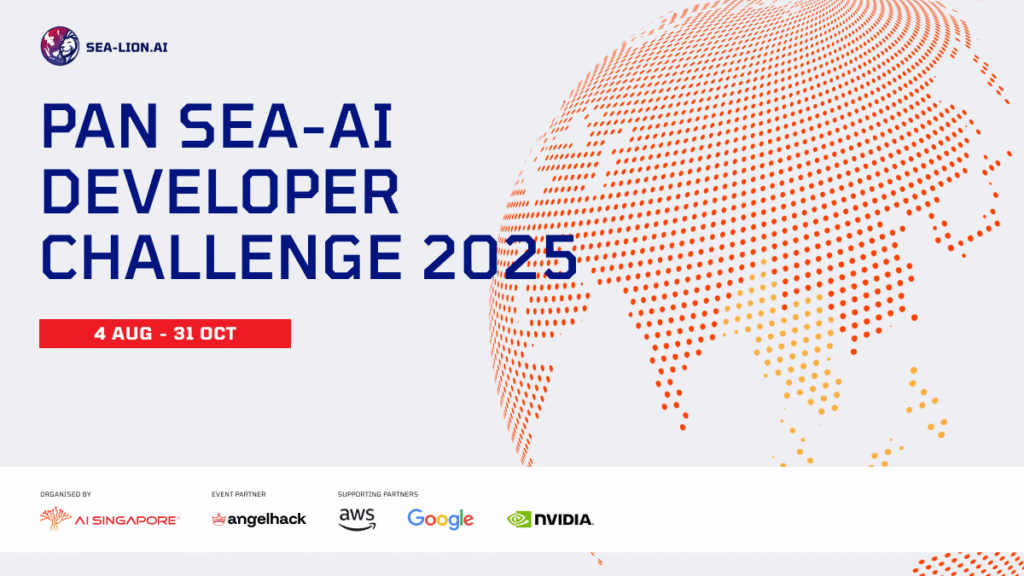
For example, the PAN SEA-Lion Developer Challenge by AI Singapore structured the program as a funnel: 796 registrations became 236 Round 1 submissions, then 40 finalists pitching at SWITCH. Each stage was a distinct conversion metric. The program ended with a pipeline of developers who had actually shipped something with SEA-Lion, not just signed up to learn about it. Structure your programs like a funnel, not an event.
🎯 Make Developers Feel Like Insiders, Not Attendees
AI has made a lot of what used to feel special about being a developer feel ordinary. Building something that works used to take weeks. Now it takes an afternoon. The prestige is harder to find, and developers notice. What hasn’t changed is that they still want to belong to something worth belonging to, and programs that deliver that are pulling ahead of the ones that don’t.
Two things hold up in this environment better than most DevRel tactics:
In-person events with a real purpose. Developers won’t show up for a virtual workshop when ChatGPT gives them the same information faster. They will show up for experiences that require human presence to work:
- Product feedback sessions where developers test and critique live builds
- Workshops built around using AI to build with your product
- Community gatherings where the value comes from the room, not the content
Exclusive programs that create real career signals. In a market crowded with AI-generated portfolios, developers are looking for credentials that can’t be faked. Invite-only programs, accelerators, and incubators deliver something an algorithm can’t:
- Invite-only programs with clear criteria and genuine exclusivity
- Incubators that connect developers to mentorship and investor visibility
- Cohort-based programs that build lasting community, not just a one-off credential
For instance, the Aptos Horizon Accelerator, run by AngelHack in partnership with Aptos Foundation, brought 10 startups from 6 countries to Osaka for an 8-week immersive program. With mentors from LayerZero and GSR, a team excursion to the Osaka World Expo, and a Demo Day that drew 60+ VCs and public sector leaders, the program gave participants something no virtual program could: sustained, in-person access to the people and resources that actually move careers forward.
Download The Developer Journey Map
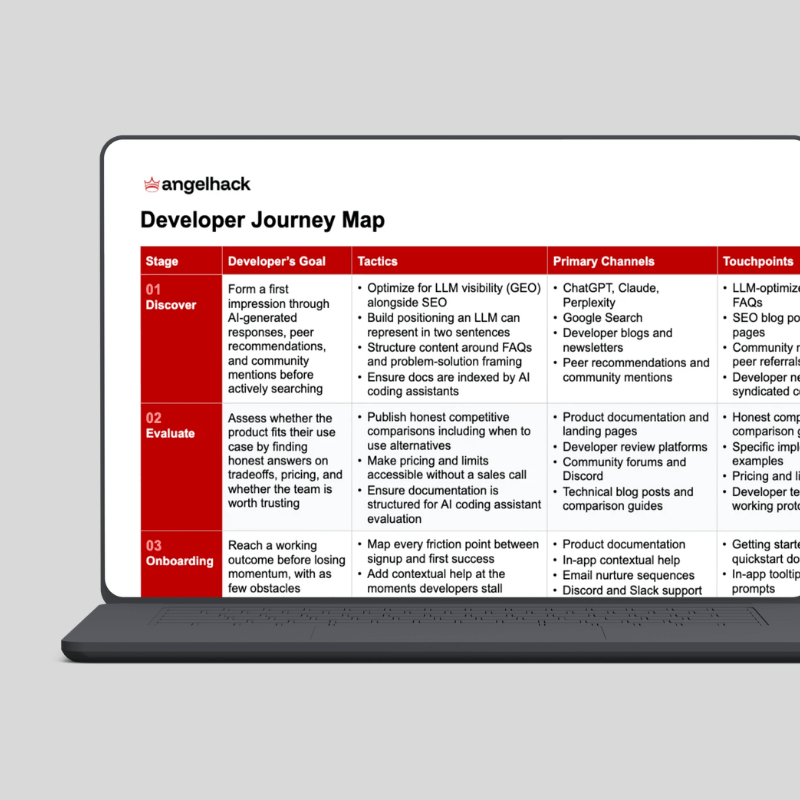
Getting a developer to sign up is the easy part. This two-page map covers what comes after: all five stages from discovery through advocacy, with:
- The tactics that move developers forward at each stage
- The primary channels where DevRel activity happens
- The touchpoints that turn channel presence into developer action
- The metric that proves it worked, tied directly to a business outcome
Use it to audit where your current program has gaps, align your team on what DevRel owns at each stage, and identify exactly where you’re leaving developer retention to chance.
The 2023 Playbook Won’t Survive 2026
Developer relations is evolving faster than most teams are moving, and the gap between programs built for how developers actually behave in 2026 and programs still running on pre-AI assumptions is widening every quarter.
Developers still distrust hype. They still reward authenticity. They still become your best advocates when you earn their trust through programs that deliver real outcomes, not just activity. The teams building those programs treat developer engagement as a cross-functional growth function with shared wins across product, marketing, and sales.
Design a DevRel Program That Drives Real Adoption
AngelHack have designed and run developer relations programs for 200+ organizations across Web2 and Web3, including Microsoft, AWS, Databricks, and Circle. If you’re rethinking your DevRel approach for 2026, tell us the outcomes you need. We’ll design the end-to-end program that gets you there.
Talk to Us