Your best early-career hires rarely look their best on paper, because strong resumes often turn into average performers while the builders you actually want never finish your application form. Young talent recruitment has a visibility problem, and a well-run hackathon fixes it.
A hiring hackathon is a time-boxed challenge where participants solve a real business or technical problem while you watch them work, which shows you the skill that resumes and interviews routinely miss, and it does so faster and cheaper than the traditional funnel. This guide covers the business case, why young talent shows up, how to design and promote the event, and how to turn participation into hires.
Why Hackathons Beat Traditional Young Talent Recruitment
The case for a hiring hackathon starts with two numbers every hiring manager tracks: cost per hire and time to fill.
The economics of cost per hire and time to hire
Traditional hiring is slow and expensive, as SHRM’s 2025 data puts the average cost-per-hire at $5,475 for non-executive roles, with a median time-to-fill of about 44 days. A single hackathon assesses dozens of candidates against that baseline in one weekend, because you source, screen, and run first-round assessment inside the same event. Hire more than one person from it and the cost per hire keeps dropping, while the open vacancy stops costing you output.
Skills a resume can’t show
Resumes report experience, but they don’t show how someone works under pressure. A hackathon puts those signals on display, because you watch each candidate build inside a time-boxed challenge. The skills worth scoring are the ones a CV never proves:
- Problem-solving. How they break down an ambiguous brief instead of freezing.
- Initiative. Whether they start building or wait to be told what to do.
- Collaboration. How they split work in a cross-functional team and handle disagreement.
- Communication. How clearly they explain their approach and demo what they built.
- Execution under pressure. Whether they ship a working prototype by the deadline.
- Response to feedback. Whether they adjust when a judge pushes back, or defend a weak idea.
You also reach the hard-to-fill profiles in AI, data, and Web3 that standard sourcing misses. Structured judging keeps these scores comparable and takes pedigree out of the decision, so you get a hiring signal you can defend rather than a gut feel from a 45-minute call. None of this matters if the right people never show up.
Why Young Talent Actually Shows Up
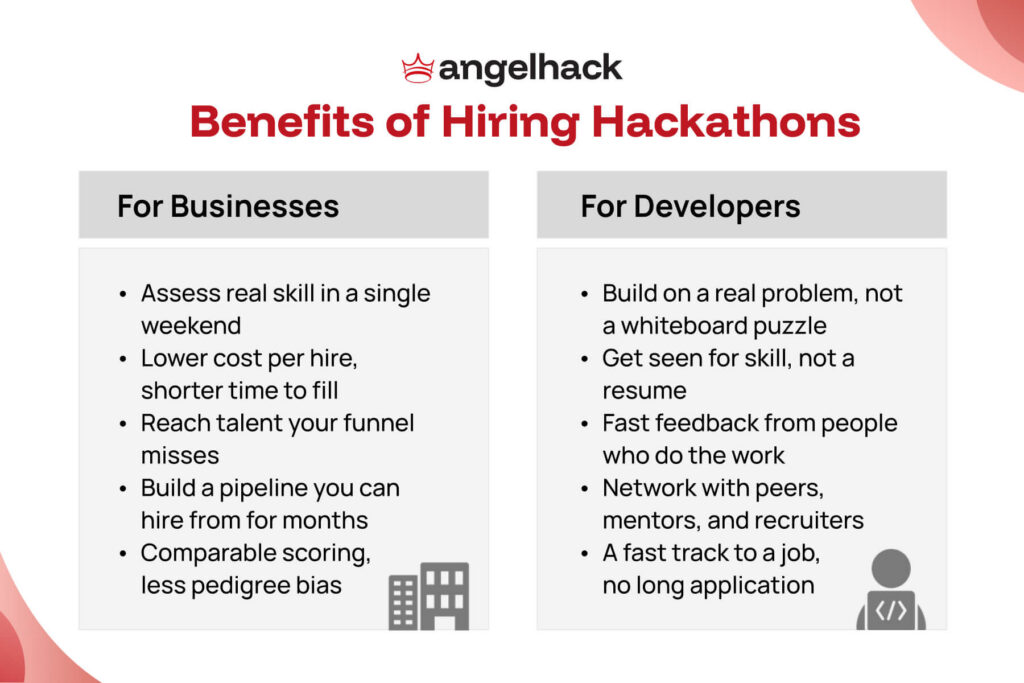
Young builders are worn out by long, impersonal hiring funnels. A hackathon that puts a real problem in front of them and a fast track to a job at the end is far more exciting than a weeks-long application process. The promise of quick hiring is the hook, and the work itself is what makes them stay.
Once that promise gets them in the door, a few specifics keep them engaged:
- A real problem with visible output, rather than a take-home test that nobody reads.
- Fast feedback from the people who do the actual work.
- A low-pressure way in, with no long application to grind through.
- A genuine chance to network with peers, mentors, and recruiters, where strong work can lead straight to an interview.
Coders aren’t the only ones who belong here, because a good hiring hackathon makes room for product, design, data, and marketing talent, which widens the pool of young people you can assess. It pulls in self-taught builders, career-switchers, and graduates your recruiters rarely reach, which is exactly where your next hire tends to hide. These are the candidates a keyword scan filters out before a human reads them, so a weekend of real work simply puts them in front of you instead.
How to Design and Promote a Hackathon for Young Talent Recruitment
Designing a hiring hackathon comes down to three moves: pick the right format, build a challenge that surfaces talent, and promote the event to the people you want to reach.
Pick the format
Start with format, because it sets the ceiling on who can take part.
- Virtual events reach the widest pool at the lowest cost.
- In-person events give you a deeper, face-to-face read on candidates.
- Hybrid gives you both, though it carries a higher operational load.
Run it externally to source new talent or internally to surface builders you already employ. For the logistics, this guide to running a hackathon end to end covers the operational side.
Design challenges that surface talent
Your challenge is your assessment, so design it to pressure-test the skills you’re hiring for, not to manufacture a flashy demo. Vague briefs produce vague signals. The strongest hiring hackathons use a few proven challenge types:
- A live coding or algorithmic problem that tests fundamentals under time pressure.
- A real business-problem brief drawn from work your team actually does.
- A build-from-scratch project that shows how someone scopes and ships.
- A debugging or code-review task that shows how they read and fix existing code.
- A product or design sprint for non-technical roles.
Once you’ve chosen the type, the setup is what turns a challenge into a fair assessment:
- Match the challenge to the role you’re hiring for, so performance maps to fit.
- Publish judging criteria tied to those skills before the event.
- Set difficulty high enough to separate strong candidates, low enough that beginners stay in.
- Lock the rules, team size, and timeline ahead of launch.
If you need a starting point, this article on 12 hackathon themes can spark the brief.
Promote it to the right people
A great challenge fails if the right people never hear about it, so reach young talent where they already gather:
- University programs and student societies.
- Developer and early-career communities, both online and local.
- Social channels your target candidates actually use.
Recent graduates and current employees make the most credible promoters, and your pitch should lead with what young talent wants: real problems, visible work, and a fast-track to a role. Make signing up effortless with a mobile-friendly page, a short form, and fast confirmation, because every extra field costs you sign-ups. Sign-ups are not hires, and the work that turns a participant into an offer happens post-event.
How to Turn Hackathon Participants Into Hires
Convert participation into pipeline
Decide where strong participants go before the event even starts, because this is where most programs quietly leave value on the table. Map the paths first, whether that means an interview track, an internship, a graduate role, or a project-based trial, and then sort everyone you met into clear groups:
- Top performers who are ready for an offer conversation.
- High-potential builders worth a second look.
- Future pipeline to re-engage when a role opens up.
Winners are not your only prospects. Strong individuals also show up on teams that don’t place, so score people, not just projects. Flag standout builders during the event and follow up directly afterwards to show that you are serious about hiring them.
The energy from the weekend fades quickly and a slow reply wastes it, whereas a strong candidate experience now is what makes a builder say yes later. Even the people you don’t hire become advocates when they feel respected, so keep every engaged participant in a database you can return to post-event, and that list becomes a standing pipeline you can hire from long after the event wraps.
Avoid the mistakes that cost you hires
Most failed hiring hackathons share the same avoidable mistakes, and each has a straightforward fix:
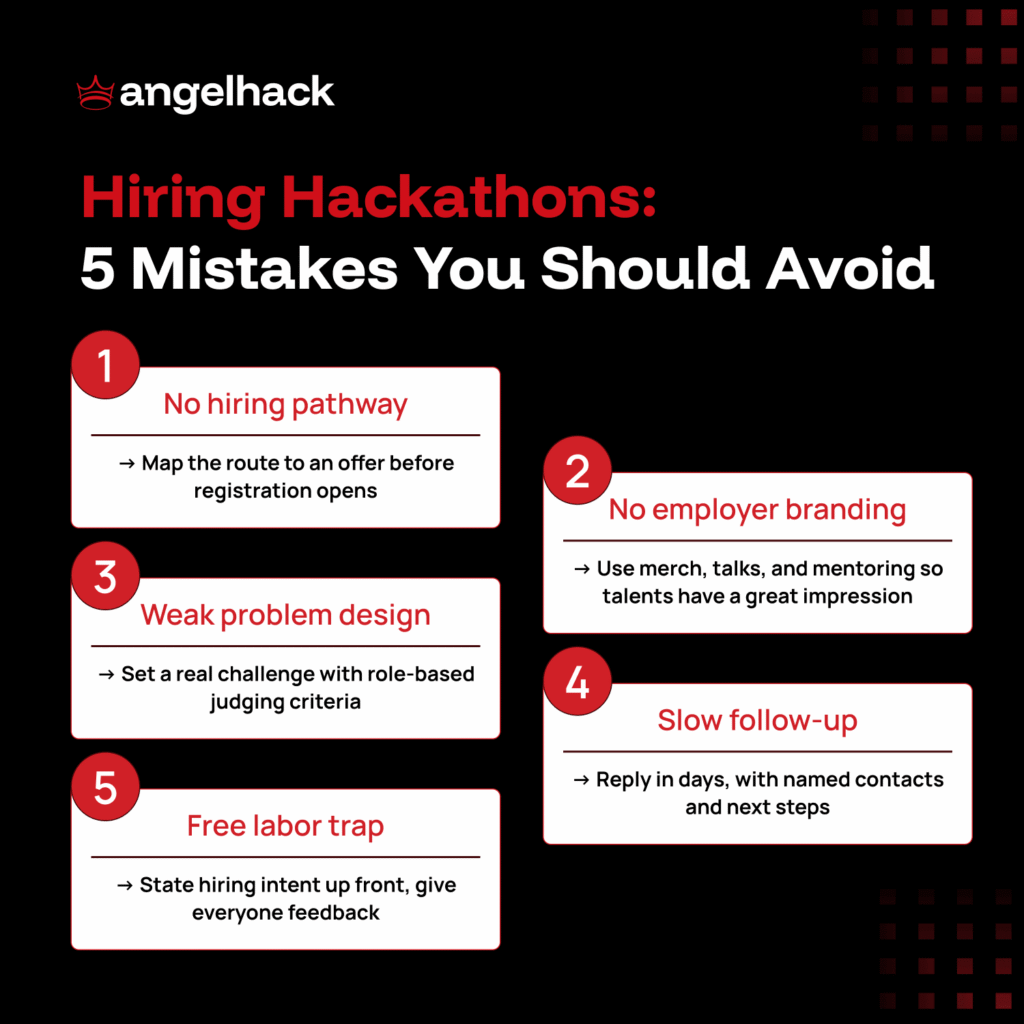
- No hiring pathway. Without a clear route from the event to an offer, you have run a contest, not a recruitment program. Map the path to interviews and offers before you open registration, and tell participants it exists.
- Skipping the employer-branding elements. Merch, an executive talk, mentoring sessions, and professional communication with every participant build the employer brand and candidate experience that make young talents have an overall positive experience with your brand.
- Weak problem design. A vague or trivial challenge frustrates the exact people you want and tells you nothing useful. Build the brief around a real problem and publish judging criteria tied to the skills you’re hiring for.
- Slow follow-up. Waiting weeks lets your best prospects accept another offer or go quiet. Follow up within days, with named contacts and concrete next steps.
- Treating talent as free labor. Mining ideas with no intent to hire breaks trust, and young builders pass that experience around fast. Make the hiring intent clear up front, and give every participant feedback or a next step.
Run Your First Hiring Hackathon
Young talent recruitment works best when you stop guessing from resumes and start watching people build, which is exactly what a well-run hiring hackathon lets you do. It attracts young talent, assesses real skill across a single weekend, and leaves you with a pipeline you can hire from for months, giving you a wider field and a clearer hiring signal than any job ad delivers.
This is the work we do at AngelHack. Over 15 years we have run more than 450 hackathons across 100-plus cities, connecting clients with a global community of 500,000-plus builders, and we have designed programs end-to-end for organizations like Microsoft, AWS, NASA and more, from the challenge brief through judging to post-event follow-up. Book a 30-minute call with our team. You’ll leave with a clear plan for your first hiring hackathon and the outcomes to measure it against.
Start Hiring Through Hackathons
Reach 500k+ developers through a partner with 15+ years and 450+ events of proven experience. Book a consultation and we’ll map your goals, close the gaps, and build the structure that gets you there.
Schedule Your CallYoung Talent Recruitment FAQs
Hackathon vs. traditional recruitment event?
A traditional recruitment event collects resumes and runs interviews, whereas a hiring hackathon has candidates solve a real problem while you watch, so you assess real skill rather than self-reported claims.
Which roles fit hackathon recruiting best?
Roles where output is demonstrable, such as software, data, product, design, and marketing. Any role you can turn into a short, judged challenge fits hackathon-based young talent recruitment.
How do you measure hiring impact in hackathons?
Track conversion rather than attendance, measuring participants who reach an interview, offers made, hires closed, and cost per hire against your usual funnel. Add 90-day performance to confirm quality.
What should you offer as hackathon prizes or incentives?
Lead with access rather than cash, because a fast-track to interviews, a real project, and time with your team matter more to early-career builders than a big prize.