The challenge is the single most important decision in an AI hackathon. It’s the brief that tells teams what to build and why, and it sets the ceiling on everything that follows: submission quality, how you judge them, and whether the winning prototype goes anywhere afterward. Most guides on how to organize a hackathon treat it lightly, pointing you to a broad theme like “build with GenAI.” That’s where many programs lose their way.
What an AI hackathon challenge actually is
Theme, track, and challenge statements are often used interchangeably. In reality, they describe three different things, so separating them is where scoping actually begins.
Theme · the umbrella subject
For an AI hackathon, that might be generative AI for industry use cases.
Track · a lane within the theme
Healthcare, finance, and retail can each form a track, which lets teams choose the area where they have the most context.
Challenge · the specific problem
One problem, one team, time-boxed. It names the user, the constraints, and what a completed build should do.
The three work together. For instance, suppose the theme is AI for customer support and the track is retail. That gives teams a direction, but not yet a problem to build against. The challenge statement is what turns it into one, and we’ll define it later through the scoping steps.
What makes a good AI hackathon challenge
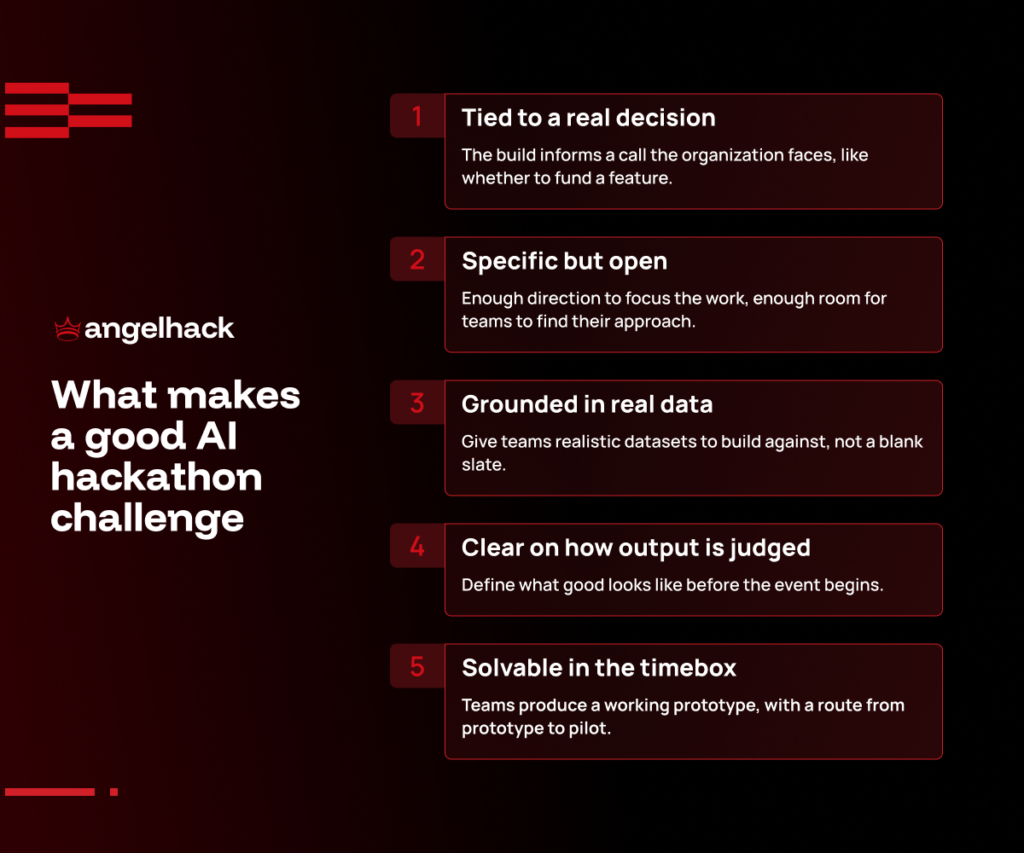
Most well-designed AI hackathon challenges share the same five traits. They are:
Tied to a real decision
The build should inform a decision the organization actually faces, such as whether to fund a feature or adopt a new tool. When the challenge maps to a live decision, the output has somewhere to go.
Specific but open
The brief needs enough direction to focus the work and enough room for teams to find their own approach. Too narrow, and every submission looks the same; too broad, and the results are hard to compare.
Grounded in real data
AI prototypes depend on the data behind them, so give teams realistic datasets to work with rather than a blank slate.
Clear on how output is judged
AI results are inherently variable, so define what good looks like before the event begins. Set the criteria that matter for your case: accuracy, relevance, or business fit.
Solvable in the timebox, with a path forward
Teams should be able to produce a working prototype in the time available, with a defined route from that prototype to a pilot.
The first characteristic matters most. A challenge built around an exciting topic rather than a real decision tends to produce polished demos that stall once the event ends, with nothing reaching the pipeline a month later.
How to scope an AI hackathon challenge backward
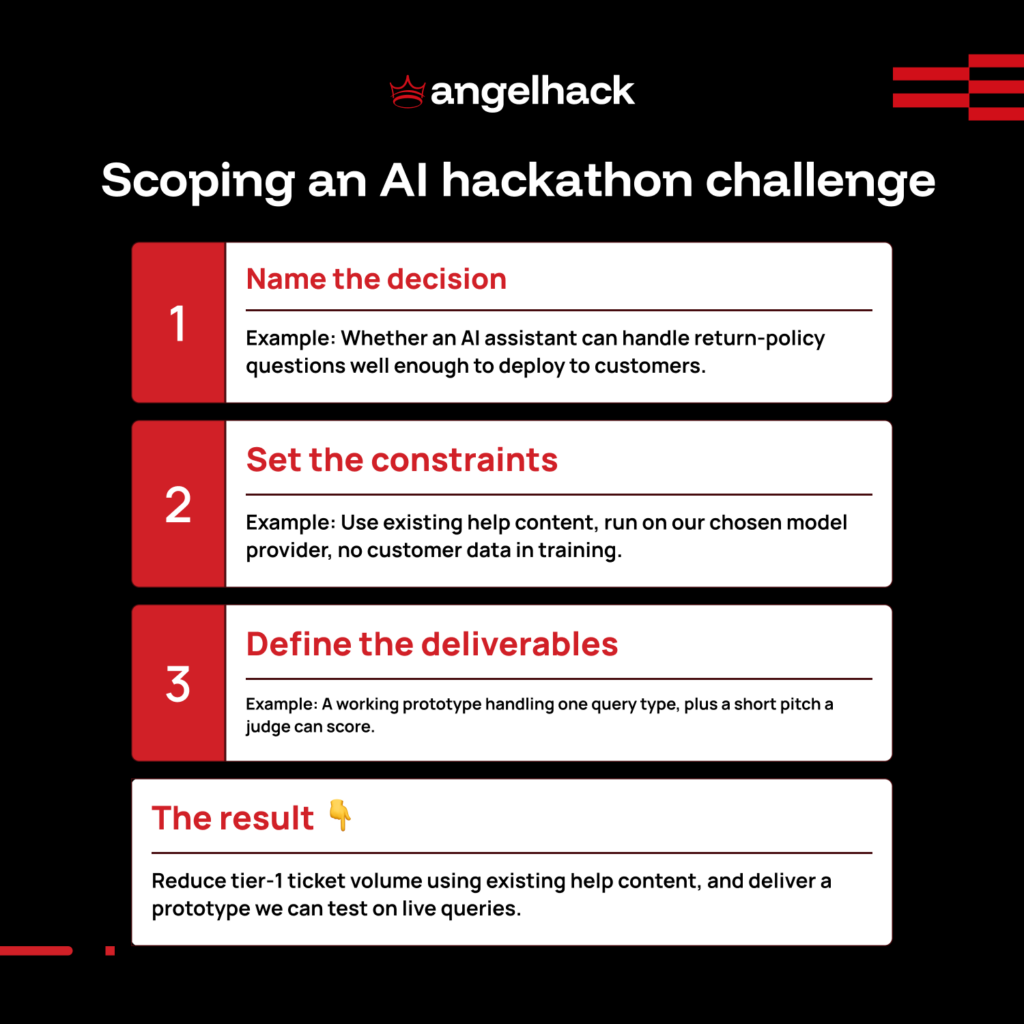
The most reliable way to design a challenge is to start from the end. Decide what the winning prototype should let the organization do, then work backward to write the statement. Three questions guide the process.
Name the decision the build should inform
Start with the business question the event exists to answer, not the technology. The decision is the spine of the brief, so write down what a successful prototype would let the organization decide or act on. If the build does not move a real decision forward, the prototype has nowhere to go once the event ends.
Name the constraints the solution must fit
Set the real boundaries the solution has to work within, since constraints give the work focus rather than limiting it. Cover the data teams can use, the tools or model provider the solution must run on, and anything it has to avoid. Clear boundaries push teams toward something that could realistically ship, instead of a demo that only works on stage.
Name the deliverable a judge can score
Define exactly what teams hand in, in a form a judge can assess consistently and quickly. Specify the working artifact and the supporting pitch, and keep both proportional to the time available. A precise deliverable produces comparable builds; a vague one produces slide decks.
Apply it to the retail support example above
The three questions land like this:
- Decision: whether an AI assistant can answer return-policy questions well enough to deploy.
- Constraints: existing help content only, the organization’s chosen model provider, no customer data in training.
- Deliverable: a working prototype handling one query type, such as refund eligibility, plus a short pitch.
When scoping a brief this way, the contrast is clear. A forward-written challenge says, “Use AI to improve customer service.” The backward-scoped version says, “Reduce tier-1 ticket volume using existing help content, and deliver a prototype we can test on live queries.” The first is a topic. The second is a brief that a cross-functional team can build against from day one.
AI hackathons in practice: Databricks
The Databricks Generative AI World Cup, hosted by AngelHack, illustrates how a scoped brief performs in real life. The challenge is designed as one theme divided into four industry tracks: healthcare and life science, financial services and retail, media and entertainment, and manufacturing and energy. Teams selected the vertical they knew best, which kept the brief specific without constraining their approach.
Two things made the brief work:
- The constraint was explicit: build a working GenAI application that solves a real problem in your industry, using Databricks.
- The data was provided. New teams received test accounts with credits and open datasets, so no one began from a blank slate.
The payoff was in the outcomes. More than 1,500 builders from 18 countries took part, and the winning entries were prototypes tied to real decisions: a biopesticide screening agent that cut processing time and a compliance assistant for building-code checks. Because the decision, constraints and data were all set before registration opened, the output was usable rather than theoretical.
Conclusion
AI keeps changing, but the rule under a good AI hackathon hasn’t. Scope the challenge backward from a decision, and the prototypes have somewhere to go. Without that anchor, even strong builds have nowhere to land afterwards.
We have designed and run AI hackathons for Databricks, IBM, Microsoft, and 200+ other organizations, and the programs that produce outcomes are the ones built from a real business decision. Tell us what you need to decide, and we’ll build the challenge that gets you there. Start the conversation with AngelHack.
Run a High-Impact AI Hackathon with AngelHack
AngelHack has run 500+ hackathons globally, designs programs backwards from a specific business decision, and brings a network of 300,000+ developers to every program we run. Tell us the outcome you need. We’ll design the program that gets you there.
TALK TO USFAQ
What is an AI hackathon challenge?
It is the specific problem teams solve during an AI hackathon. A strong challenge names the user, the data, the constraints, and what a completed build should do, so participants understand exactly what to deliver.
How do you scope an AI hackathon challenge?
Work backward from a decision. Name the business decision the build should inform, set the constraints the solution must fit, and define the deliverable a judge can score. The statement is the result of those three.
How specific should an AI hackathon challenge statement be?
Specific enough to direct teams toward a real decision, and open enough to allow different approaches. Define the problem and the constraints, but avoid prescribing the solution.
Who should write the AI hackathon challenge?
The people who own the decision it informs, typically a product or business lead, working alongside someone technical. The business side defines the outcome; the technical side keeps it buildable within the timebox.