🎯 TL;DR
- What changed in 2026: AI copilots and assistants now recommend the tools developers use, often before anyone visits your site.
- Where to spend: documentation, developer experience, AEO-aligned content, sandboxes, community, and focused high-intent paid.
- Where to stop: generic display, broadcast social, over-gated tutorials, and swag-driven vanity events.
- Where to start: run a documentation and developer experience health check, then rebalance one budget line toward what AI surfaces.
What Developer Marketing Means in 2026
Developer marketing is how you earn adoption for APIs, SDKs, tools, and platforms in a world where AI now sits between developers and their choices. Rather than chasing brand awareness, you are getting your product surfaced, tested, and integrated before a competitor gets there first. Yet, many 2026 budgets still fund the tactics developers walked away from two years ago.
That quiet gap between the plan and the reality is where the money leaks out. This article is written on how to close it, for the marketers and developer relations folks who want to own adoption rather than impressions.
How Developer Marketing Changed in 2026
🔍 Developers now find tools without searching for them. Copilots in the IDE and browser now answer the “which tool should I use” question before a human opens a single tab. They lean on your documentation to make the call. Your writing is doing the selling whether you planned for it or not.
💬 Social changed shape too, as developers drifted into Discord, Slack, Reddit, and niche forums. A thoughtful answer from a peer in a GitHub issue now convinces a developer far more than marketing and promotion.
📋 Evaluation compressed as well, as the developer who once read a nurture sequence over weeks now tests your product in-tool in minutes. That means GitHub stars, sample apps, and visible open-source activity carry more weight than a polished benefit statement ever could.
The fundamentals shifted underneath all of these changes are:
- Documentation is the primary marketing surface. Developers and AI engines both read it first when deciding whether you are worth the effort.
- Developer experience is the message. The quality of your sandbox, onboarding, API ergonomics, and error messaging says more than any campaign running alongside it.
- Time-to-first-successful-API-call is a marketing metric. Product teams already watch it, and marketing should too, because it predicts whether early interest turns into a working prototype.
Miss these and the rest of your strategy has nothing solid to build on.
Where to Spend Your Developer Marketing Budget in 2026
Fund what AI surfaces and what developers actually reach for. Every lever below leads to a measurable outcome rather than a pageview, and the closer a channel sits to a developer getting working code running, the better it works.
Documentation as a product
Invest in architecture, search, versioning, and analytics, and keep it updated as a living asset. ChatGPT, Claude, Perplexity, Google AI Overviews, and the copilots built into GitHub and Cursor all read structured, accurate documentation first and recommend what they can process, which lifts both activation and AI citations.
AEO-aligned content
Write the formats an AI engine can excerpt and hand back as a finished answer. That includes “build X with Y” implementation guides, migration guides, head-to-head comparisons, troubleshooting entries in every language you support, and architecture write-ups showing the product running in production. Each one earns recommendation traffic that generic blog posts rarely capture.
Portals and sandboxes
Ship the API explorers, playgrounds, and starter repos that shorten the road from curiosity to “it works,” which lifts first-call rates and gives evaluation a starting point.
Map the path from first call to production
Connect documentation analytics, product usage, and your CRM so one developer can be followed across five stages: read the docs, sign up, make a first API call, return within 30 days, ship to production. Only when you can see where developers drop off can you focus on fixing that stage.
Community participation
Put your engineers into GitHub issues, Stack Overflow threads, and the Discord servers where your product already comes up, answering real questions including the ones where a competitor is the better answer. Dropping launch links and campaign copy into those same channels reads as advertising and gets ignored. Trust earned by solving problems compounds into referrals no vendor claim can buy.
Developer relations advocacy
Fund the people who create, support, and route feedback back to engineering. Those advocates turn power users into champions who bring their whole teams along.
Targeted paid media
Sponsor developer newsletters and buy the search terms tied to commercial-intent queries like “best X for Y stack.” Lead with documentation, a sandbox link, or a working example. That way your spend meets developers already evaluating, rather than strangers scrolling past a banner.
At a glance:
| Lever | What to fund | What it returns |
|---|---|---|
| Documentation as a product | Architecture, search, versioning, analytics | Higher activation, more AI mentions |
| AEO-aligned content | Implementation, migration, comparison, troubleshooting guides | Recommendation traffic blog posts miss |
| Portals and sandboxes | API explorers, playgrounds, starter repos | Curiosity to “it works” faster |
| Instrument the path to production | Docs analytics, product usage data, CRM | Budget follows the stage that leaks |
| Community participation | Engineers in issues, threads, Discord | Referrals no vendor claim can buy |
| Developer relations advocacy | Advocates who create, support, route feedback | Power users become champions |
| Targeted paid media | Newsletters, commercial-intent search | Spend meets developers mid-evaluation |
💡 Take Hedera’s Hello Future Hackathon Trilogy as an example.
Together with AngelHack, Hedera ran a three-chapter global program with a combined prize pool of $550,000, carrying builders across the full developer pipeline, from a newcomer’s first line of code to a production-ready project. Across the three chapters, it drew more than 2,700 registrations and 662 project submissions. A mapped pipeline drives real adoption, while a headcount only measures attendance.
What to Stop Doing in Developer Marketing
Cut the four line items AI discovery ignores and developers no longer trust.
- Generic display and untargeted brand campaigns. A banner on a general tech site reaches developers who aren’t evaluating anything. No AI assistant has ever recommended a product because it saw an ad. That money works better in a developer newsletter, or against search terms where someone is already comparing options.
- Broadcast social as your primary strategy. A company feed mostly reaches people who already know you. Meanwhile the developer weighing you against a competitor is asking in a Discord server, or on a GitHub issue nobody from your team is watching. Put the effort where the question is being asked.
- Over-gating documentation and tutorials. A form in front of a tutorial stops the developer who wanted to test you in ten minutes. The same form blocks the crawlers that feed AI assistants, so you drop out of the answer completely. Ungate it, and keep the subscription optional.
- Events without follow-up. Badge scans at conferences and expos count how many people walked past a booth, not how many people actually tried out your products afterwards. Put the budget into workshops, hackathons, and accelerator programs instead, where you finish with working prototypes and a shortlist of teams worth funding.
💡 Canton Core Academy shows the alternative in practice.
Canton Network needed to onboard developers using Daml, the new programming language Canton runs on, and that takes longer than one event. Together with Canton, AngelHack built a staged path with a $28,000 prize pool: lessons and rewards to earn fluency, an ideathon across five finance themes to turn fluency into prototypes, then four weeks of mentorship to get those prototypes ready for the Canton ecosystem. 25,861 developers joined, the ideathon produced 45 working prototypes, and multiple teams went on to keep building on the network.
Setting a Developer Marketing Budget
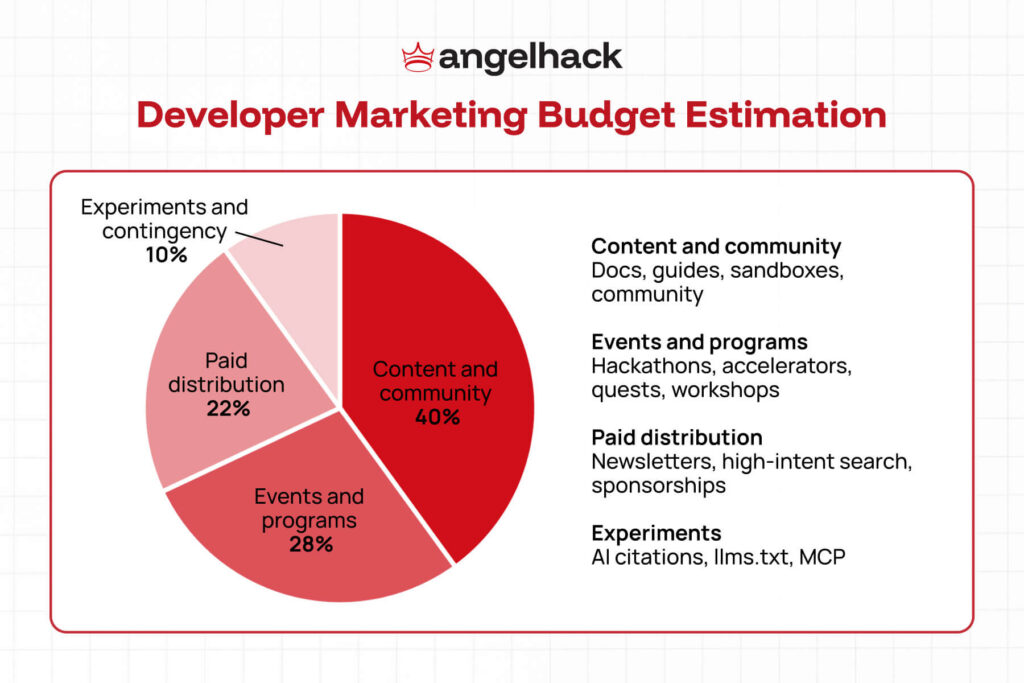
Skip the rigid formula. Weight your spend toward the compounding fundamentals rather than campaigns that spike and fade within a quarter, and keep a portion to test the AI channels that barely existed two years ago. That means getting named in the answers from ChatGPT, Claude and other LLMs, publishing an llms.txt file, and shipping an MCP server so assistants can call your product. A rough starting split:
- 35-40% to content and community (technical content 15-20%, online programs and community 15-20%)
- 20-25% to paid content distribution and sponsorships
- 25-30% to events and programs like hackathons and accelerators
- The remainder 5-10% to experiments, AI-native formats, and contingency
Every quarter you delay is a quarter a competitor spends building the trust you could have – so make the move today. For a complete breakdown, AngelHack’s developer marketing budget guide packages the allocation model, a pre-loaded budget calculator, and a monthly tracking checklist.
Key Metrics to Track in 2026
Signups tend to be misleading for developer tools, since a form fill is a long way from a working integration. Track activated, repeat users instead, because those predict adoption far better than raw registrations.
Review the trends monthly, run a deeper review each quarter, and report the leading signals alongside the lagging ones:
Leading signals:
- Documentation engagement: time on key reference pages and search-to-success rate (Target: 5 in 10 doc searches end in a click)
- Sandbox usage: how many developers run a live example, and how many come back for a second (Target: 5 in 10 run an example, 1 in 4 return within a month)
- Time-to-first-call: median time from signup to a first successful API call (Target: from 15 to 30 minutes)
Lagging signals:
- Retained developers: the share still making calls 30, 60, and 90 days later (Target: 4 in 10 still active at 30 days, 3 in 60 days, 2 in 90 days)
- Production integrations: how many move from testing into a shipped deployment (Target: 1 in 10 ship within six months)
- AI-surface citations: how often assistants like ChatGPT, Claude, and Perplexity recommend your product (Target: named in half of 20 test prompts, checked monthly)
Building the Team to Run It
Developer marketing sits at the meeting point of product, engineering, and go-to-market – so ownership has to span all three to work. So, you will want a fairly specific mix of people including:
- Developer advocates who create content, support real users, and build community with a genuine voice.
- Technical writers who treat documentation as a product surface rather than an afterthought.
- A growth lead comfortable with both the channels and the code underneath them.
- Analytics support for measurement and attribution across documentation, product, and community.
The 2026 skill set adds AEO content structuring, experimentation, and community research. Thus, it also pays to push technical literacy into marketing, whether you hire former engineers or upskill your existing marketers. The most credible narratives come from people who understand the stack.
If you need that capability faster than you can hire for it, whether it is developer reach, technical depth, or program infrastructure, AngelHack developert marketing solutions can help fill the gap. We bring a 500,000+ developer network, 15+ years of execution across hundreds of programs, and the expertise to run strategy end-to-end, while ownership stays with you.
Final Word
With all that said, here is where to start. Run a documentation and developer experience health check, then ship one high-impact initiative this quarter. Let AngelHack help you design the program that turns the initiative into measured adoption. Tell us the outcome you are aiming for and we will reach it with you.
Start to Plan & Budget for
Your 2026 Developer Marketing Strategy Now
AngelHack, with 15+ years of experience in hackathon and developer marketing services and a community of 500,000+ developers worldwide, is happy to guide you through the process. Reach out for a free consultation today, and let us help you craft a plan that fosters true connection, growth and success.
Book a free consultationFAQs
How is developer marketing different in 2026?
AI now sits in the middle of discovery, so copilots recommend tools before a developer visits your site. Community has quietly replaced broadcast social. Documentation plus developer experience decide whether early interest becomes real adoption.
How do you market to developers without sounding salesy?
Lead with genuine utility. Ship clear documentation, working tutorials, open-source examples, and honest comparisons. Developers trust what they can run and verify, rather than a polished benefit statement.
How do I optimize documentation for AI recommendations and citation?
Structure your documentation so AI engines can read and excerpt it comfortably. That means accurate content, clear headings, direct answers, and clearly labeled working code. Current, well-labeled documentation is what gets cited and recommended back to developers.
Which channels work now for developer marketing?
Documentation, the AI and search surfaces, GitHub, Stack Overflow, Reddit, the Discord and Slack communities, and developer newsletters. Across all of them, a focused, high-intent sponsorship beats broad display.
How should I plan my developer marketing budget?
Weight documentation, content, and community first. Keep your paid spend focused and high-intent rather than broad. Then protect a small slice for experiments on AI-native surfaces, so you test them before your rivals do.