An internal hackathon gives your own teams a scoped challenge and a fixed deadline to build working prototypes against problems your company already needs solved. When a program like this runs well, it turns a vague innovation mandate into something concrete within a matter of days, and when it runs badly, it consumes a weekend and leaves behind slide decks that nobody revisits. The difference between those two outcomes comes down to the work behind the event, which means designing the challenge carefully, running the sprint with real support, and tracking which prototypes advance once the event ends. A company can carry that work in-house or hire an agency to run the whole thing end-to-end. This guide walks through what a great internal hackathon looks like, how to choose the right partner, when it makes sense to run one yourself, and the results that real programs have delivered.
What Is an Internal Hackathon?
An internal hackathon is a time-boxed event where your own teams receive a scoped challenge and a fixed deadline, then build and test real use cases inside your organization. Unlike public hackathons that draw external developers, internal programs focus on employees. That keeps intellectual property in-house and strengthens cross-functional collaboration.
The format gives staff room to step away from daily responsibilities and build something that matters. Participants form teams, tackle defined problems, and present working prototypes. All of it happens inside a compressed timeframe that creates urgency and focus.
Internal hackathons serve several goals at once:
- Fresh thinking: Teams attack problems without the usual approval layers slowing them down.
- Innovation pipeline: Promising prototypes move toward pilots instead of staying as ideas.
- Team cohesion: Builders meet colleagues across functions they rarely work with.
- Upskilling: Employees build with new tools and techniques, turning a weekend into practical skills.
The rookie mistake is treating an internal hackathon as a one-day event rather than a structured program with measurable outcomes. The fix is to design backward from a business decision, then run the event against it.
What Makes a Great Internal Hackathon?
A great internal hackathon starts from a business decision and works backward toward the challenge, so the outcome you actually need shapes the problem statement, the judging criteria, and the path a winning prototype follows once the event wraps up.
The programs that deliver share a short list of traits:
- Scoped challenges: Teams get a defined problem space with real constraints, not a vague call to innovate.
- Executive sponsorship: A named leader commits to acting on the strongest prototypes before the event starts.
- Cross-functional teams: Builders, designers, and domain experts produce more complete submissions than engineering-only groups.
- Technical mentorship: On-hand experts keep builds close to production standards during the time-boxed sprint.
- Feasibility-first judging: Criteria reward implementation potential rather than creativity or polish on their own.
- A post-event path: Winning prototypes have somewhere to go, from pilot to pipeline.
The single biggest lever is specificity, because a challenge that different teams can each interpret in their own way, while still producing outputs you can compare and evaluate side by side, sits in exactly the right place. Challenges pitched too broadly tend to generate scattered noise, while challenges pitched too narrowly funnel almost every team toward the same obvious answer.
Without that structure, an internal hackathon becomes one weekend of excitement with no lasting payoff.
What to Look for in an Internal Hackathon Organizer
The most important selection criterion is whether the organizer can point to measurable post-event outcomes from programs they have already run, so ask them for specific prototypes that moved into production rather than a headline attendance figure.
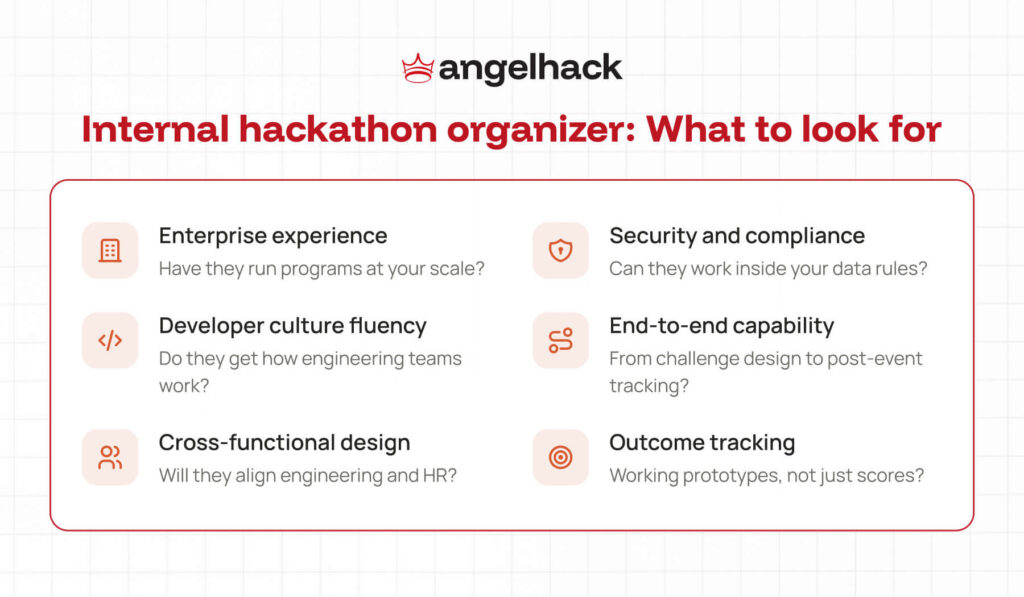
Evaluate organizers against five criteria:
- Enterprise experience: Have they run programs at your scale? A 600-employee event needs different infrastructure than a 50-person pilot.
- Security and data compliance: Can they run the program inside your security and data-handling rules, especially when employees build with internal systems or customer data?
- Developer culture fluency: Do they understand how engineering teams actually work, or do they run generic corporate events?
- End-to-end capability: Can they own challenge design, participant engagement, technical mentorship, judging, and post-event tracking?
- Cross-functional design: Will they partner with both engineering leadership and HR to deliver shared wins?
- Outcome tracking: Do they measure success by working prototypes and pipeline adoption, or by satisfaction scores alone?
The pattern worth watching is how an organizer talks about the days after the event, because weaker partners tend to wind down once the closing ceremony ends, while stronger partners have already mapped out the adoption path before registration even opens.
Hackathon Agency vs. Hackathon Platform vs. DIY
The right organizer type depends on your internal capacity, the complexity of the program, and the outcomes you are targeting, and each of the three models trades control, cost, and results against one another in a different way.
| Organizer Type | Best For | Key Trade-Off |
|---|---|---|
| Hackathon Agency | Enterprise programs needing end-to-end. flawless execution and measurable pipeline outcomes | Higher cost and less internal ownership of the process |
| Hackathon Platform | Teams with internal program management capacity needing registration, submission, and judging tools | Lower cost, needs significant internal bandwidth to design and run |
| DIY | Small teams or pilots with limited scope and existing hackathon experience | Minimal external cost, high risk of team-building theater over real innovation |
Hackathon agencies like AngelHack handle everything from challenge design and participant engagement to judging frameworks and post-event pipeline integration. This model fits when the budget has to be justified by innovation outcomes, not participation metrics alone.
Hackathon platforms supply the infrastructure but leave design, facilitation, and outcome tracking to your team. That suits organizations with a dedicated innovation lead who has the bandwidth to run execution.
DIY can work for a small pilot, though it rarely holds up as programs grow, and without experienced facilitation these events tend to drift into unfocused brainstorming that generates ideas with no realistic path to implementation.
The trade-off stays consistent across all three models, since more external support generally buys more measurable outcomes at a higher price, while less support saves money and raises the risk of running a weekend of activity that produces nothing your teams can actually utilize later on.
How to Decide: Agency vs. Platform vs. DIY
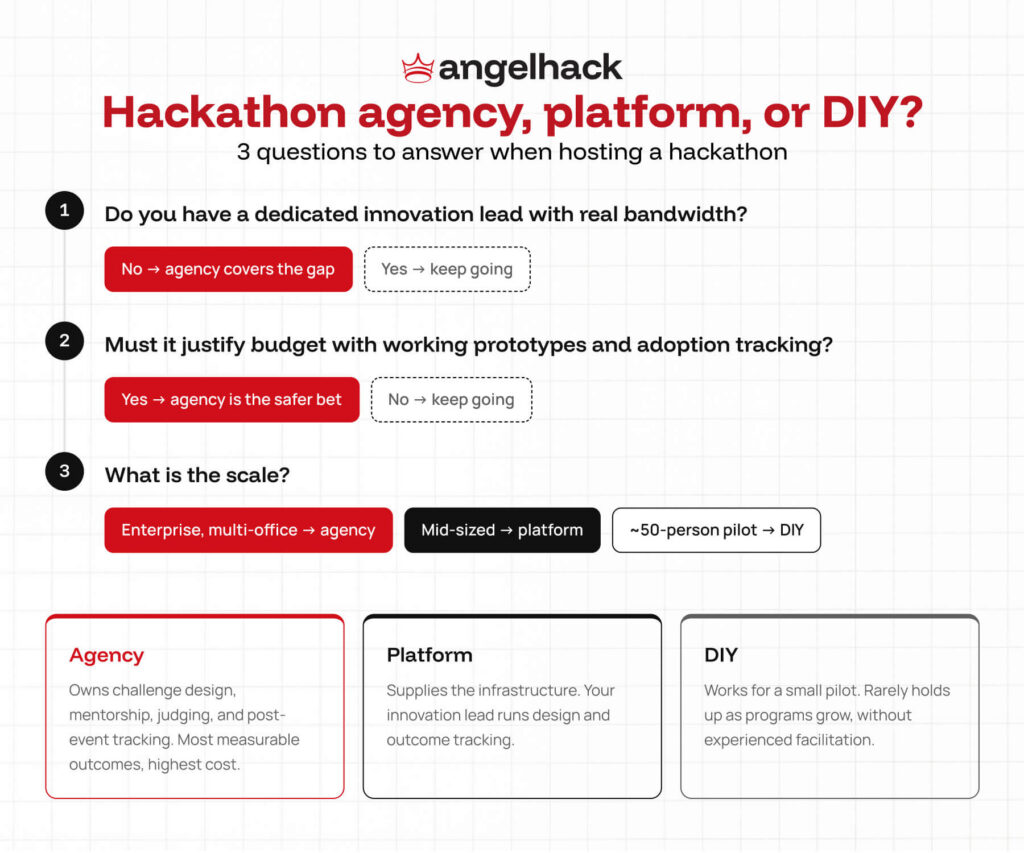
Three questions settle most decisions. Answer them honestly and the right model becomes obvious.
- Do you have a dedicated innovation lead with real bandwidth? If yes, a hackathon platform can carry a mid-sized program. If no, a hackathon agency covers the gap.
- Does this program need to justify budget with outcomes? If leadership expects working prototypes and adoption tracking, an agency is the safer bet. DIY rarely produces evidence a CFO will accept.
- What is the scale? A 50-person pilot can run DIY or on a platform. A 600-employee program across time zones needs distributed facilitation and consistent judging that most teams cannot build in-house.
- What’s the budget you’re working with? Map your expected costs before you choose a model, since the three organization methods sit at very different price points.
The honest reason most enterprise programs end up hiring an agency comes down to capacity, because running a hackathon at any real scale is a full operation, and few internal teams have the people or the accumulated practice to carry it on top of their existing day jobs. An agency brings three things that a platform or a DIY effort generally cannot match:
- Staff who run this weekly: Program managers, facilitators, technical mentors, and judges who have done it across hundreds of events, so problems get solved before they reach you.
- Resources already in place: Mentor networks, judging rubrics, submission tooling, and a developer community, none of which you have to build from scratch.
- Operations experience: The playbook for pre-event alignment, live coordination across offices and time zones, and post-event tracking that moves prototypes toward pilots.
A useful shortcut: pilot small to test the format, then bring in an agency once you scale. The right move is to match the model to the outcome you are chasing rather than to whichever proposal happens to carry the lowest price tag.
Success Stories: UBS and Discover
Two AngelHack internal programs show what the format produces when it’s run end-to-end.
UBS Innovate reignited engagement across a global bank spread over five countries. AngelHack ran five simultaneous events in New York, London, Zurich, Singapore, and Hong Kong, linked by live video.
- 500+ employees on cross-functional teams
- Open-ended problems tied to real business challenges
- Winning teams pitched directly to UBS executives
- Top teams entered a post-program accelerator with funding and leadership access
Discover’s Innovation Hack turned employee ideas into patents and products in a 52-hour event.
- 614 employees from 35 states and 196 cities
- Six challenge tracks including Open API, Banking, and Payments
- 90+ projects submitted and one patent filed
- Over 65% of participants worked with colleagues they had never met
Run Your Next Internal Hackathon with AngelHack
AngelHack has run 450+ hackathon events, including internal programs for UBS, Discover, Microsoft, and Databricks. The difference is end-to-end management, from cross-functional design through post-event adoption tracking, so your internal hackathon produces working prototypes that enter your pipeline.
Tell us the outcome you need, and the program gets built backward from that decision, run across your offices, with tracking on which prototypes advance.
To move past team-building theater and deliver measurable outcomes, book a program scoping call with AngelHack. One conversation maps your challenge, format, and post-event path.
Run Your Internal Hackathon with AngelHack
We have run hackathons and developer programs for UBS, Discover, and 200+ other organizations, with 15 years of delivery across 100+ cities. Tell us the change you want to see in your organization, we will design and run the right internal hackathon that gets you there fast in a few weeks.
TALK TO USFrequently Asked Questions
What is an internal hackathon?
An internal hackathon is a time-boxed event for employees, where teams get a scoped challenge and a fixed deadline to build and test real solutions. It keeps IP in-house and produces working prototypes rather than ideas alone.
How do you organize an internal hackathon from start to finish?
Define challenges tied to business priorities, recruit cross-functional teams, provide technical mentorship, judge on feasibility, and build post-event adoption paths. Most enterprise programs partner with a hackathon agency rather than attempting DIY coordination.
How much does it cost to run an internal hackathon?
Costs range from $5,000 to $50,000 depending on scope, participant count, and organizer type. DIY programs may cover only catering and prizes. Enterprise-scale events with an agency, venues, and technical infrastructure sit at the higher end.
What is the difference between an internal hackathon and a public hackathon?
Internal hackathons are for employees only, keeping IP inside the company and focusing on company-specific challenges. Public hackathons draw external developers for community building or talent sourcing. Audience, IP, and strategic purpose differ across the two.
How do you measure the success of an internal hackathon?
Measure working prototypes that advance into development pipelines, not participation or satisfaction scores alone. Track how many projects move beyond the event, time-to-implementation for winners, and cross-functional relationships that persist afterward.