The AI Ready ASEAN Youth Challenge is a regional ideathon organised by AI Singapore with Google.org, IMDA and the ASEAN Foundation, and delivered by AngelHack. Teams of up to three proposed an AI solution for their own community, showed it could be built, and planned outreach to 1,000 people. The challenge drew 2,600+ participants and 600+ submissions across all 11 ASEAN member states, with 11 national champions advancing to the Regional Grand Finals in Singapore.
Wint Wah Kyaw Soe, a student at the University of Computer Studies of Yangon, represented Myanmar and competed as FutureFlux with 2 other members. The team took the Myanmar national title, then placed third at the Regional Grand Finals in Singapore. FutureFlux is an offline learning hub for areas with limited digital access, delivering personalised tutoring and adaptive quizzes while flagging in real time where a student is falling behind. It runs on a Raspberry Pi 5, a board with far less memory than a language model expects.
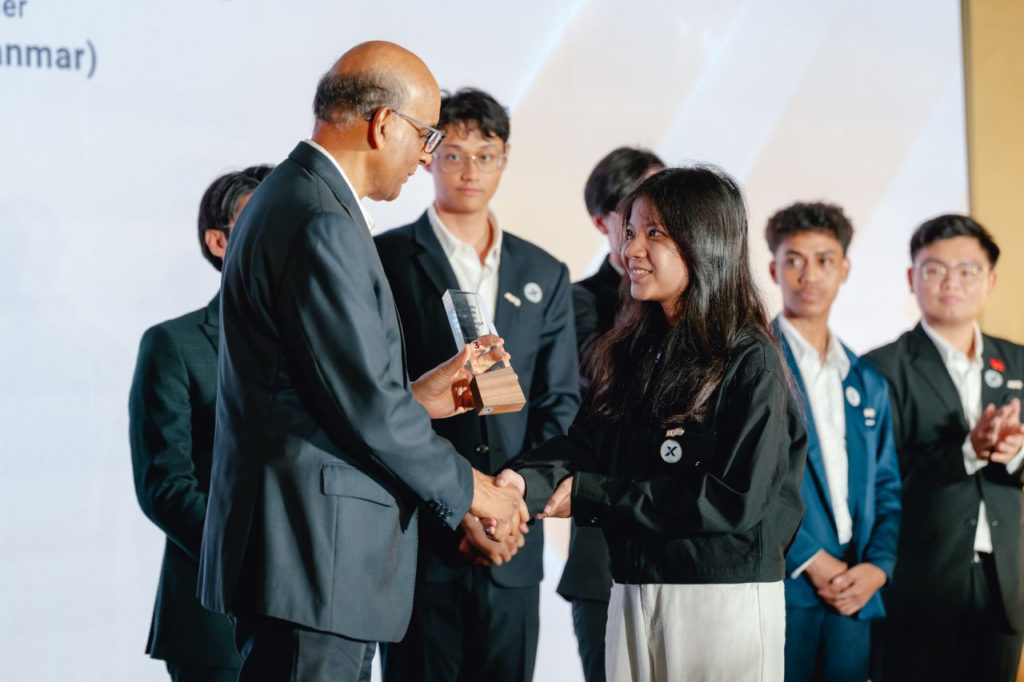
Wint Wah Kyaw Soe, representing the FutureFlux team at the ATxSG2026 Opening Gala in Singapore, to receive their awards from President Tharman Shanmugaratnam
How did your project idea come about?
Wint Wah: The idea came from observing a critical gap in how AI is being distributed across the ASEAN region. AI tools are transforming education globally, but they rely heavily on consistent, high-speed internet and expensive cloud infrastructure. Knowing that many students and remote communities in Southeast Asia experience unstable connectivity, we realised that standard cloud-dependent AI tools are inadvertently widening the digital divide.
What did you build it with?
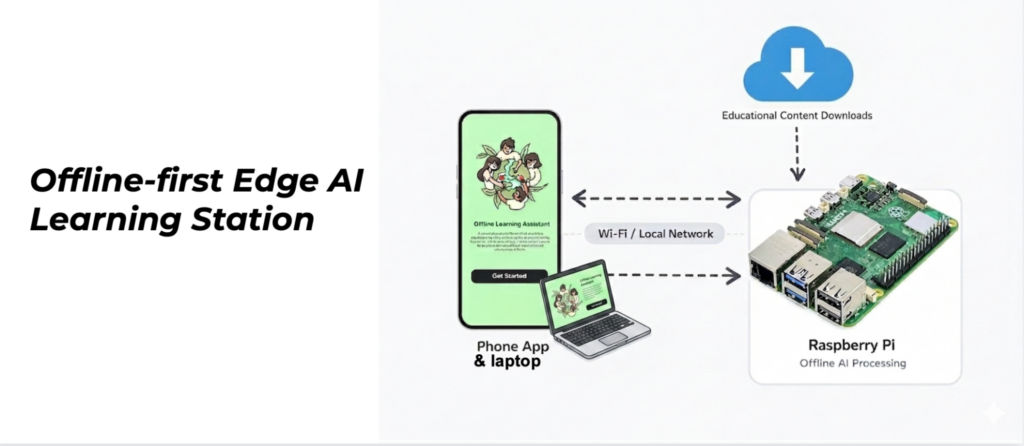
Wint Wah: The prompt of “AI Ready ASEAN” made me ask: how do we make a community truly AI-ready when resource access is unequal? We built our offline learning ecosystem, FutureFlux, by integrating optimised software with compact hardware:
- Raspberry Pi 5: the core platform, functioning as a decentralised local server
- Ollama: lightweight large language models providing the AI intelligence
- FastAPI: the system backend, managing local requests efficiently
- React Native: a clean architecture for the user-facing digital classroom interface
What are you most proud of?
Wint Wah: I am most proud of successfully optimising and executing local model inference on edge hardware within the hackathon’s tight timeframe. Getting a large language model to respond efficiently on a device with highly limited RAM and processing power without melting the hardware is a massive optimisation hurdle. Seeing the system successfully process complex, offline educational prompts in real time was incredibly rewarding.
This was my first time working deeply with on-device LLM deployment, or edge AI. Previously, I had only interacted with AI through standard cloud-hosted API wrappers. Configuring lightweight local inferences and managing active RAM usage to prevent hardware crashes forced me to completely rethink software efficiency.
「 Getting a large language model to respond efficiently on a device with highly limited RAM and processing power without melting the hardware is a massive optimisation hurdle. 」
What was the biggest obstacle, and how did you overcome it?
Wint Wah: The biggest hurdle was the severe hardware constraint of running a large language model locally on a Raspberry Pi. Standard LLMs are massive and designed to run on heavy cloud servers with powerful GPUs. Trying to run even a smaller open-source model on a tiny edge device quickly led to critical out-of-memory errors, system freezes, and painfully slow inference speeds that made the digital classroom completely unusable. With the hackathon clock ticking, we were trapped between sacrificing the AI’s intelligence or crashing the hardware.
I overcame this through model quantization and memory optimisation. I spent hours testing different compression levels to shrink the model’s footprint so it could fit tightly within the Raspberry Pi’s limited RAM. I then optimised our backend architecture using lightweight FastAPI routes and aggressive garbage collection in Python to free up system resources immediately after processing a request. By carefully balancing model weight with hardware execution, we achieved fast, completely offline AI responses on the edge device without a single system crash.
How would you describe the event itself, the atmosphere and the mentorship?
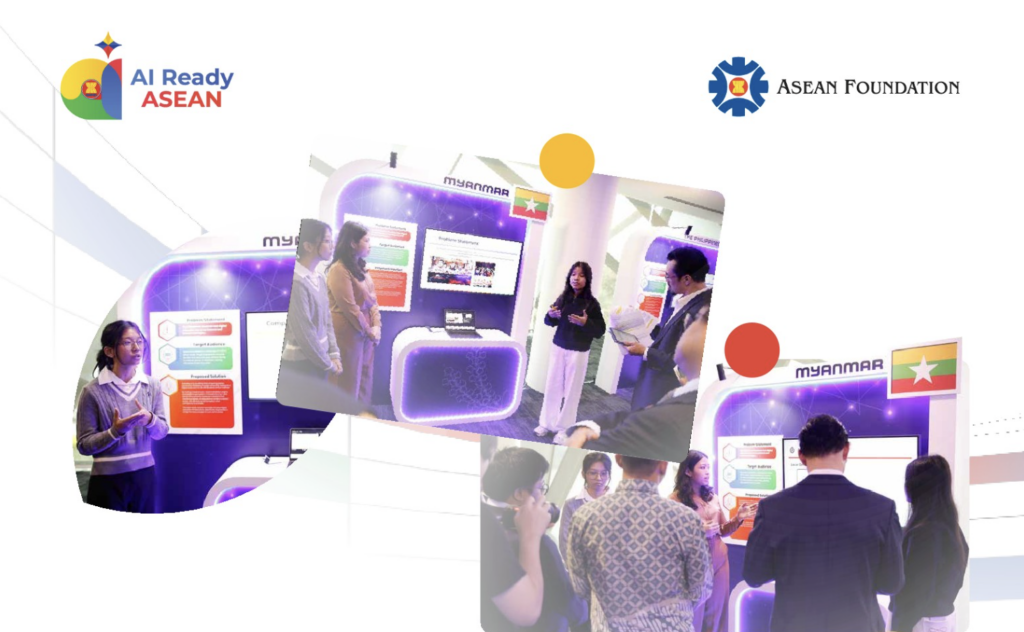
Wint Wah: What started as an intense virtual competitive sprint transformed into a world-class regional showcase at the Grand Finals in Singapore. The atmosphere was highly charged, collaborative, and forward-thinking, bringing together the top youth innovators from all 11 ASEAN member states. Exhibiting at our country booth during the AI Student Developer Conference 2026, surrounded by teams tackling massive social issues using technology, felt less like a strict competition and more like a collective blueprint for the region’s digital future.
The mentorship provided by AI Singapore and its regional partners was exceptional. During the post-national final consultations, our advisors didn’t just look at our code; they challenged us to think about long-term scalability, regional implementation, and the ethics of public-good AI. Their guidance was instrumental in refining a raw, highly technical edge-computing prototype into a structured, viable product proposal that resonated with the final judging panel.
「 The AI Student Developer Conference 2026, surrounded by teams tackling massive social issues using technology, felt less like a strict competition and more like a collective blueprint for the region’s digital future」
What did winning mean to you, and has anything developed since?
Wint Wah: Winning the challenge was an incredible validation of our core engineering philosophy: that technology should be built for real-world constraints, not just ideal conditions.
Representing Myanmar at the AI Student Developer Conference and the ATxSummit Opening Gala in Singapore provided us with tremendous regional exposure. Most notably, Nanyang Polytechnic (NYP), one of Singapore’s leading technological institutions, expressed deep interest in our offline edge architecture. They have officially offered to collaborate with us to co-develop and refine the project further. This partnership opens up access to advanced institutional resources and expert guidance, shifting our direction from a successful hackathon prototype into a validated, scalable educational solution ready for broader regional deployment.
「 Technology should be built for real-world constraints, not just ideal conditions. 」
How was your experience with the AngelHack team?
Wint Wah: My experience with the AngelHack team was absolutely exceptional. From the very moment we stepped foot in the airport, their team was there to welcome us warmly, and that high level of care continued consistently until the very end of the event. Navigating a major international competition can be incredibly overwhelming for a student team, but AngelHack took care of every single detail for us. They were profoundly professional, organised, and attentive, ensuring we could completely focus on our presentation without worrying about logistics. They didn’t just run an event; they made us feel genuinely valued and supported as young developers representing our country on a global stage.
「 They didn’t just run an event; they made us feel genuinely valued and supported as young developers representing our country on a global stage. 」
What advice would you give someone considering their first hackathon?
Wint Wah: The best time to start was yesterday; the second best time is today. You don’t need to be an expert to enter your first hackathon, you just need to be a builder who is willing to learn under pressure. A great hackathon team isn’t just three people who are good at coding. It’s a group that balances our core strengths. Judges at top-tier hackathons like AI Ready ASEAN aren’t just looking for complex scripts; they are looking for solutions to real-world problems.
「 The best time to start was yesterday; the second best time is today. 」

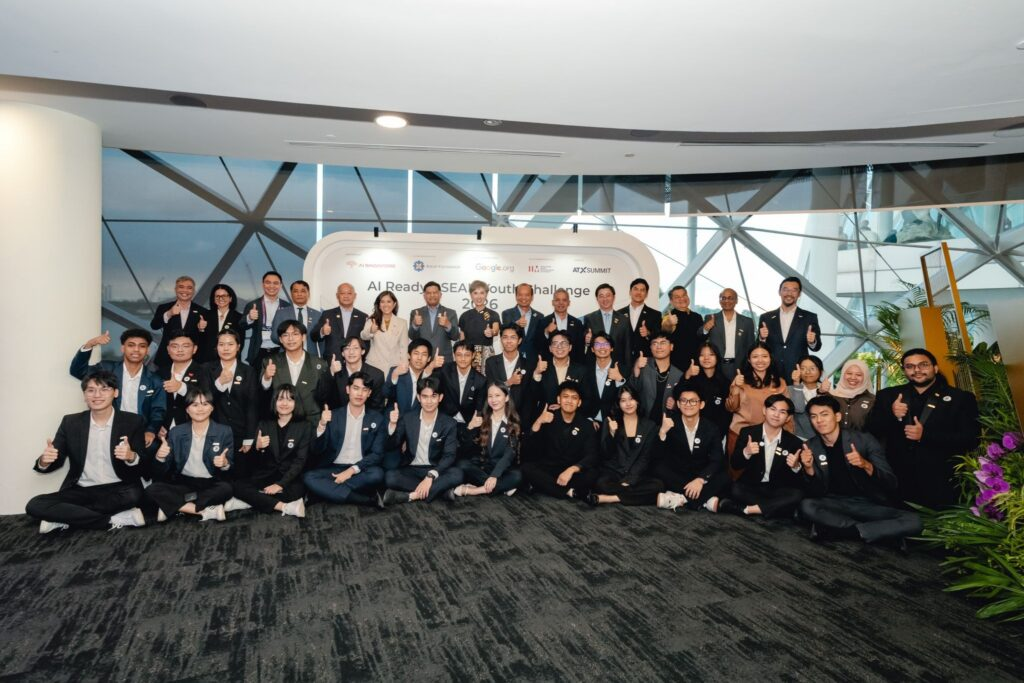
FutureFlux entered with a problem their own community lives with, and left with a partner willing to build it further. Find your next hackathon, find people whose strengths fill your gaps, and see how far an idea can take you.
Subscribe to TechTalk by AngelHack
Let’s keep you updated on the latest developer events around the world as well as in-depth insights on how to champion innovation and developer relations.