Across the 450+ hackathons we’ve run, the teams that stall in the first hour aren’t short on skill. They’re stuck choosing what to build. Most advice on hackathon project ideas tells you how to build one. Almost none tells you how to pick the right one before the clock eats your weekend. That first hour decides more than people expect, and teams that burn it brainstorming rarely win the time back. Here’s the method we’ve watched winning teams use to get from a blank page to a committed idea before the hour is up.
How to find a hackathon project idea, fast
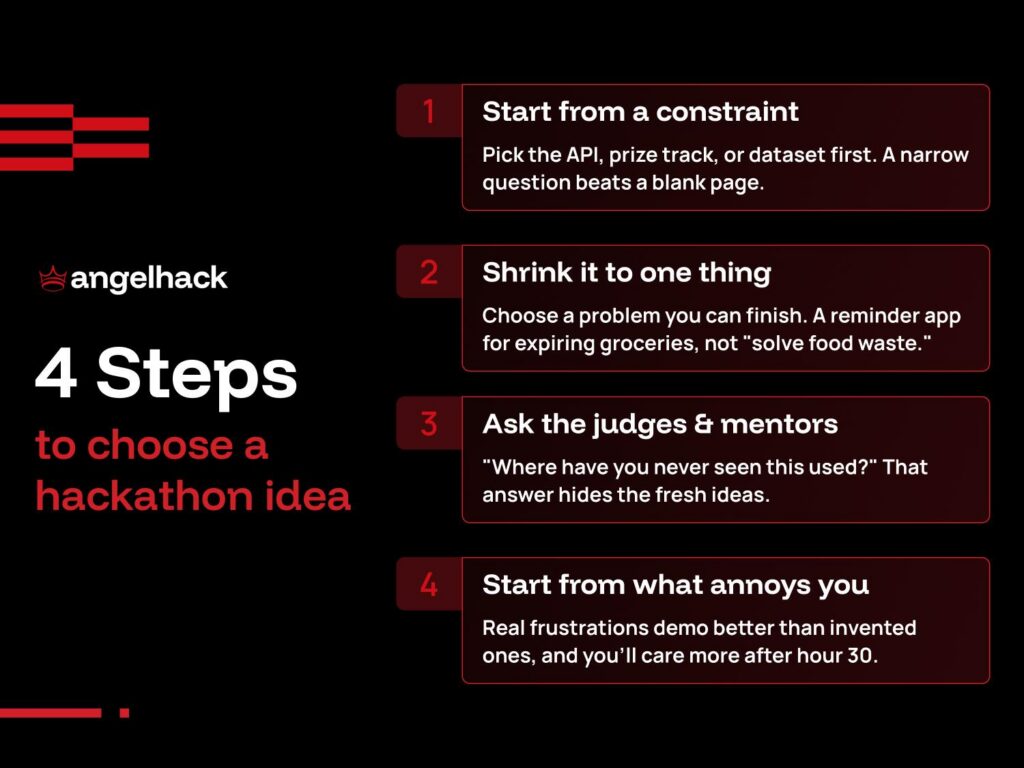
You don’t need more hackathon project ideas. You need a faster way to land on one worth building. These four moves get you from a blank page to a real candidate inside an hour.
🎯 Start from a constraint: Pick the API, prize track, or dataset first, then build off it. A narrow question beats an open one every time.
🔍 Shrink it to one thing you can show: Choose a small problem you can finish, not a big one you can’t. Think of a reminder app for groceries about to expire, not “solve food waste.”
🗣️ Ask the judges & mentors the question most teams skip: Try “How have you seen this used, and how have you never seen it used?” The second answer is where the fresh ideas hide.
🔥 Start from what annoys you: Real frustrations demo better than invented ones, and you’ll care more at hour 30.
These moves stack. The strongest starts we see combine a constraint with a tight scope, like picking one sponsor API and building the single feature that shows it off. A team that opens with “we’re using the maps API to flag unsafe crossings near schools” is already ahead of the team still debating themes at hour two. Keep the ambition big and the scope small enough to finish by Sunday.
If you’d rather pick from a shortlist than stare at a blank page, our list of 65+ hackathon ideas you can build in a weekend gives you a pool sorted by difficulty and theme. Either way, the goal is the same: get to a candidate fast. Ideas are rarely the bottleneck. Picking the wrong one and finding out on Sunday morning, that’s where the weekend goes.
How to decide which hackathon project idea is worth building
Finding a candidate is the easy half. Deciding it’s the one you commit to is where strong teams separate from the rest. Score each idea on four things:
- Impact. Will anyone outside your team care that this exists?
- Feasibility. Can you build a working version in the time you have?
- Novelty. Is it different enough to stand out in a room of similar projects?
- Demo-ability. Can you show it working, live, without a setup speech?
Run the scoring fast, out loud, and on a clock:
- Rate each idea one to five on all four criteria.
- Add the totals and compare them.
- Give yourselves 60 minutes, then commit and stop reopening the question.
- Before you lock it in, ask one question: can you show this working in three minutes flat? If the demo needs a paragraph of setup, it’s the wrong idea.
The drift is the part to watch. One team we saw kept adding features to a solid build, each a little further from the brief, until the judges’ first question was why none of it matched the theme. They’d built something polished that no longer answered the question on the board. Check the idea against the brief every time the scope grows.
Skip this filter and you risk building something that looks impressive and scores nothing. The boring 90 minutes up front is what keeps that from happening.
💡 Read more: Hackathon Tips – What Repeat Winners Do Differently
Two hackathon project ideas worth walking away from (and what to build instead)
Some ideas feel right and still lose. Two patterns show up again and again, and spotting them early saves the weekend.
The crowded idea
The idea that arrives in two minutes arrived for everyone else too. The classic version is an AI tool that summarizes long meeting recordings into action items.
❌ Why it loses: it scores fine on feasibility and demo, then dies on novelty when five other teams pitch the same thing.
🔍 How to check: walk the room in the first hour and count how many teams describe something close to yours. If you hear it twice, the judges will hear it five times by Sunday.
🔀 The fix: trade the obvious idea for the messier one that’s yours alone.
The un-demoable idea
An idea you can’t show in three minutes can’t win, however strong the concept.
❌ Why it loses: Projects that need a massive dataset, or that have no single visible moment, look impressive on paper and fall flat on stage.
🔍 How to check: Hold the idea against two questions. If it fails either, it isn’t ready:
- Do you have a dataset that size on hand?
- Can you demo it convincingly in three minutes?
🔀 The fix: Narrow it until it’s both finishable and demoable. Scope down to one user, one workflow, one clear result. Don’t fear the pivot either. Some of the strongest projects start as something bigger and get narrowed into shape, so plan for that pivot instead of dreading it.
In practice
Take the Databricks Generative AI World Cup. The brief asked teams to build a working generative AI solution on Databricks’ Mosaic AI tools, aimed at a real industry problem. A common first instinct was an enterprise assistant that answers questions across a company’s entire internal document library, which fails both checks at once. The teams that won narrowed instead:
- AITHENA took the APJ title with a retrieval pipeline scoped to legal research.
- Exyte won the grand prize with a compliance assistant scoped to building-design regulations.
Both were narrow enough to finish and clear enough to demo, and both beat the broader ideas in the room.
Commit early, then go build

The hackathon project idea you pick in the first hour is the one you defend on stage Sunday. There’s no fixing that choice later, so it’s worth getting right early. The whole method fits in one line: brainstorm from a constraint, filter on a timer, then commit. For the first-timer reading this, your idea doesn’t have to be brilliant. It has to be finishable.
Once you’ve committed, winning comes down to execution. See what repeat hackathon winners do differently for the prep, build pacing, and demo habits that put teams on the leaderboard. When you’re ready to put a real idea to work, join the AngelHack developer community to find your next event and a live brief to build against.