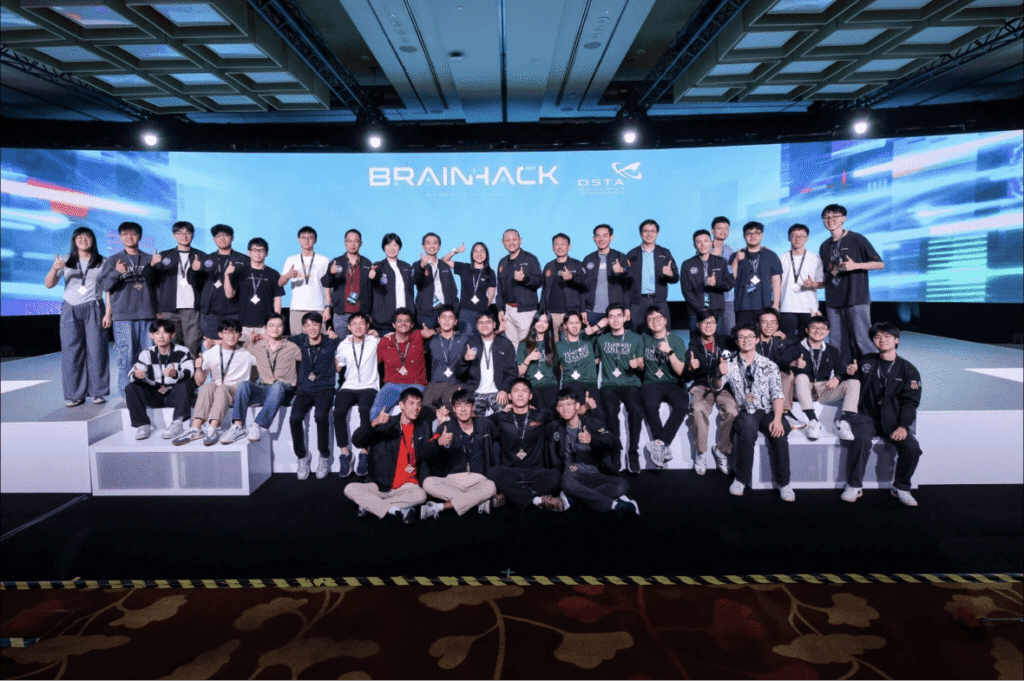
DSTA BrainHack is Singapore’s national showcase of defence technology. Its TIL-AI track (Today I Learned AI) has been designed and run by AngelHack for three years running. In 2026, it drew 774 participants across 68 teams, with 40 reaching the in-person finals at Marina Bay Sands.
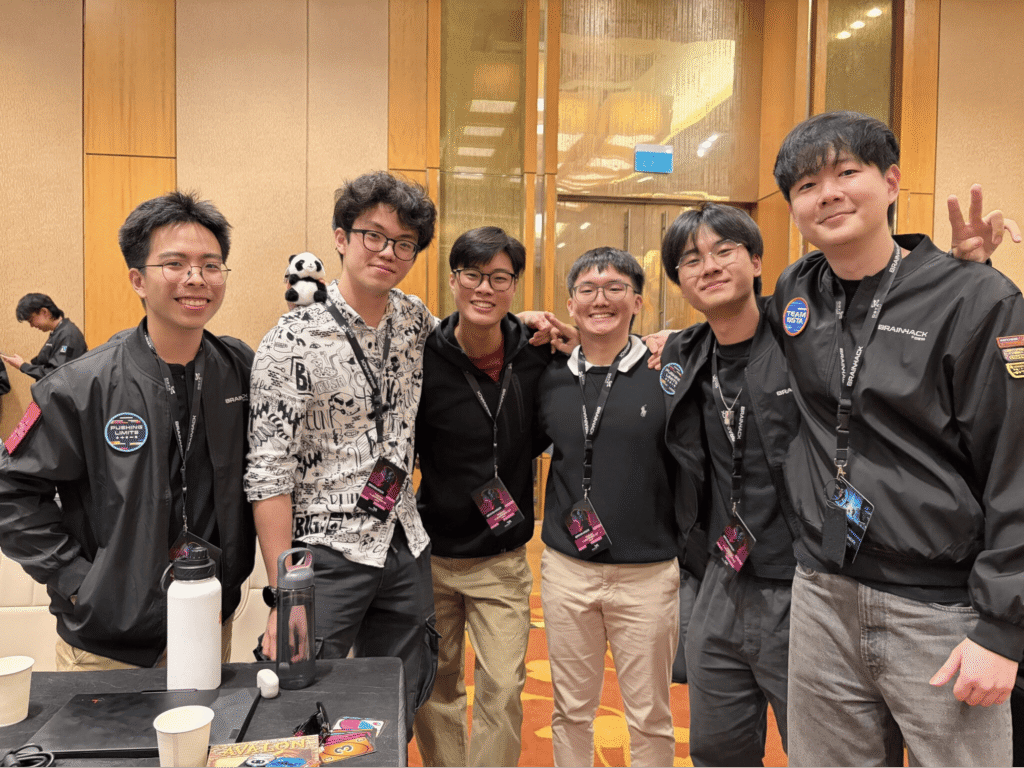
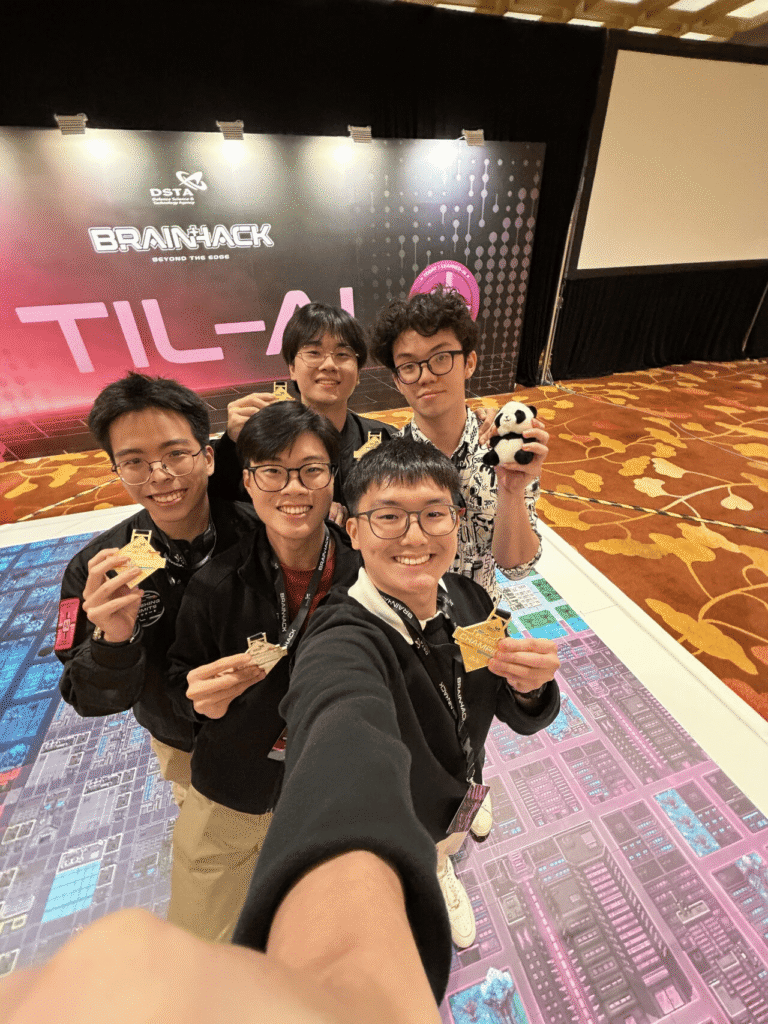
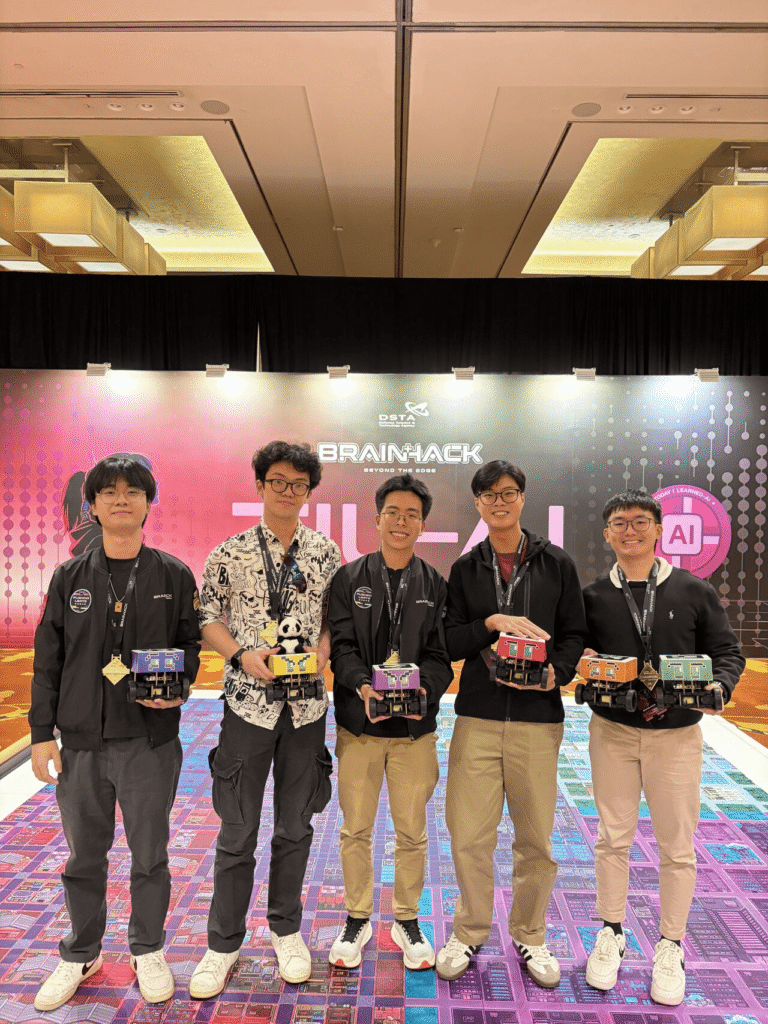
Ian Abiel Wangsa, Justin Too, Chen Ling Song, Koh Yu Jian and Noah Goh of the National University of Singapore competed as Team Pandamonium and finished as Novice track winner. Here’s how they got there on their first attempt at machine learning.
The Novice track asks for five AI capabilities, each running as its own service inside an air-gapped evaluation environment. Accuracy alone doesn’t win it. The system has to hold together within the competition’s hardware and time limits, under an evaluation the team can’t watch or debug live.
Pandamonium answered with five Dockerised FastAPI microservices, each tuned for accuracy and inference speed. Docker was new to them, so was Jupyter, and so was every machine learning library they ended up depending on. Here’s Pandamonium on what they built, how that swap happened the night before the finals, and what they’d tell anyone signing up for the first time.
What made the team sign up for BrainHack?
Pandamonium: We were in school getting through NUS Computer Science, and some of us had internships and personal projects taking up most of the week. We wanted something outside the curriculum, something to remind us there’s more to life than coursework. DSTA being behind it helped, and the TIL-AI problem statement was genuinely interesting. In the age of AI, we felt we should challenge ourselves and take part in an AI challenge to improve our skills.
What did Pandamonium actually build?
Pandamonium: Each task in the Novice track needed its own AI model, so we built five and packaged them to run separately. All five were Dockerised FastAPI microservices deployed into an air-gapped evaluation environment, each optimised for accuracy and inference speed:
🎙️ Speech recognition on NVIDIA Parakeet, transcribing messy audio
👁️ Computer vision on YOLOv26, detecting and classifying objects in cluttered images
📄 Document retrieval using BM25 to find the right answer across a pile of documents
🤖 Autonomous exploration trained with reinforcement learning
🔊 Noise handling for degraded audio
Python, PyTorch and Docker sat underneath all of it, and we worked in Jupyter throughout. Nothing could reach the internet during evaluation, so each service had to run on its own.
What sets Pandamonium apart?
Pandamonium: Our schedules were the most optimised thing about us. One of us could work from morning to afternoon while the others picked it up into the early hours, sometimes until 5am. Beyond the rota it was determination to always improve the model, even if it was by 0.01%.
It also came down to trusting our models. The day before the finals we realised the autonomous exploration model used on testing day, 10 June, was the wrong one. We asked Ryan to restore our earlier AE model, and we went into the finals without knowing which version was actually running. It held up.
「 What set us apart was our determination to always improve the model, even if it was by 0.01%. 」
What achievement are you most proud of given the time constraints?
Pandamonium: Everything was new. None of us had used Docker or a Jupyter workspace before, and this was the first time any of us had touched a machine learning library. We spent the opening days reading the material we’d been given before deciding which path to take, then split the modules according to who was strongest where. When we saw the gap between where we stood and where we needed to be, that became the motivation.
「 When we saw the gap between where we stood and where we needed to be, that became the motivation 」
What was the biggest obstacle you faced, and how did you overcome it?
Pandamonium: At the start there wasn’t any communication. After the initial discussion everyone went off to do their own task, and after a while we all felt alone with our own problems. What fixed it was writing things down. We started logging progress and telling each other the current problem along with everything already tried, so anyone stepping in got the context immediately. More time went to debugging and optimising instead of re-explaining. We also went to our mentors Wilson Lim and Ryan Nah as the deadline closed in, and they helped us improve the models.
Five services built in parallel don’t converge into one working system without that kind of protocol. Cross-functional teams discover this the same way Pandamonium did, usually with less time left on the clock.
What did the competition floor actually feel like?
Pandamonium: Walking into the room the first time was intimidating. We assumed everyone there was operating on a completely different level, so we told each other to just do our best with zero expectations. Then we looked around and saw everyone in their own world, working through their own problems, and realised everyone there was just like us. We’re all here to learn, try our best and have fun. After that shift we started seeing the other teams as peers rather than competitors, and the mentors helped with that too. In the rounds before the final, one of us decided to liven up the atmosphere by verbalising commands out loud for the fun of it, and nobody asked us to stop.
「 Everyone there was just like us. After that shift we started seeing the other teams as peers rather than competitors 」

How was working with the AngelHack team?
Pandamonium: Fabulous. The team worked tirelessly to help us and everyone else, and we hope they get the recognition they deserve.
What has winning set in motion?
Pandamonium: Training AI turned out to be fun. You get to make it learn the way you want, and sometimes it goes past what you imagined. The other thing we took away was the power of friendship, which sounds like a joke until you’ve spent a build like this depending on four other people. We have a new goal now, which is to train more models that excel at playing games, and we’re looking at other AI hackathons where we can apply what TIL-AI taught us.
「 Training AI turned out to be fun. You get to make it learn the way you want, and sometimes it goes past what you imagined 」
What would you tell a first-time competitor?
Pandamonium: Don’t think, just go. It’s better to try and fail than to never have tried at all. You only really lose if you fail and don’t learn anything. The worst outcome is looking back and asking why you didn’t sign up for BrainHack.
Read Pandamonium’s sharing on the win, and see how SpicyBananas won the Advanced track.
Subscribe to TechTalk by AngelHack
Let’s keep you updated on the latest developer events around the world as well as in-depth insights on how to champion innovation and developer relations.