Every company has problems need solving. But few have a system to solve them.
Innovation challenges are one of the most proven mechanisms to close that gap. Governments, enterprises, and tech companies use them across every industry to surface ideas internal teams can’t generate alone, then turn those ideas into working prototypes the organization can actually act on.
This article walks through what an innovation challenge is, how to structure one that delivers, and what four global organizations learned from running them. No theory. Just what worked, and what you can take from it.
What Is an Innovation Challenge?
An innovation challenge is an initiative designed to generate creative solutions to a defined problem. It runs through structured competition, collaboration, and incentives, and it usually pulls participants from outside the team that owns the problem.
Innovation challenges run in two formats:
- Open challenges welcome external participants like developers, startups, researchers, and domain specialists.
- Closed challenges focus on internal employees, specific teams, or business units.
The format works across every sector, and the topics range as widely as the organizations behind them. The common thread is structure: a real problem, a defined participant group, and a plan for what happens after the event ends.
The point isn’t the event itself. It’s the pipeline of validated ideas the event produces.
How to Structure Impactful Innovation Challenges
Most innovation challenges underdeliver for the same structural problems: The brief is too vague. The audience is too broad. There’s no plan for what happens after the event ends.
Follow the six steps below and you’ll build a program that avoids all three.
Step 1: 🎯 Define the problem, not the theme
Start with one sharp problem statement tied to a real business need. That gives participants a focused target and your team a measurable definition of success.
✗ Vague brief: “Innovate the future of finance.”
✓ Sharp brief: “Build a tool that helps first-time investors understand risk in under 60 seconds.”
Set challenge categories only after the core problem is clear. They help participants self-select the right track, not broaden the scope. The sharper the brief, the stronger the submissions, and the easier it is to identify which ones are worth a post-event pilot.
Step 2: 👥 Identify your target participants
Ask who has the skills, perspective, or lived experience to solve this problem. The wrong audience produces the wrong solutions even with a perfect brief.
- Internal: Employees, teams, or business units with institutional knowledge and direct access to real data.
- External developers and startups: Independent technologists with fresh perspectives and no organizational baggage.
- Academic: Students, researchers, and faculty with emerging methods and an appetite to build.
- Domain specialists: Industry experts or end-users with the lived experience your team may lack.
- Cross-functional mix: Combinations of the above when the problem spans technical and business disciplines.
Define your participant profile before you open registration so marketing, mentors, and judging criteria align with the people you want to build.
Step 3: ⚡ Choose your engagement format
Three options, each suited to a different outcome:
- Online: Participants join remotely from any office or location, removing geographic barriers across your organization. Ideal for companies with distributed teams who want to run a challenge without pulling people away from their day-to-day or coordinating travel.
- In-person: Participants gather in a shared space, enabling real-time collaboration, on-site mentorship, and a higher-energy experience. Ideal for deep problem-solving, cross-functional team building, and challenges where direct interaction with your product, data, or internal stakeholders is part of the brief.
- Hybrid: Combines both, connecting teams across multiple offices through a shared challenge structure while preserving the depth of in-person collaboration at each site.
The format you choose determines how you coordinate across teams, what infrastructure you need internally, and how winners present their outcomes to leadership.
Step 4: 📈 Set innovation KPIs before you launch
Define what success looks like before a single participant registers. KPIs decided after the fact aren’t KPIs, they’re post-hoc justifications.
.kpi-grid { display: grid; grid-template-columns: 1fr 1fr; gap: 16px; font-family: ‘Manrope’, sans-serif; margin: 24px 0; } @media (max-width: 600px) { .kpi-grid { grid-template-columns: 1fr; } }📊 Quantitative
- Registered participants
- Working prototypes demoed
- API integrations completed
- Post-event hires / pipeline value
💬 Qualitative
- Solution quality vs. brief
- Cross-functional relationships built
- Internal stakeholder satisfaction
Setting these targets up front means every operational decision, from mentor matching to judging panels, ties back to outcomes you can actually report.
📥 Download The Innovation Challenge Brief Template
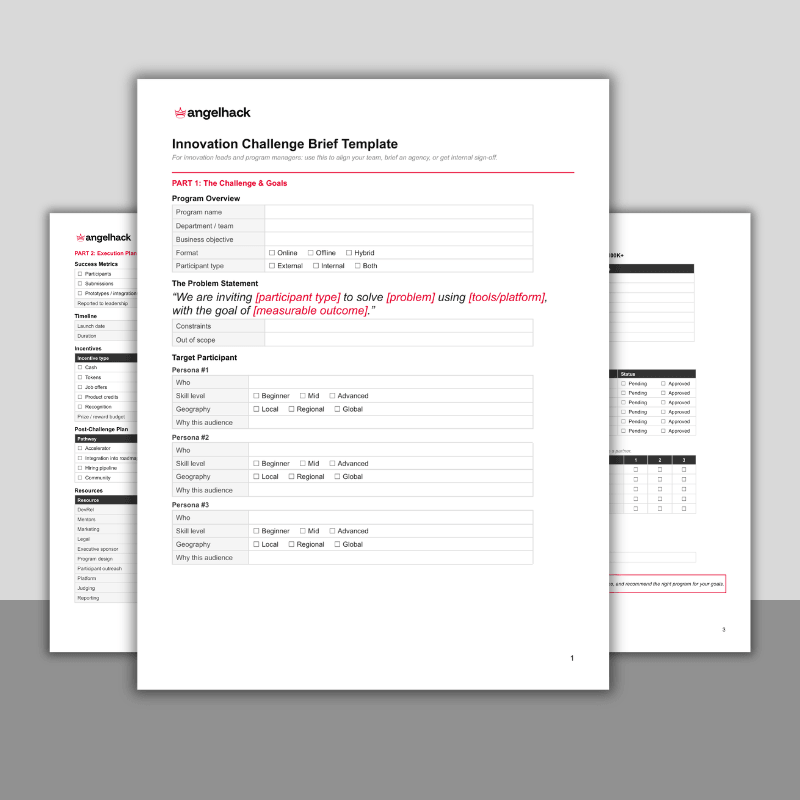
We’ve put this template together to help you define your program, lock in your KPIs, and build the internal business case before your first conversation with anyone. Three pages, fully fillable, with a readiness check across legal, finance, marketing, and product so you can spot gaps before committing budget or stakeholder time.
Step 5: 🛠️ Build in challenge structure
A challenge without structure is just a deadline, and deadlines without scaffolding produce half-finished submissions. Strong programs include:
- A clear kickoff briefing so every participant understands the problem and the criteria from day one
- Scheduled mentor office hours rather than optional drop-ins, so even the quietest teams get real feedback before submission
- Mid-point check-ins that catch teams going off-brief before it’s too late to course-correct
- Explicit judging criteria published before submissions open, so participants build for the right standard
- A diverse judging panel of technical and business evaluators, so submissions are tested against more than one definition of “good”
Structure doesn’t constrain creativity. It directs it toward outcomes you can act on.
Step 6: 🚀 Plan the post-event phase
What happens to the best submissions after the program ends determines whether the challenge was worth running. The event surfaces the candidates. The post-event phase turns them into business outcomes.
Options for the post-event phase:
- Acceleration: Give top teams resources, mentorship, and a timeline to develop their prototype into something pilot-ready.
- Integration: Fast-track winning solutions into a product roadmap or internal pilot, so the work doesn’t sit in a folder after demo day.
- Hiring pipeline: Convert standout participants into candidates or contractors, often at lower cost than traditional recruitment.
- Community: Keep the participant network engaged beyond the event, building a recurring pipeline for future programs and an active builder audience.
Without a post-event plan, even the best submissions go nowhere.
Lessons from Global Innovation Challenges
Four organizations came to AngelHack with four different problems. Here’s how each program was structured and the results they delivered.
Ecosystem Innovation: Coupang x hackseoul 2025
DBS Bank x hacksingapore 2024: Financial Inclusion Innovation

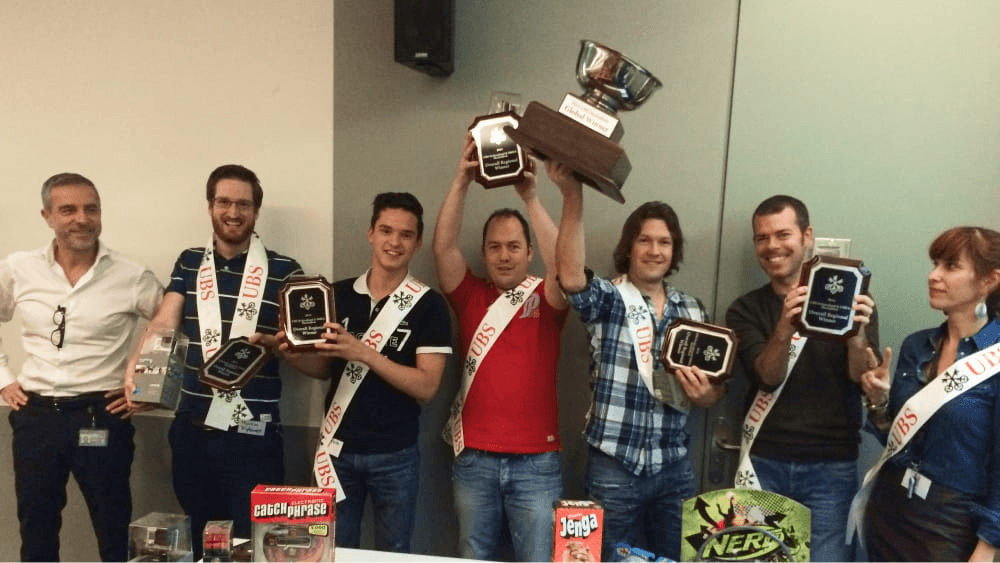
UBS Innovate: Internal Innovation
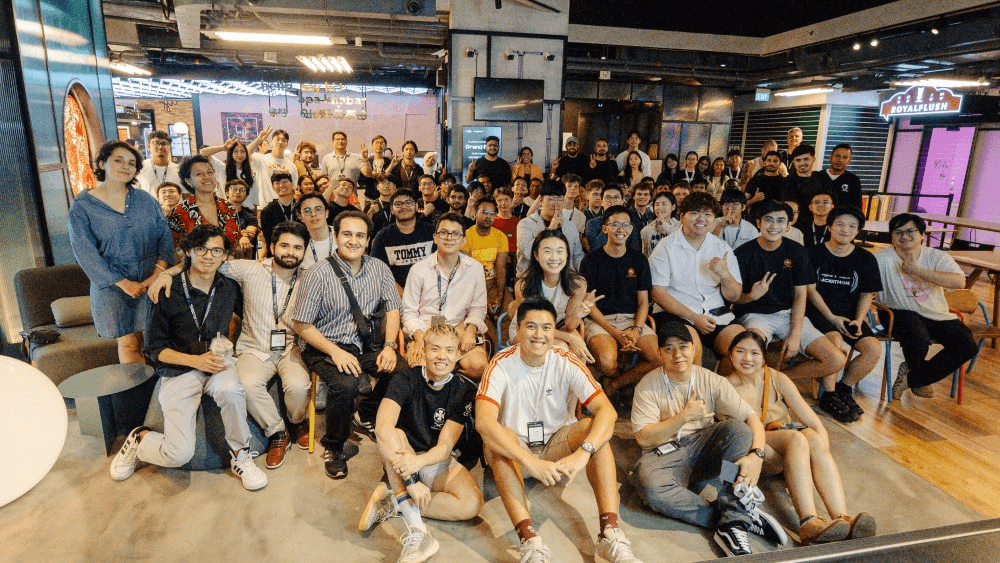
Lyf x hackglobal Grand Finals: Operational Innovation
Conclusion
Four organizations. Four different problems. One consistent pattern: a defined challenge, the right participants, a structured program with a real post-event phase.
Innovation challenges work when they’re built around a real problem and run with enough rigor to turn submissions into outcomes. Most fall short not because the idea was wrong, but because the execution wasn’t there.
We’ve spent 15 years designing and running innovation programs end-to-end. Book a strategy call, tell us the challenge to solve, and we’ll build the program around it.
Scale Your Innovation Program With Experts
We’ve spent 15 years designing and running innovation programs end-to-end. Book a strategy call, tell us the challenge to solve, and we’ll build the program around it.
Book a Strategy Call