
Innovation management is no longer a side project for well-funded R&D teams. In 2026, it is a disciplined, portfolio-driven system that helps organizations move faster, make smarter bets, and build lasting competitive advantage. If you are a C-suite executive setting strategy or a VP of Innovation making the case for your next program, this guide is for you.
Core Concepts of Innovation Management
At its core, innovation management is a systematic, repeatable process for turning ideas into real business value. It is not a brainstorm here and a hackathon there. It is a disciplined approach aligned to corporate strategy, with governance structures, defined roles, and measurable outcomes at every stage.
Not all innovation works the same way, and treating it as though it does is one of the fastest ways to waste resources.
- Incremental innovation improves existing products, services, or processes. Lower risk, shorter cycles, measured by efficiency and customer satisfaction.
- Breakthrough innovation creates entirely new markets or business models. Higher risk, longer horizons, measured by market creation and long-term growth potential.
Each type needs its own governance model, funding structure, and stage-gate criteria. Running both through the same process tends to slow down incremental wins and starve breakthrough bets.
Beyond the innovation type, strong programs rest on three structural pillars:
- Governance: C-suite sponsorship, stage-gate reviews at defined milestones, and clear portfolio decision rights
- Roles: Explorers who identify opportunities, Builders who prototype and test, and Accelerators who scale what works
- Competencies: Cross-functional talent, an experimentation culture, and the process maturity to move ideas through the funnel consistently
Without all three in place, even the best ideas stall somewhere between discovery and deployment.
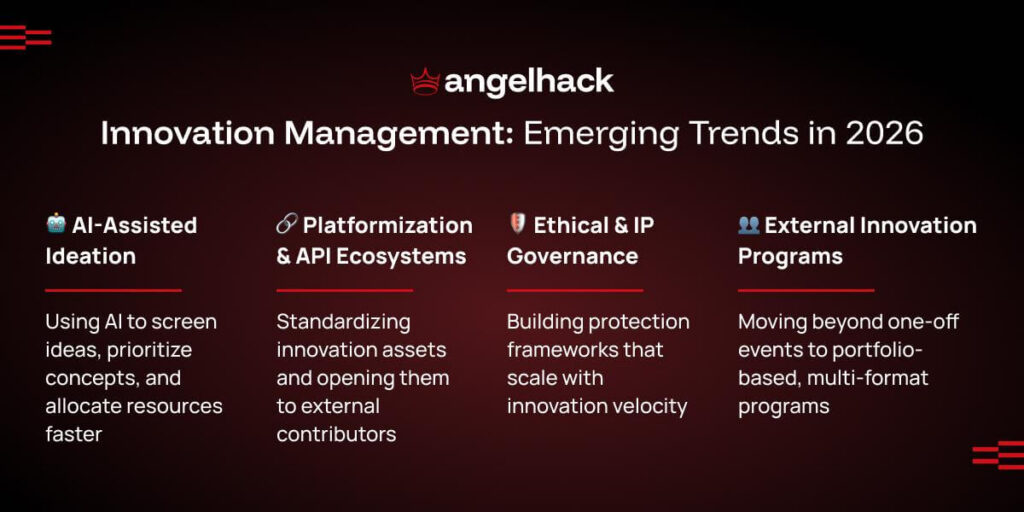
Innovation Management: Emerging Trends in 2026
Innovation doesn’t stand still, and neither do the organizations winning at it. These are the trends defining how the best teams are building and running programs in 2026.
AI-assisted ideation
AI-assisted ideation is now a standard part of the toolkit. AI tools augment discovery, idea screening, and concept prioritization across the funnel, while predictive analytics help teams allocate resources to the highest-potential ideas earlier. The innovation management software market is expected to grow from $2 billion in 2025 to over $3 billion by 2032 (HYPE Innovation), driven largely by this wave of AI integration.
Platformization and API ecosystems
Platformization and API ecosystems allow companies to standardize and reuse innovation assets across business units while enabling external contributors to extend the organization’s reach. This trend is accelerating fast: Gartner projects that over 90% of new enterprise applications will incorporate APIs as core components (Gartner), and 82% of organizations have already adopted some level of an API-first approach (Postman), a 12% increase from the previous year.
Ethical and IP governance
Ethical and IP governance is increasingly non-negotiable. As collaboration scales, so does exposure. Protection frameworks need to be built into program design from day one, and governance models must keep pace with growing innovation velocity. Organizations are taking this seriously: the global enterprise governance, risk, and compliance market is projected to grow from $70 billion in 2024 to nearly $300 billion by 2034 (Market.us), reflecting how central oversight infrastructure has become to scaling innovation safely.
External innovation programs
External innovation programs are no longer a nice-to-have, but a strategic tool. Over 60% of organizations now use crowdsourcing to enhance productivity (ReAnIn), and open innovation initiatives grew by 41% between 2021 and 2024 (Market Growth Reports), with more than 59% of product launches now integrating crowdsourced ideation inputs. The smartest organizations are moving beyond one-off events toward portfolio-based, multi-format strategies tied directly to business objectives. We dig into exactly what those programs look like in the next section.
External Innovation Programs as a Core Strategy
Structured external innovation programs give organizations a strategic edge that internal teams simply cannot build alone. Running a diverse mix of program formats, from open challenges and hackathons to accelerators and co-creation sprints, means you are never relying on a single source of ideas or a single type of contributor. Each format attracts different talents, surfaces different insights, and serves a different stage of the innovation lifecycle. Together, they create a system that is greater than the sum of its parts.
Well-designed programs do more than surface ideas. They:
- Tap into outside talents, perspectives, and expertise to accelerate concept development beyond organizational boundaries
- Create repeatable pipelines of validated concepts, market insights, and partnership opportunities
- Build brand equity and signal thought leadership within relevant industry communities
- Feed outputs directly into portfolio review and strategic investment decisions
The right format matters as much as the decision to run a program at all. Most organizations start with one and expand their mix as they learn what works. Here is a breakdown of the main options:
| Format | What it is | Best for |
|---|---|---|
| Open Innovation Challenges | Competitions inviting external participants to solve defined business problems, with structured submission, evaluation, and prize mechanisms | Clear problems requiring diverse, high-quality external solutions |
| Hackathons | Time-boxed coding or building competitions where participants develop working prototypes around a defined challenge, typically over 24 to 72 hours | Rapid prototyping, developer engagement, and platform adoption |
| Crowdsourcing Campaigns | Broad calls for ideas from the public, customers, or specialist communities | Early-stage discovery and trend sensing |
| Innovation Accelerators | Cohort-based programs taking selected concepts through mentorship, validation, and go-to-market preparation | Promising ideas that need structured development to reach proof of concept |
| Co-Creation Sprints | Time-boxed collaborative sessions with external partners, customers, or cross-industry peers to rapidly prototype and stress-test ideas | Rapid prototyping while building lasting external relationships |
| Internal Innovation Labs | Dedicated teams running continuous experimentation cycles drawing on cross-functional talent from across the business | Maintaining a steady internal pipeline alongside external programs |
Great program design is what separates a productive pipeline from an expensive event. Before launching anything, get clear on:
- The business objective, time horizon, and target participant profile
- Clear problem statements, deliverables, and evaluation criteria
- The right level of openness: fully public, curated community, or invite-only, based on strategic goals and IP sensitivity
- Post-program processes to capture, evaluate, and advance the strongest outputs into the broader portfolio
To see what this looks like in practice, here are three successful open innovation programs:
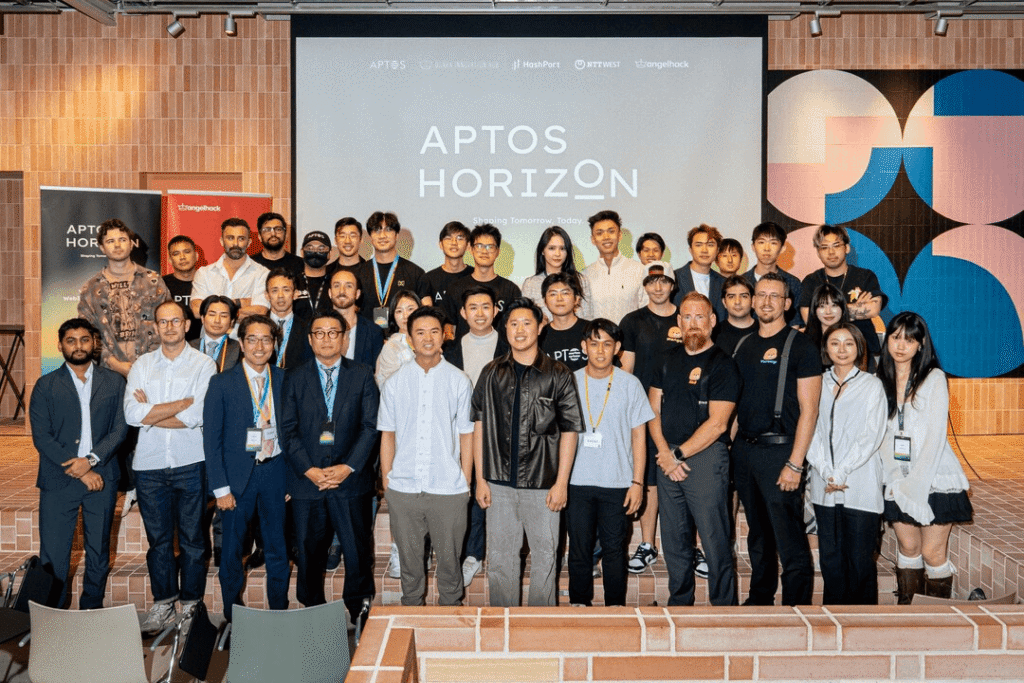
The Aptos Horizon Accelerator brought together 10 startups from 6 countries across DeFi, Gaming, NFTs, AI, and Real World Assets for an 8-week program in Osaka, backed by the Osaka Prefecture Government, NTT West, and HashPort. A globally livestreamed Demo Day drew 60+ VCs and public sector leaders, showing how government-backed innovation programs can build credible ecosystems and attract serious investment at scale.
Lyf hosted the hackglobal Grand Finals in Singapore, challenging finalists from 7 countries to solve real problems in community building, operational efficiency, and sustainability. Thirty solutions emerged from the hackathon, and the grand-winning project, a real-time carbon footprint tracking system, is now being explored as a live pilot within Lyf properties.
Databricks’ Generative AI World Cup challenged developers and data professionals to build GenAI solutions on Databricks’ Mosaic AI platform. A rigorous vetting process ensured high-caliber participation, with 1,500+ participants across 18 countries delivering production-ready solutions across biotechnology, legal tech, construction, and telecommunications.
Innovation Management Starts With the Right Organizational Capabilities
Programs are only as strong as the organization running them. Before launching anything, make sure these four foundations are in place.
- Talent architecture: Assign clear roles across the innovation lifecycle. Explorers find opportunities, Builders prototype and test, and Accelerators take what works to scale. Invest in upskilling across agile, design thinking, and rapid prototyping.
- Culture: Create an environment where people feel safe to experiment and fail. Recognize learning, not just wins, and build in cross-functional collaboration from the start.
- Innovation Metrics: Innovation needs to show up on scorecards. Track portfolio health, idea-to-pilot conversion rates, and program adoption, and review them quarterly.
- Readiness assessment: Evaluate five dimensions before committing to a full program: strategy alignment, leadership and culture, process, talent, and measurement. The goal is to identify which one or two dimensions are the biggest blockers so you know where to focus first.
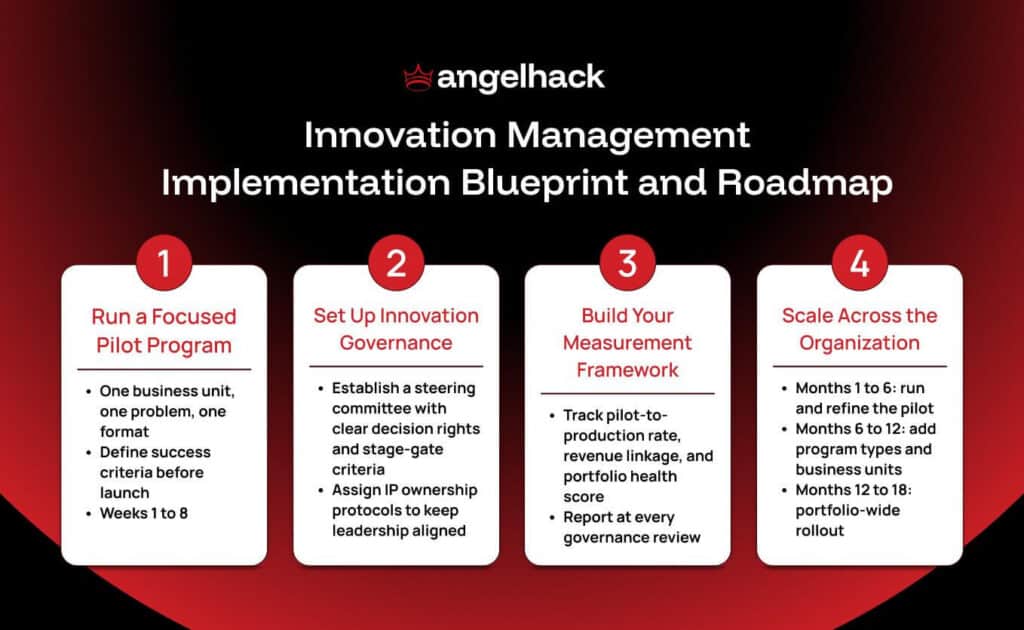
Your Innovation Management Implementation Blueprint and Roadmap
Most organizations know what they want to achieve with innovation, but not all of them have a clear, phased plan for getting there. Here is a practical blueprint to structure the journey from pilot to portfolio-wide program.
Pilot design (Weeks 1 to 8)
Starting small is not a compromise. It is the smartest way to build momentum without overcommitting resources. Most organizations are better served by proving the model in one focused area before scaling it everywhere.
- Choose one business unit, one problem domain, and one program format
- Secure an executive sponsor and assemble a cross-functional team before anything goes out the door
- Define clear success criteria upfront so there is no ambiguity about what a good result looks like
- Treat the pilot as a chance to identify issues, test feasibility, and fine-tune the process before committing to a full-scale rollout
Governance setup (before program launch)
Solid governance is what separates programs that scale from programs that stall. Without clear ownership and decision rights, even well-designed programs lose momentum between stages.
- Establish a steering committee with clear decision rights and stage-gate criteria
- Assign IP ownership protocols and prepare executive briefing materials so leadership is aligned from the start
- Schedule quarterly reviews to assess portfolio health and keep programs on track
Measurement framework
What gets measured gets managed. Revenue linkage should be built into your reporting from day one, not added as an afterthought.
- Pilot-to-production rate: The share of proof-of-concept projects that reach full deployment, widely considered the most important single indicator of program health
- Revenue linkage: Track how innovation outcomes connect directly to sales growth and report this at the board level
- Portfolio health score: A composite rating that evaluates the balance and quality of your innovation pipeline across three horizons: incremental improvements to existing products, adjacent opportunities in new markets or segments, and transformational bets that could redefine the business.
- Idea-to-pilot conversion rate: The percentage of submitted ideas that make it through evaluation and into an active pilot.
Pair these with a risk-versus-impact matrix, a simple tool that plots each project by potential business impact against execution risk so resources flow to the initiatives most likely to deliver, and use an ROI dashboard that consolidates your key metrics into a single view for leadership at every governance review.
12 to 18 month roadmap
Once the pilot is complete, here is how to scale it. Organizations that commit to a structured multi-phase rollout are significantly more likely to achieve portfolio-wide adoption than those that try to scale everything at once.
Months 1 to 6: Run and learn
- Launch your pilot with a clearly scoped challenge, defined participants, and agreed success metrics
- Focus on execution quality, not scale
- Run a structured retrospective after the event covering what worked, what did not, and which outputs showed the most promise
- Use the learnings to refine your challenge design, outreach strategy, and post-event evaluation process
Months 6 to 12: Expand and integrate
- Bring additional business units into the program and introduce new formats alongside your original one
- Connect hackathon outputs to existing innovation pipelines such as accelerators, product roadmaps, or venture-building processes
- Formalize governance structures including stage-gate criteria, IP protocols, and quarterly review cadences
Months 12 to 18: Scale and institutionalize
- Move from a program to a repeatable capability with portfolio-wide adoption
- Establish a recurring annual calendar with clear ownership at both program and executive level
- Report innovation metrics at the board level and allocate resources based on portfolio performance rather than individual program advocacy
- At this stage, innovation should feel like a standard operating rhythm, not a special initiative
Innovation Management at Scale: How AngelHack Can Help
Since 2011, AngelHack has been a trusted partner to technology leaders including IBM, Mastercard, Google Cloud, and NASA. We design and run open innovation programs that help enterprises leverage the global developer communities to innovate faster.
We work with enterprises across four core areas:
- Developer Relations: Build lasting relationships with the developer community and turn them into active contributors to your ecosystem
- Developer Marketing: Drive meaningful awareness and adoption of your technology among the right developer audiences
- Corporate Innovation: Run structured programs that surface high-quality external ideas and feed the strongest ones directly into your business portfolio
- Talent Recruitment: Identify and connect with skilled builders from a global community of engaged developers
Whether you are launching your first innovation program or scaling an existing one, we bring the expertise, the community, and the operational infrastructure to make it work.
The Bottom Line
Innovation management in 2026 is a repeatable discipline, not a department or a one-off event. The organizations pulling ahead are the ones that have built the right governance, talent, and programs to deliver sustained value. External innovation programs, designed strategically and run with rigor, are among the most powerful tools available to corporate innovators today.
Scale Your Innovation Program With Experts
Whether you are launching your first innovation program or scaling an existing one, AngelHack brings the expertise, the community, and the operational infrastructure to make it work.
Talk to UsFrequently Asked Questions
What is innovation management and why does it matter in 2026?
Innovation management is the systematic process of moving ideas through discovery, validation, and scaling in a way that is aligned to corporate strategy and governed by clear decision rights. In 2026, the pace of change in technology and market dynamics means organizations that treat innovation as a disciplined portfolio practice consistently outperform those running ad hoc efforts.
What is the difference between incremental and breakthrough innovation?
Incremental innovation improves existing products or processes with lower risk and shorter cycles, measured by efficiency and customer satisfaction. Breakthrough innovation creates new markets with higher risk, longer time horizons, and metrics focused on long-term growth. Both are important but require different governance models, funding structures, and success criteria. Running them through the same process tends to disadvantage both.
What types of external innovation programs should companies consider?
The main formats are open innovation challenges, crowdsourcing campaigns, innovation accelerators, co-creation sprints, and internal innovation labs. The right choice depends on your business objective, time horizon, and how openly you can share your problem statement. Match the format to the goal, not to what is most familiar.
How do you measure the ROI of an innovation program?
The most important metrics are pilot-to-production rate, revenue linkage, portfolio health score, and idea-to-pilot conversion rate. A useful framework pairs a risk-versus-impact matrix with an ROI dashboard that reports to leadership at defined governance intervals, keeping innovation visible at the board level.
How can AngelHack support our open innovation goals?
AngelHack designs, executes, and scales external innovation programs for enterprises globally. We support the full spectrum of program types with end-to-end capability, from initial strategy to execution and post-program evaluation. If you want to understand where your organization stands and what to build next, book a strategy call with us.