
Hackathons are one of the most efficient innovation formats available. The question is not whether hackathons work. It is whether yours will. That depends less on your challenge brief or your prize pool and more on who is running the program with you. This guide walks you through what “run well” actually means, and how to find the hackathon agency that can deliver it.
Why Hackathons, and Why Now?
The conditions for a great hackathon have gotten a lot better over the years. Smarter tools, bigger communities, faster outputs. If you have been on the fence about running one, here is why 2026 is the right moment.
- Generative AI has raised the quality floor. Open-source models like Meta’s Llama and Mistral give participants enterprise-grade building blocks without licensing friction. Functional prototypes that once took months now get shipped in 48 hours.
- Formats have evolved. Virtual and hybrid hackathons have eliminated geographic barriers entirely. Your participant pool is now global by default.
- The community has scaled. According to GitHub’s Octoverse 2025 report, the platform alone hosts more than 180 million developers worldwide, with over 36 million joining in just the past year.
Even AI-native companies have taken notice. Meta’s Llama Impact hackathon series and Google’s 2024 AI Hackathon program both treat hackathons as core go-to-market tools, not side experiments. For organizations competing in developer-driven markets, hackathons are becoming competitive moats. They activate communities, surface talent, and generate co-developed solutions faster than any internal R&D sprint.
So the opportunity is real. But capturing it requires more than booking a venue and opening a registration form. That brings us to the question most teams underestimate.
Why You Actually Need a Hackathon Agency
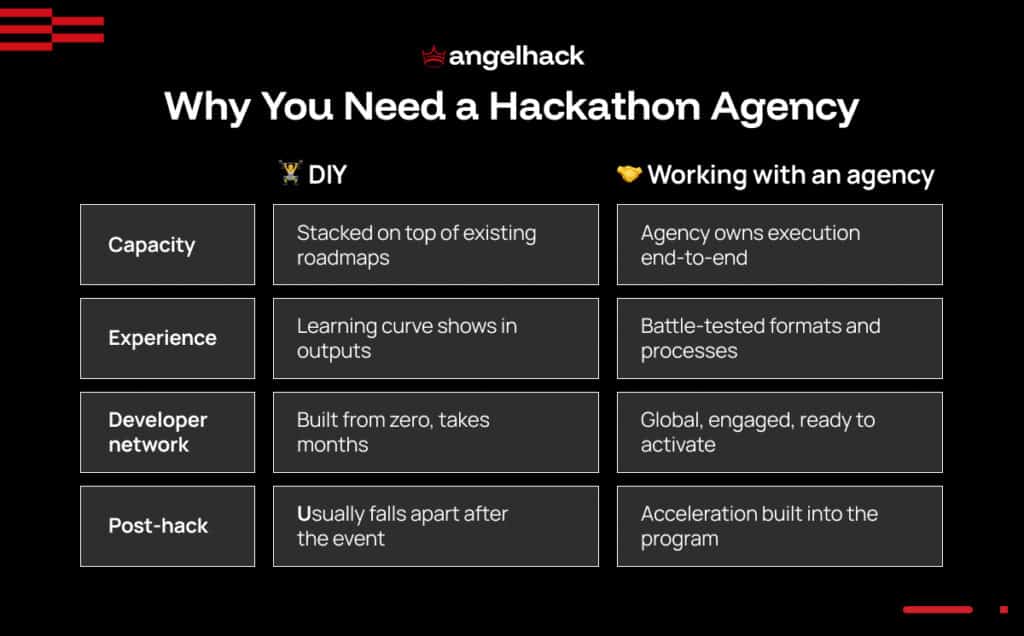
Many teams start with the assumption that they can run a hackathon themselves. After all, it is just an event, right? In practice, the organizations that go the DIY route almost always hit the same wall:
- Your team is already at capacity. Planning and running a high-quality hackathon is not a side task. It requires dedicated time for outreach, platform setup, sponsor coordination, mentor recruitment, judging logistics, and post-event follow-through. Stacking that on top of existing roadmaps is a recipe for a mediocre event and a burned-out team.
- Hackathon experience is genuinely specialized. Knowing how to structure a challenge brief, promote to the right audience, manage live troubleshooting during the event, and evaluate prototypes fairly are skills most internal teams simply have not built. The learning curve shows up in participation rates and output quality.
- You probably do not have the network. This is the biggest hidden gap. An experienced hackathon agency brings thousands of pre-engaged developers, vetted mentors, and credible judges. Building that from scratch for a single event takes months and rarely produces the same quality of participation.
- Post-hack follow-through is where most DIY programs fall apart. Getting to a finished event is one thing. Converting the best prototypes into actual pilots, partnerships, or hires is an entirely different capability. Agencies that do this well build it into the program design from day one.
The goal was never a great event. It was pilots, partnerships, and ecosystem growth. And a good hackathon agency brings an established developer community, handles the operational weight, and makes sure your team can focus on what the program was always meant to deliver.
How to Choose a Hackathon Agency: 9 Things to Evaluate
So you are ready to find a partner. Not all agencies are built the same, and the gap between a good one and a mediocre one shows up in ways that are hard to recover from mid-program. Before you start scoring, it helps to understand what type of agency you are actually looking for:
- Full-service agencies handle everything from program design to post-hack acceleration. Strongest fit for enterprise programs with multiple objectives.
- Platform-first agencies provide the technology and a registered developer base but leave most execution to your team. Best for well-defined, self-directed challenges.
- Recruitment-focused platforms run hackathon-style challenges primarily as a talent screening tool rather than a co-innovation format. Best when hiring is the primary goal.
- Innovation management platforms are built for structured idea collection and evaluation. Best for organizations with existing internal innovation processes that need software support.
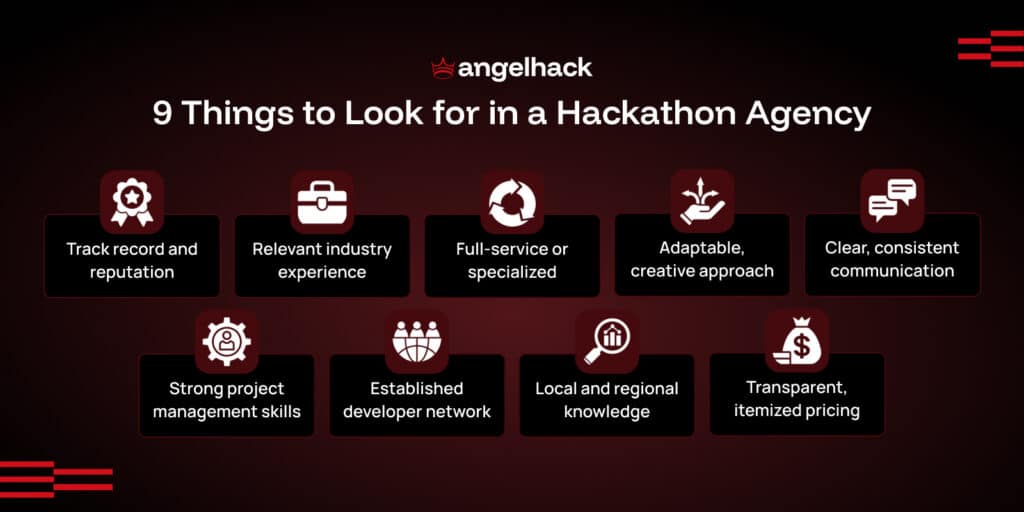
Once you know which type fits your objectives, score every candidate across these nine dimensions:
- Reputation: Look for verifiable case studies, named client partnerships, and industry recognition. A polished website is not evidence.
- Experience and expertise: Has this agency run events at your scale, in your industry, and with your type of developer community? Technical setup capability and community engagement experience both count.
- Service range: Most agencies specialize in one area, whether that is marketing, logistics, or platform. Very few operate end-to-end. Confirm they can cover everything you need – from program design to post-event reporting.
- Creativity and flexibility: Can they innovate within the format? Can they adapt when things change on the ground? Rigid playbooks break under real-world conditions.
- Communication: Frequent updates, transparent progress tracking, and a genuinely collaborative working style are non-negotiable. Poor communication is the most common cause of hackathon failure.
- Project management: Detail-oriented execution requires proper tooling and experienced coordinators who can resolve issues fast without escalating every decision.
- Developer network: A strong existing community directly shapes participant quality, mentor caliber, and judge access. Agencies without one are starting from zero on your timeline.
- Location knowledge: For multi-city or international programs, local familiarity with venues, suppliers, and regulations is essential, not a nice-to-have.
- Budget transparency: Low headline quotes frequently hide add-on costs for participant recruitment, platform access, and post-event moderation. Always request a fully itemized breakdown.
Score every candidate agency against all nine criteria before you request a formal proposal. With those criteria in hand, let’s look at who is actually in the market.
The Hackathon Agency Landscape: Who Does What
The hackathon agency market is more varied than it looks from the outside. Each player has a genuine sweet spot, and choosing one that does not match your objectives is just as costly as choosing none at all. Here is an honest breakdown of the main options.
AngelHack
AngelHack is the go-to choice for organizations running end-to-end hackathon programs. With 15 years of experience and enterprise partnerships that include Google, IBM, Microsoft, AWS, and NASA, the team operates at true global scale. Their developer community spans 500,000+ members across 140+ community partners worldwide.
What sets AngelHack apart is its flexibility. Whether you need full end-to-end delivery or want to plug in support for specific parts of your program, the team works around your setup. Their services include:
- Program strategy and design tailored to your goals
- Marketing, outreach, and participant recruitment at scale
- Event management across virtual, hybrid, and in-person formats
- Platform hosting and technical setup via StackUp
- Post-hackathon acceleration built in as a core deliverable
For organizations building broader Developer Relations programs beyond hackathons, AngelHack also offers the full package with bounties, quests, events and incubators.
Major League Hacking (MLH)
MLH has built one of the most recognizable brands in hackathon culture, especially on university campuses. With a community of 600,000+ student developers, their strength is in early-career reach and collegiate credibility.
Here is what you get with MLH:
- A 600,000+ member community of student and early-career developers
- A strong pipeline for campus-focused talent recruitment programs
- Established credibility and trust among university audiences globally
- Reliable event execution within the student hackathon format
Where MLH falls short is at the enterprise level. Post-hack acceleration and co-innovation outcomes are not their focus. If your goal is pilot-ready prototypes or ecosystem activation, MLH is not the right fit. If you are building a campus talent pipeline, it is hard to beat.
Devpost
Devpost operates primarily as a self-serve platform rather than a full-service agency. It powers a large number of the world’s online and in-person hackathons, with customers including AWS, Google, Meta, Microsoft, and IBM.
What Devpost offers:
- A self-serve challenge setup, submission, and judging platform
- Strong visibility and discoverability for product-focused developer challenges
- A broad global registered developer base across many technical disciplines
- Low management overhead for teams running autonomous, well-defined challenges
The tradeoff is real: participant quality can be variable, and there is minimal curation, mentorship coordination, or post-event follow-through. Best suited for product-led challenges where developer autonomy is the goal.
Agorize
Agorize is a global innovation management platform with a global community of innovators and a client base that spans Europe, North America, and Asia Pacific. They have worked with enterprise organizations including Huawei, LVMH, PepsiCo, Bayer, Schneider Electric, and L’Oreal.
Where Agorize fits well:
- Large enterprises with mature internal innovation programs seeking a platform-first approach
- Organizations that want structured digital workflows for crowdsourcing and evaluation
- Programs that prioritize platform reporting and idea management over hands-on community activation
- Teams running startup scouting, intrapreneurship, or open innovation programs alongside hackathons
Agorize is stronger on platform and workflow than on community-driven hackathon execution. A good fit when the innovation management infrastructure is the priority and you have an existing audience to bring to the challenge.
HackerEarth
HackerEarth is primarily a developer recruitment and technical skills assessment platform, with a global community of developers. Their core product helps organizations source, screen, and hire technical talent at scale through coding tests, video interviews, and hackathon-style challenges.
When HackerEarth makes sense:
- Your primary objective is screening and hiring developer talent at scale
- You want skills-based assessments integrated with your recruitment funnel
- You are running campus hiring or lateral recruitment programs
- Internal HR or talent acquisition teams are the primary stakeholders
If co-development, ecosystem activation, or post-hack prototypes are on your agenda, HackerEarth is the wrong tool. It solves a recruitment and assessment problem, not a co-innovation problem.
BemyApp
BemyApp is a global hackathon agency that has organized hundreds of events across 35+ countries since 2010, with a developer community of 400,000+ members. Their client roster includes Google, Samsung, Intel, JPMorgan Chase, Microsoft, Salesforce, and the European Commission, spanning both tech and non-tech industries.
Where BemyApp adds value:
- Organizations looking for an experienced full-service hackathon agency with a global track record
- Programs spanning internal innovation sprints, external developer competitions, and university challenges
- Companies that want a white-labeled event platform alongside managed execution
- Teams running developer programs in Europe where BemyApp has particularly deep roots
BemyApp’s post-hack acceleration offering is more limited compared to agencies with built-in incubation programs. A strong option for organizations that need proven global delivery across formats, particularly when a white-labeled platform is a requirement.
Agency Comparison at a Glance
| Agency | Best For | Geographic Reach | Enterprise Track Record |
|---|---|---|---|
| AngelHack | Both virtual & in-person hackathon formats End-to-end or modular hackathon management | Global | P&G, AWS, DBS Bank, Google, NASA |
| MLH | Student & early-career talent pipelines | North America, Europe | University & campus programs |
| Devpost | Companies needing a self-serve hackathon platform | Global | AWS, Google, Meta, Microsoft |
| Agorize | Enterprise innovation management platform | Global | Huawei, LVMH, PepsiCo, L’Oreal |
| HackerEarth | Developer recruitment & skills assessment | Global | Amazon, Walmart, GE, Barclays |
| BemyApp | Global hackathons & innovation challenges | Global | Google, Samsung, Intel, JPMorgan |
Use this table as a quick reference when shortlisting agencies against your objectives.
How to Choose a Hackathon Agency: A Three-Step Process
With the landscape clear, here is how to move from research to a decision you can actually stand behind.
Step 1: Define Your Objectives First
Before you contact any agency, get clear on four questions. The answers will eliminate half the field immediately.
- What is your primary goal? Talent acquisition, product co-development, ecosystem activation, or internal innovation?
- What is your geographic scope? Single market, multi-market, or global?
- What post-hack outcome do you actually need? Brand awareness, accelerated product adoption, pilot-ready prototypes, or formal partnerships?
- What is your realistic budget? Under $50K typically aligns with self-serve platforms. $50K to $200K supports a well-managed regional program with a full-service hackathon agency. Above $200K, you are in multi-market or large-scale hybrid territory.
Step 2: Start the Search Early
This is where most teams get caught out. A great hackathon program takes time to design properly, and agencies with strong developer networks book up early.
- Start your agency evaluation 4 to 5 months before your target event date
- Shortlist two to four agencies with portfolios relevant to your objectives
- Request detailed proposals and fully itemized cost breakdowns from each
- Ask for references from programs similar to yours in scale and industry
Step 3: Evaluate and Compare
Now put the nine-criteria framework to work. Score each agency, compare references, and pay close attention to one thing in particular:
- Confirm that post-hackathon support is explicitly included in scope, not listed as an optional upgrade
- Require a full cost breakdown before any commitment, not just a headline figure
- Look for demonstrated experience in your industry or format, not just generic hackathon delivery
- Ask how they handle situations when things go wrong, not just how they describe success
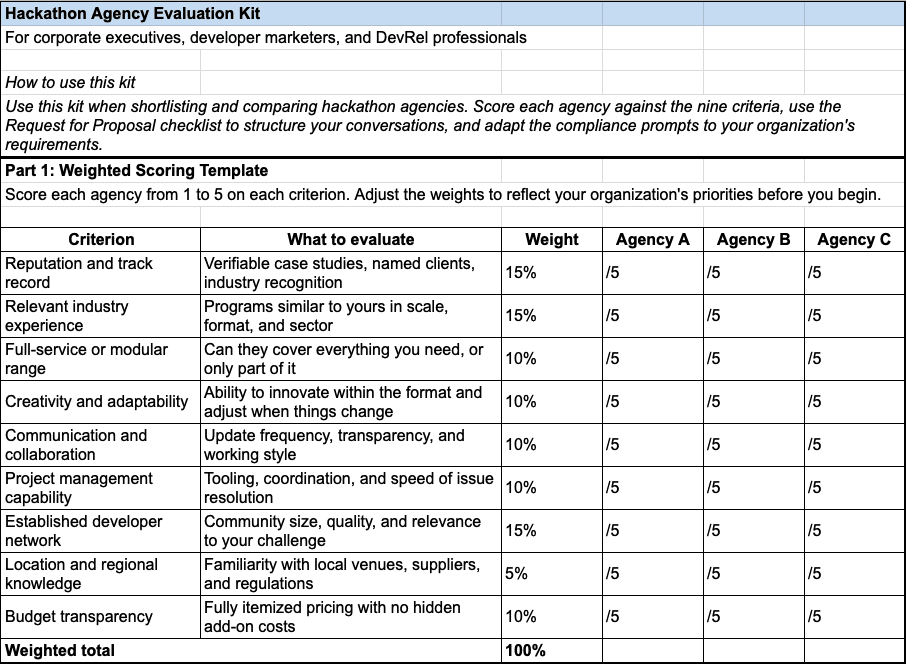
To make this easier, we’ve put together the Hackathon Agency Evaluation Kit: a 20-question RFP checklist, a weighted scoring template across the nine criteria, and IP and compliance prompts you can adapt for your organization. Download it and go into every agency conversation with the right questions already in hand.
Download the Hackathon Agency Evaluation Kit →
Final words
Not every company needs a hackathon agency. But when you do, the right partner takes a lot off your plate and raises the bar at the same time. They bring in an existing developer community, handle the heavy operational work, and keep everything moving so your team can stay focused on the hackathon outcomes, not logistics. The best agency will be able to help companies turn a one-off event into a repeatable innovation pipeline that keeps delivering long after the first hackathon ends.
How AngelHack Can Help
AngelHack has been running hackathons for enterprises across every format and geography for 15 years. End-to-end or modular, the team designs around your objectives and builds post-hack acceleration from the start, not as an afterthought.
Ready to see what your program could look like?
Book a complimentary consultation with the AngelHack team and get a proposal built around your 2026 goals.
Talk to UsFrequently Asked Questions
What does a hackathon agency do?
It manages the full program lifecycle: strategy, participant recruitment, logistics, platform setup, mentorship, judging, and post-hack follow-through. The best agencies also run post-event acceleration to convert winning prototypes into real pilots. The key difference from DIY is that they bring an existing developer community and operational infrastructure you cannot easily replicate internally.
How much does it cost to hire a hackathon agency?
Costs vary based on scope and format. As a rough guide: under $50K typically means self-serve platforms; $50K to $200K covers a full-service regional program; $200K and above is for multi-market or large-scale global events. Always ask for a fully itemized proposal because low headline quotes often hide significant add-on costs.
What are the main types of hackathon agencies?
There are 4 main types: Full-service agencies handle everything from program design to post-hack acceleration. Platform-first agencies give you the technology but leave most execution to your team. Recruitment-focused platforms use hackathon-style challenges primarily for talent screening. And innovation management platforms suit organizations that need structured idea collection and evaluation workflows.
How do I measure hackathon ROI?
Track it across four areas: participant quality (numbers, geographies, skill levels), output quality (prototypes submitted and their technical depth), post-hack conversion (how many ideas became pilots or formal collaborations), and ecosystem growth (new developers onboarded, API adoption rates). Define your success metrics before the event starts, not after.
How far in advance should I start planning?
Four to five months before your target date at a minimum. This covers RFP processes, proposal comparison, contract negotiation, and program design before participant recruitment begins. For large-scale multi-city programs, six months is safer.