
The teams get the applause, but a hackathon runs on someone you rarely see on stage. Long before anyone starts building, the hackathon organizer sets the goal, shapes the challenge, and clears the path from prototype to pilot.
A good organizer takes a fuzzy goal like “we should do something with AI” and turns it into a time-boxed program that produces working prototypes a business can act on. Get the setup right and the event becomes a pipeline. Get it wrong and you get a busy weekend with little to show afterward.
This guide maps what the role takes: the skills, the tools, and how to get them. Use it as a self-audit if you’re building the capability in-house, or as a checklist if you’re sizing up an agency. For the step-by-step of running the event itself, see our guide on how to organize a hackathon.
Hackathon Organizer Skills: Strategic Planning
Before anyone writes a line of code, the organizer sets the direction. This is the part that decides whether the hackathon produces anything the business can use.
🎯
Decide what the hackathon is for:
Recruitment, internal innovation, community growth, and product feedback are different goals with different designs. Pick one as the primary. An event that chases all four delivers on none.
✏️
Turn the goal into a challenge with a point of view:
“Build something with AI” hands teams a blank page. A sharper brief gives them a finish line: “Cut average support-ticket resolution time by 30% using our last 12 months of ticket data.” The tighter the brief, the stronger the submissions.
👥
Pick the right format and the right audience:
In-person, online, and hybrid each suit different goals and budgets, and the audience you want decides which one fits. A recruitment push aimed at local graduates is a different event from a global developer challenge. Conclude on both before you design anything else.
🔗
Think in pipeline, not a single weekend:
Line up an executive sponsor, decide who owns the winning ideas, and map the path from prototype to pilot before the brief is final. Set your success metrics here too: prototypes that reach a pilot, time to proof of concept, cross-functional participation, with a baseline up front so you can show movement later.
Skip this layer and even a packed, high-energy event leaves nothing a business can act on once the room clears.
Hackathon Organizer Skills: Event Management
Strategy points the event in the right direction. Event management is the skill set that fills the room and keeps it running. These hold whether you run in person, online, or hybrid. The format changes the tactics you use, not the work itself.
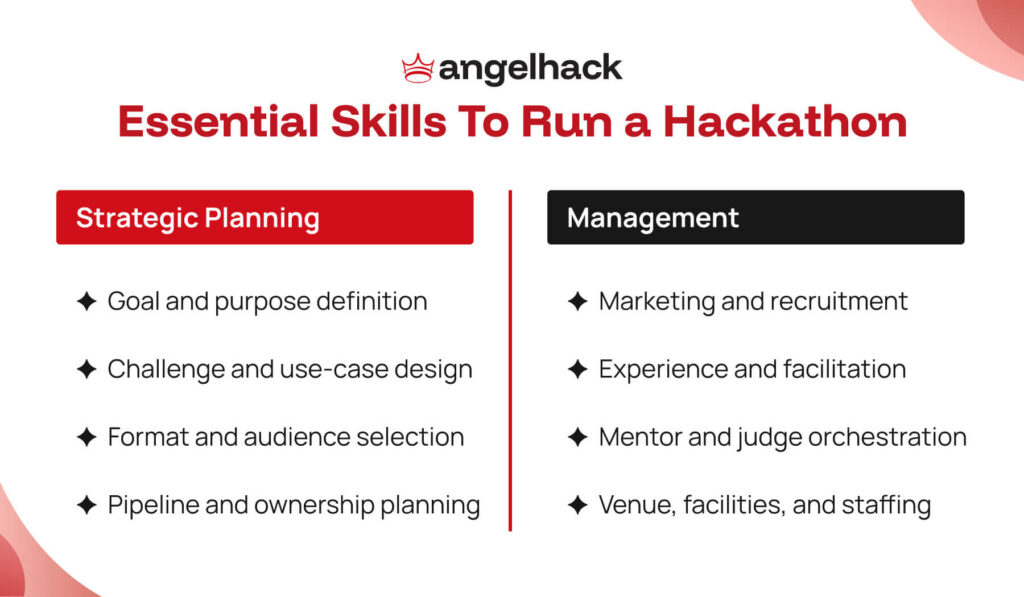
Marketing and participant recruitment
A strong challenge with no audience is an empty room. Fill it through community partnerships, past-participant outreach, and a brief sharp enough that the right builders self-select. Warm lists beat cold ads, and paid promotion needs weeks of runway.
Participant experience and facilitation
This is keeping momentum from kickoff to demo. In a room, that means on-site facilitation and unblocking teams fast. Online, it means moderating chat and spotting a disengaged team before they drop out.
Mentor and judge orchestration
Line up mentors who understand both the tech and the business, publish the scoring criteria before the event, and have judges score independently first to limit groupthink. Participants can tell within an hour whether the judging is serious.
Venue, facilities, and staffing
For in-person events this is the unglamorous part that makes or breaks the day: a space with enough power and bandwidth, food and somewhere quiet to work, and enough trained staff to handle check-in, AV, and the problems nobody planned for. Online, the equivalent is a stable platform and a support channel that answers fast.
Get this layer wrong and participants spend the weekend fighting logistics instead of building.
The Tool Stack Every Hackathon Organizer Needs
Skills decide what you do. The right tools decide how fast you can do it. Here’s a stack that covers most hackathons, grouped by function.
Platform and registration
This is the backbone that keeps sign-ups, team formation, submissions, and judging in one place instead of scattered across separate tools. We run this on our own platform, StackUp, which handles virtual hackathons, quests, and bounties end-to-end and connects you to an active community of 350,000+ developers worldwide.
Collaboration
Teams need a shared space to work and somewhere that work survives the weekend. Miro or Mural handle the live canvases, while Notion or Confluence keep the documentation after the event ends. Add starter templates for problem framing and pitch decks so teams spend their time on outcomes, not formatting.
Communication
Clear channels keep participants, mentors, and organizers aligned in real time. Slack, Discord, or Teams cover announcements, team rooms, and mentor help, while Zoom or Meet carry kickoffs, mentoring, and judging for remote crowds.
Developer and data
Builders should be solving the challenge, not fighting their setup. Pre-configured cloud sandboxes on AWS, Azure, or GCP and repositories on GitHub or GitLab get them coding fast, and access-managed datasets and APIs with real docs keep them unblocked. Friction here on day one is the fastest way to lose a team.
Evaluation and analytics
Good tooling makes judging fair and gives you a read on the room. Digital judging forms standardize scoring, a live participation dashboard shows engagement as it happens, and pre- and post-event surveys catch problems while you can still fix them.
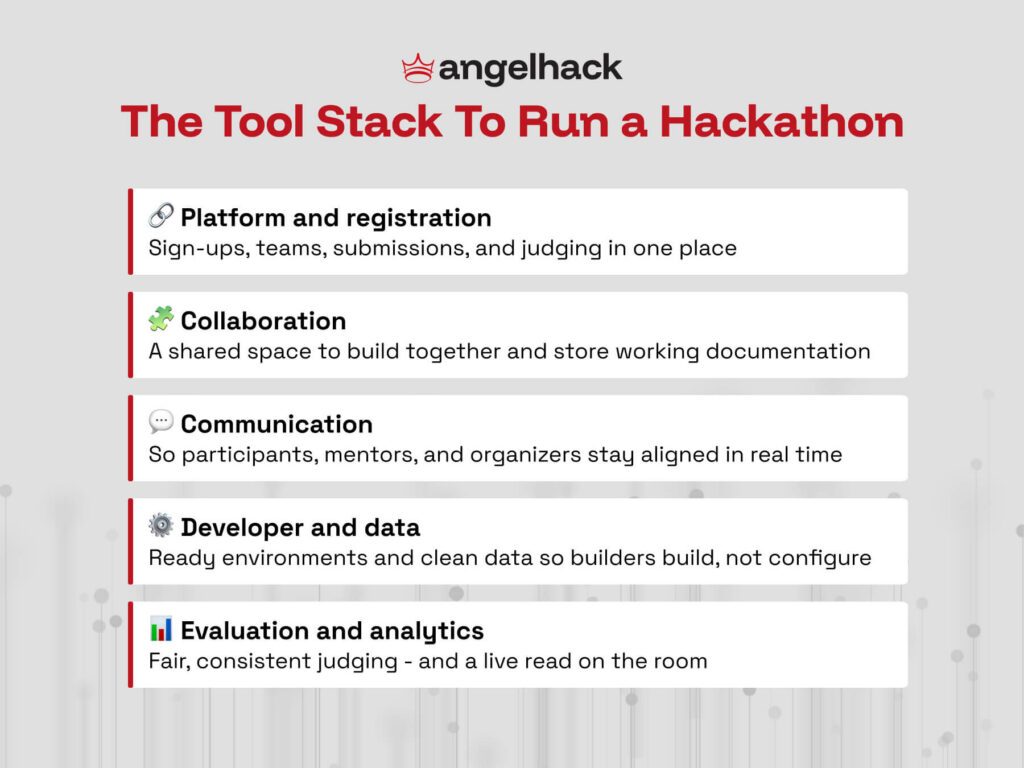
The tools are the easy part to buy. Matching them to your format and your skill gaps is the harder problem, and that comes down to who owns the work.
Getting the Hackathon Skills You Need: Build, Hire, or Partner?
Most companies have these skills scattered across teams, with nobody owning the whole picture. There are three honest ways to fix that.
👩🏻💻
Build internally
Best when you run hackathons regularly and want the capability to grow over time. Put one organizer in charge end-to-end, with real budget and decision rights — not just the title. Volunteers can support delivery, but they won’t carry the program.
📢
Hire for the gap
When one piece is missing rather than the whole set. For most internal teams that gap is marketing and event management, not strategy. A dedicated organizer closes it faster than a product manager running an event on top of a day job.
🤝
Bring in an agency
When the math doesn’t work any other way: a tight timeline, a flagship event, or too few events a year to justify a full-time hire. An agency brings skills, and a developer network from day one so you’re not building all three from scratch under deadline.
An experienced hackathon agency like AngelHack brings the skills, tooling, and a developer network from day one, so you’re not building all three from scratch under deadline.
Choose wrong here and you either burn budget on a hire you can’t keep busy, or stretch a team that’s already full until the event slips.
Final Words
The highest-return programs usually pair an internal owner who holds the strategy with an external partner who handles execution. Get that balance right and hackathons stop being one-off events and start compounding into a real innovation pipeline.
We’ve run 450+ hackathons across 100+ cities for 200+ clients, plugging in wherever a team needs a strategy consultant, an operations partner, or a developer network. Tell us the outcome you need on a quick 30-minute call and we’ll design the program that gets you there.
Need Expert Support to Launch an
Impactful Hackathon?
If you want a hackathon built on 15+ years and 450+ events of what actually works, book a consultation with our team. Let us map out your goals, close the gaps, and build the program structure that gets you there.
Schedule Your CallFrequently Asked Questions
What are the most important skills of a hackathon organizer?
Strategy comes first: tying the challenge to a real business decision so the output is usable. After that, stakeholder management, recruitment, facilitation, and measurement.
How do online and in-person organizing skills differ?
The skills are the same; the tactics shift. In-person leans on logistics and on-site energy. Online leans on community building, remote moderation, and time-zone fairness.
What is the minimum viable tool stack for a hackathon?
Five things: a hackathon platform, a chat channel, a collaboration board, a judging form, and a feedback survey. Everything else is an upgrade.
How do you tell whether a hackathon organizer or agency is competent?
Ask for named programs with real numbers, an end-to-end service range, a developer network they can activate, and a clear way to measure outcomes. Then ask how they handle the post-event handoff.
What mistakes do hackathon organizers often make?
No challenge tied to a business decision, no owner for the winning ideas, weak recruitment, fuzzy judging criteria, and no measurement plan. Each one turns a promising event into a sunk cost.