Ramón Aguileira and Santiago Caprioli took second in the Sustainability track at Hedera’s Hello Future Apex Hackathon. Here’s how they built verifiable carbon proof for a real recycling business, what broke along the way, and what the win opened up.
Ramón had spent months proving something he couldn’t put on paper. His company, Eggologic, takes in 300 to 600 kg of restaurant food waste a week in Maldonado, Uruguay, and turns it into eggs, protein, and compost through a closed biological loop. What he couldn’t do was prove that impact to a customer or a carbon buyer, because the only recognized way to verify it was a formal MRV audit that runs north of $10,000, more than a small operator can justify. At Hedera’s Hello Future Apex Hackathon, Ramón and his co-founder Santiago Caprioli built the proof themselves, wiring the whole operation into a verifiable system on-chain. The project finished second in the Sustainability track.
The Hello Future Apex Hackathon was the finale of Hedera’s three-part Hello Future Trilogy, a five-week virtual build with a $250,000 prize pool hosted by AngelHack.
Can you tell us about yourselves and the business behind the project?
Ramón: I’m the founder of Eggologic. We run a circular-economy operation in Maldonado, Uruguay. A restaurant partner hands us 300 to 600 kg of organic waste a week, and we run it through a closed loop: Black Soldier Fly larvae convert the scraps into protein, the larvae feed laying hens, the hens produce eggs, and whatever’s left becomes compost. It keeps methane-producing waste out of landfills. The problem was proof. We’re doing real environmental work every week but had no way to prove it without spending $10k+ on an MRV audit we can’t afford.
Santiago: I’m the co-founder and technical lead, based in Argentina. Most of my blockchain experience has been inside the Ethereum network, so Hedera was new to me. Apex was my fourth hackathon but my first on Hedera. My experience within the Hedera ecosystem before Apex was basically null.
What made the Apex hackathon the right place to build this?
The idea wasn’t really invented for the hackathon, it came straight out of a problem we already had.
Ramón: The idea wasn’t really invented for the hackathon, it came straight out of a problem we already had. Hedera has a policy engine called Guardian that lets you write your own environmental methodology into a policy that runs on the network. That was exactly what we needed, a way to make every waste delivery something anyone can check instead of a line in a spreadsheet. The Sustainability track was the obvious fit.
What does Eggologic actually do, on-chain and off?
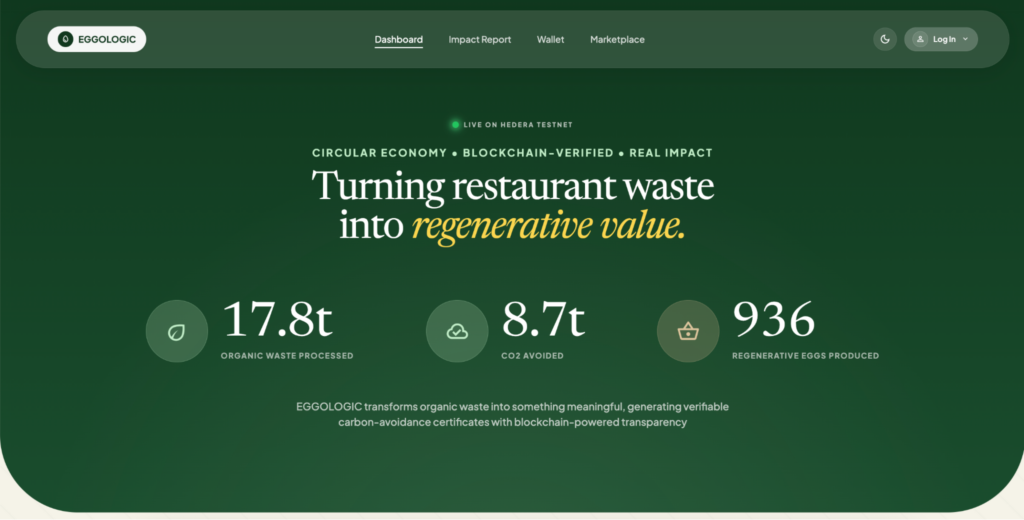
Ramón: Off-chain, it’s the recycling loop. On-chain, we record each step of that loop as a verifiable credential on Hedera. We adapted an established UN carbon methodology into our own policy, which we call EWD-RB, and built it across four parts:
- Guardian (Managed Guardian Service): the policy engine, 8 data schemas and 5 roles that mirror the real operation
- Consensus Service: timestamps every policy message into a tamper-proof trust chain
- Token Service: mints two tokens, EGGOCOIN rewards to the restaurant on an approved delivery, and a Circular Impact NFT on an approved impact calculation, where one NFT equals one tonne of CO2 avoided
- Mirror Node and a lightweight dashboard: reads balances straight from the network, so anyone can verify the record on the public explorer
Nothing mints until a verified reviewer approves real data first.
What was the hardest part to build?
Santiago: Taking something messy and physical and forcing it into Guardian’s schema logic. Weighing scraps, grading contamination, timing when the larvae finish converting, all of it had to fit a rigid structure and still trigger the right token at the end. We tried easily +12 times before getting the first one right, and then we had to do it again two more times. You need a zen-ish “try again, you’ve learned” mentality. The fix was real data. Testing with actual delivery numbers from our restaurant partner surfaced the edge cases that made-up figures would have hidden. I also picked up the security side, like when and why to use AWS key management for the credentials that sign each record.
What did taking second place set in motion?
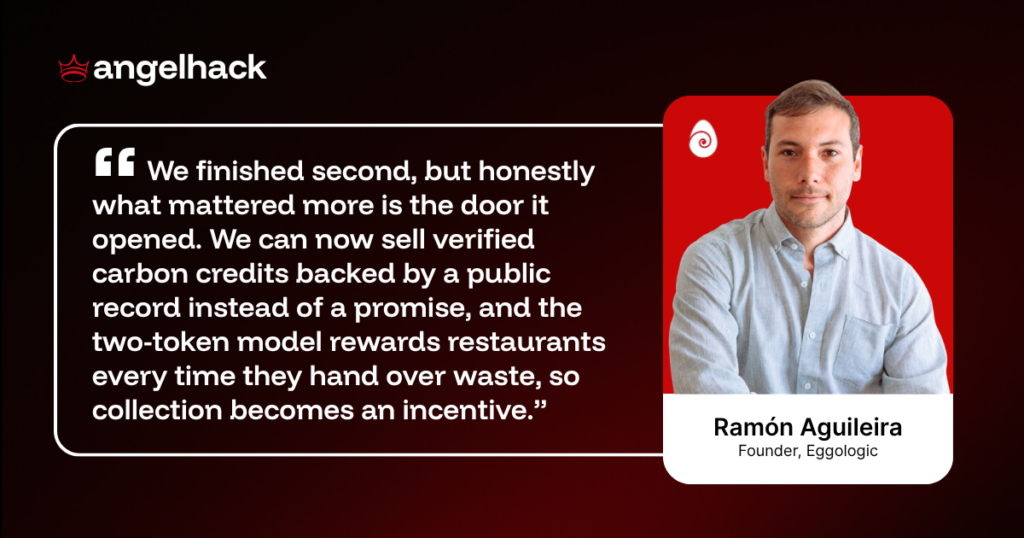
Ramón: We ended up 2nd in the Sustainability track, with a $13,500 prize. But honestly what mattered more is the door it opened. We can now sell verified carbon credits backed by a public record instead of a promise, and the two-token model rewards restaurants every time they hand over waste, so collection becomes an incentive. We’re now going after the DLT Earth Guardian bounty, a Hashgraph Association grant, and a national grant here in Uruguay through INIA. A V2.0 is already in testing, aiming for a public testnet launch by the end of Q3.
What was the hackathon experience like?
You could tell people were building things they actually cared about, not just chasing a prize.
Ramón: Really good energy. You could tell people were building things they actually cared about, not just chasing a prize. The mentors were generous with their time and asked sharp questions that pushed us to defend our numbers, which made the project better. There was a genuine interest in the project itself, not just in the competition part of it.
Santiago: The sessions were warm, and everyone was incredibly helpful and kind. I personally reached out to some of the mentors so many times that all I can say is thank you and sorry to them.
What would you tell a first-time hackathon builder?
Ramón: If you can, walk in with something real. Teams starting from zero are inventing a problem and a solution at the same time under a ticking clock. We already had both.
___________
The Hello Future Apex hackathon drew in builders with real problems worth solving, and gave them the tools and mentorship to prove their solutions on Hedera. Eggologic is just one of those stories.
Thinking about a hackathon for your organization? Start a conversation with the AngelHack team.