💡 TL;DR:
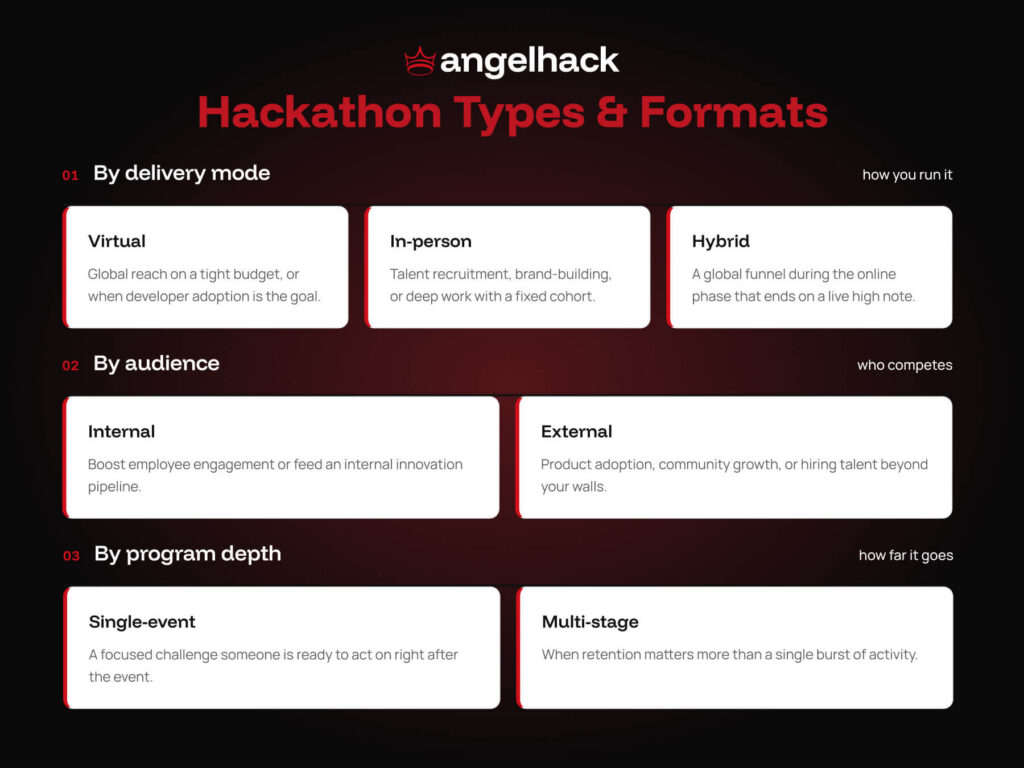
Choosing a hackathon format means three decisions that shape your reach, cost, and results, whether you run the event in-house or bring in a hackathon agency.
- Delivery mode: how you run it, virtual, in-person, or hybrid
- Audience: who competes, your employees or the outside community
- Program depth: how far it goes, a single event or a multi-stage pipeline
- Start from the outcome you need, and the right mix of the three follows
A hackathon is a time-boxed event where teams build working prototypes against a defined challenge. What started as a niche developer pastime is now one of the most reliable ways companies drive innovation, tool adoption, and problem-solving. But hackathons come in many shapes: virtual or in-person, internal or external, a single weekend or a months-long program. This article covers the main types and formats, the pros and cons of each, and when you should choose one over another.
By delivery mode
Delivery mode is the first decision most organizers face. It sets your reach, your budget, and the kind of energy the event generates.
Virtual hackathon
A virtual hackathon runs entirely online, with participants building and submitting from anywhere. Registration, team coordination, and judging happen on a shared platform, often over days or weeks.
✅ Pros:
- Reaches a global talent pool, since anyone with an internet connection can join
- Lowest cost per participant, with no venue, catering, or travel to fund
- Fast to launch and scale on an existing platform
❌ Cons:
- Energy is harder to sustain when no one shares a room
- Informal networking and spontaneous collaboration thin out online
- Drop-off climbs without active community management throughout the event
Go virtual when you want global reach on a tight budget, or when developer adoption is the goal. Consensys ran a three-month virtual hackathon that drew 1,600+ participants worldwide.
In-person hackathon
An in-person hackathon gathers participants in one physical space for the duration of the event. Teams build side by side, usually over one to two intense days.
✅ Pros:
- High energy and momentum that a screen rarely matches
- Faster problem-solving when teams and mentors sit together
- A memorable brand moment and strong face-to-face networking
❌ Cons:
- Venue, catering, and travel costs add up quickly
- Headcount is capped by the size of the space
- Geography limits who can realistically attend
Pick in-person for talent recruitment, brand-building, or deep work with a fixed cohort. BrainHack, DSTA Singapore’s flagship event, ran its TIL-AI track as an online qualifier that drew 800 registrations, then brought the top 32 teams together in person for live semi-finals and finals.
Hybrid hackathon
A hybrid hackathon combines an online build phase with an in-person finale. Participants compete remotely, then top teams gather live to pitch and demo.
✅ Pros:
- Global reach during the online phase, wide top of funnel
- The energy and payoff of a live final for the best teams
- A natural filter that rewards the strongest projects with a stage
❌ Cons:
- Two operating models to plan and run at the same time
- More coordination across phases, tools, and time zones
- Higher production cost than either format on its own
Reach for hybrid when you want a global funnel that ends on a high note. The AWS hackglobal series ran across 25 cities using this hybrid model.
By audience
The audience decides who competes: your own people or the wider community. Each serves a different goal, and the choice shapes everything from challenge design to marketing.
Internal hackathon
An internal hackathon is open only to employees of the hosting company. It gives staff dedicated time to build outside their usual roles, often across departments.
✅ Pros:
- Surfaces hidden talent and skills that day jobs keep buried
- Breaks down silos as people build across teams
- Lifts engagement and morale, and it’s fast to organize
❌ Cons:
- A single company produces less idea diversity than an open field
- Momentum fades fast without executive follow-through on winners
- Everyday work can pull participants away mid-event
Run an internal hackathon to boost employee engagement or feed an internal innovation pipeline. UBS ran its internal hackathon across five cities with 500+ employees, and winners pitched directly to executives.
External hackathon
An external hackathon opens the challenge to developers, students, and builders outside the company. It trades control for reach.
✅ Pros:
- Fresh perspectives from people outside your usual talent pool
- Wider brand awareness and product adoption among developers and the tech community
- A talent and innovation pipeline you can tap into long after the event ends
❌ Cons:
- Less control over who shows up and their skill level
- Needs genuine marketing spend to attract quality participants
- More screening and support to keep submissions on track
Open it up externally for product adoption, community growth, or hiring talent beyond your walls.
By program depth
Program depth is the axis most companies overlook. A hackathon can be a single event or one stage in a longer program that carries ideas forward.
Single-event hackathon
A single-event hackathon is one self-contained competition with a start, a finish, and a set of submissions. Most hackathons still work this way.
✅ Pros:
- Focused and contained, with a clear beginning and end
- Lower cost and quicker to plan than a longer program
- Well suited to a specific prompt with a clear owner for the output
❌ Cons:
- Winning prototypes often stall with no path to production
- The energy built over a weekend fades without a next step
- Little time to move from rough idea to something deployable
A single event works best for a focused challenge someone is ready to act on, for example, the BrainHack hackathon, hosted by DSTA Singapore to unveil young talent in national defense.
Multi-stage program
A multi-stage program links several phases into one pipeline, typically learn-and-earn, then a hackathon, then incubation. Each phase moves participants closer to real adoption.
✅ Pros:
- Builds a lasting talent pipeline instead of a one-off spike
- Keeps builders engaged and learning across every phase
- Moves the strongest ideas toward pilots and deployment
❌ Cons:
- Longer timeline that demands more budget and resources
- Needs sustained mentorship and follow-through to work
- Harder to keep participants committed over weeks or months
Build a multi-stage program when retention matters more than a single burst of activity. Hedera ran learn-and-earn campaigns, then a hackathon, then an incubator, moving developers from first lesson to funded project in one connected pipeline. That structure successfully engaged 5,000+ developers and incubated 7 standout projects.
How to choose the right format
The best approach is simple: work backward from the outcome you need. Before you commit, ask yourself a few questions.
- What are the quantitative and qualitative results of this hackathon?
- Who do you need in the room: your own people or the wider community?
- What’s your budget, timeline, and team capacity?
- Does a winning idea need a path to production, or is a strong prototype enough?
- What is more important: reach and brand awareness, or engagement and submission quality?
Your answers point to the right mix of delivery mode, orientation, depth, and focus. For the operational side, see our guides on how to organize a hackathon and how to choose a hackathon agency.
Conclusion
There’s no single best hackathon, only the one that fits what you want to achieve. Once you know that outcome, the format follows.
From there is the question of execution, and that’s where an experienced partner earns its keep. AngelHack has organized every hackathon format in this article end-to-end, with a track record of 200+ global organizations in the last 15 years. We offer expertise across every aspect of hackathon organization, whether you require a complete program built from the ground up or support in a single area. Tell us the outcome you need, and we’ll create the program that gets you there.
Ready to host a hackathon that drives real innovation?
AngelHack has run 500+ hackathons globally, designs programs backwards from a specific business decision, and brings a network of 300,000+ developers to every program we run. Tell us the outcome you need, we’ll design the program that gets you there.
TALK TO USFrequently asked questions
What are the main types of hackathons?
Hackathons are grouped three ways: by delivery mode (virtual, in-person, or hybrid), by audience (internal or external), and by program depth (single-event or multi-stage).
Is a virtual, in-person, or hybrid hackathon better?
None is better outright. Virtual maximizes reach and cost efficiency, in-person maximizes energy and networking, and hybrid combines both at the price of added coordination and production complexity.
Which format works best for an AI hackathon?
Most AI hackathons run virtual or hybrid to reach the widest pool of builders. Use a single event for fast proof, or a multi-stage program when prototypes need a path to pilot. For a full walkthrough, see our 2026 playbook on how to run an AI agent hackathon.
Which format suits internal innovation?
An internal, single-event or short multi-stage hackathon suits internal innovation best. It gives employees time to build across teams and surfaces talent, provided that leadership commits to acting on the winning ideas.
How long should each format run?
It varies by depth. Single-event hackathons run 24 to 48 hours, virtual events span days to weeks, and multi-stage programs run over several weeks or months from learning to incubation.