🎯 TL;DR
- What it is: Hackathon ROI compares what a hackathon gives back with what it costs. The formula is (value − cost) ÷ cost × 100.
- Value depends on your goal: brand awareness, product adoption, talent recruitment or innovation. Each one is priced differently.
- Cost includes people’s time: add internal staff and participant hours to your cash spend.
- Plan the measurement early: set targets, owners and reporting dates before launch, then report at day 30, 90 and 180.
A hackathon is one of the fastest ways to get developers building with your product, meet new talent or turn ideas into working prototypes. It’s also no small investment. An end-to-end hackathon management fee usually starts at $20,000 and can reach $80,000 depending on format and scale, before prize money. With a budget that size, management will want an ROI calculation before they approve it.
The good news is that hackathon ROI can be measured like any other investment. You need a clear goal, a fair price for each outcome, an honest cost total and a few dates to report on. This guide walks you through each one, in that order.
How to calculate hackathon ROI
Hackathon ROI uses the same formula you’d apply to any other investment:
Hackathon ROI (%) = (value − cost) ÷ cost × 100
- Value is every outcome tied to your goal, turned into money by asking what the same outcome would cost you through another channel.
- Cost is your cash spend plus the hours your team and participants put in.
- Time window is when you report. Day 90 and day 180 work well, since hires, pilots and retained users show up after the event.
Don’t worry if the number looks low at day 90. A good share of the value arrives later, which is why it helps to agree the window upfront. Before you can price any of that value, though, you need to decide what you’re measuring it against.
Pick your hackathon goal first
A hackathon can deliver several things at once, but your ROI needs one primary goal. That goal decides which outcomes you count, how you price them and who owns the result after the event. Here are four common goals and what each one gives back:
| Goal | What it gives back | Who usually owns it |
|---|---|---|
| 📣 Brand awareness and positioning | Reach, earned media and a stronger reputation with developers | Marketing or DevRel |
| 🔑 Product adoption | Activated developers, product usage and new accounts | Product, DevRel or growth |
| 👥 Talent recruitment | Qualified candidates and hires | HR or talent acquisition |
| 🧪 Innovation | Working prototypes, pilots and time saved | Innovation or product leads |
Pick one and treat the rest as a bonus. Once that’s settled, you can start putting a price on the outcomes.
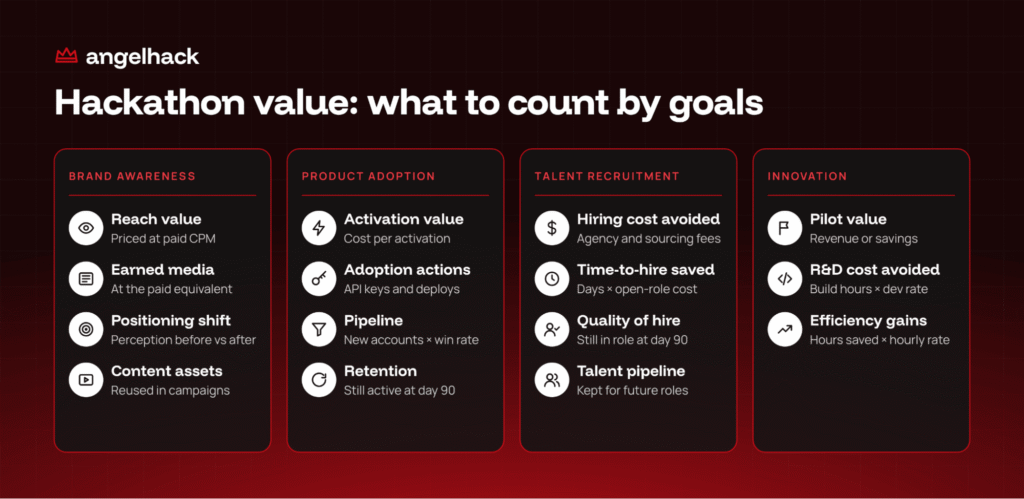
What to include in hackathon value, by goal
For each outcome, start with what the same result costs you through another channel today. If you don’t have that number yet, the regional benchmarks below give you a reference point. They come from paid channels and market rates, so use them for comparison rather than as targets.
📣 Brand awareness and positioning
- Reach value: impressions and reach from the program, priced at what you’d pay per thousand impressions (CPM) to reach the same audience.
- Earned media: press coverage, creator posts and community mentions, priced at the paid equivalent.
- Positioning shift: how developers see your brand before and after the program, measured with a short survey, plus any lift in branded search.
- Content assets: demos, recordings and project showcases you can reuse in later campaigns.
Benchmarks:
- Developer audiences: CPM of $35 to $60 for native ads in developer publications and $25 to $45 on X (Idlen, 2026).
- Meta Ads, SaaS and tech advertisers: CPM of $14.20 to $22.80 (Stackmatix, 2026).
🔑 Product adoption
- Activation value: developers who start using your product, priced at what an activated developer costs you through other channels.
- Adoption actions: API keys, deployments and sandbox accounts, priced at your current cost per action.
- Pipeline: new accounts × win rate × average contract value.
- Retention: developers still active at day 90.
Benchmarks:
- LinkedIn Ads, developer tools: $40 to $90 per free-trial signup and $200 to $500 per activated trial (Optimize LinkedIn Ads, 2026).
- Google Search, SaaS and B2B software: $3.40 to $8.20 per click and $65 to $220 per acquisition (Stackmatix, 2026).
👥 Talent recruitment
- Hiring cost avoided: hires made through the program, priced at your agency fee plus standard sourcing cost.
- Time-to-hire saved: days saved, priced at the daily cost of an open role.
- Quality of hire: program hires still in their role at day 90.
- Talent pipeline: strong candidates you keep on file for future roles.
Benchmarks:
- Tech roles: $7,500 to $12,000 per hire (PeoplePilot, 2026).
- Agency hires: 15% to 25% of first-year pay, so the fee rises and falls with local engineering salaries (WorkInsiders, 2026).
🧪 Innovation
- Pilot value: pilots launched, priced at the yearly revenue gained or cost saved by each one.
- R&D cost avoided: build hours on shortlisted prototypes, priced at regional developer rates.
- Efficiency gains: hours saved by workflow prototypes that reach production, priced at a loaded hourly rate.
Benchmarks
- Build cost: $2,000 to $10,000 for a prototype and $5,000 to $20,000 for a proof of concept (TeaCode, 2026).
- Minimum viable product cost by region: $80,000 to $250,000+ in the US and Canada, $60,000 to $180,000 in Western Europe, $25,000 to $80,000 in Latin America and $8,000 to $50,000 in Asia (TeaCode, 2026).
Culture and morale gains are real too, but they’re hard to price with confidence. Keep them out of the number and report them alongside it. With value covered, the other side of the formula is cost.
What to include in hackathon costs
Cost is the easier side to total, as long as you account for both direct and indirect costs.
💵 Direct costs
- Hackathon platform and supporting software
- Venue, AV and production for in-person formats
- Catering, travel and accommodation
- Prize pool and swag
- Design, branding and program website
- Paid ads and community partnerships for external hackathons
- Mentor and judge stipends
- Agency fees, if you work with one
⏱️ Indirect costs
- Internal staff hours for planning, operations and judging
- Participant hours away from regular work, for internal hackathons
- Post-event follow-through, such as pilot support, engineering time and onboarding new hires
An in-house program typically takes 200 to 400 hours of internal staff time. Price those hours at your loaded hourly rate. Leave them out and your ROI looks better on paper than it really is.
With both sides of the formula covered, the next step is agreeing what a good result looks like before you launch.
Set your ROI targets before launch
Targets turn the formula into a plan to work towards. Set them right when you start planning for the hackathon, because some starting points, like how developers see your brand today, can’t be measured after the fact.
- Tie it to a business goal. Name what the hackathon should deliver, such as stronger positioning, adoption of a new API, roles to fill or workflows to automate.
- Choose one headline metric. Pick the single number that best proves the goal, like activated developers or hires made, and support it with two or three secondary metrics. A long list of equal targets makes it hard to say whether the program worked.
- Pull your baselines. Use your own cost per impression, activation, hire or prototype, and fall back on the regional benchmarks above where you have none.
- Set targets for each stage. Work back from the headline metric to the registrations, submissions and activations you need, with the conversion you expect between each stage and a date to check it. If a stage falls short, you’ll know exactly where.
- Build the program around the targets. Write the challenge, prizes and judging criteria so they reward the outcome you’re measuring. An adoption goal, for example, can require every submission to run on your product.
- Model three scenarios. Conservative, expected and best cases keep expectations realistic from day one.
- Sign off with management. Agree the formula, the cost lines and the reporting dates, so the result is accepted when it arrives.
Skip this step and the ROI conversation starts after the budget is already spent. Once targets are agreed, all that’s left is tracking them.
Hackathon ROI benchmarks: what’s a good return?
No one has published an ROI percentage for hackathons yet, but these benchmarks set a realistic bar:
- Marketing ROI: a 5:1 return (500%) is considered strong in most industries, and 2:1 is roughly break-even. B2B SaaS and enterprise campaigns typically return 5:1 to 10:1 or more (Demandbase, 2026).
- Event ROI: 35% of B2B brands see a 2:1 to 5:1 return on their events (Event Marketer, 2020), and 98% of B2B event marketers say that return is holding steady or growing (EventTrack 2026).
- Project survival: 35% of public hackathon projects see any work after the event, and 3.55% are still active five months later (Nolte et al., 2020).
- Idea to product: best-performing companies need 4.5 ideas for each successful product, and other companies need 11.4 (PDMA).
Use these to set your targets, then track the numbers that prove you cleared them.
How to measure and monitor hackathon ROI
Track two kinds of signal, and give every metric one owner. Early signals tell you whether the program is on track while you can still adjust it. Later signals carry the value that goes into your ROI formula.
- Early signals (days 0 to 30): reach and impressions, registrations, submissions, working prototypes, activations and candidates shortlisted.
- Later signals (days 90 to 180): shifts in brand perception and branded search, retained developers, accounts in pipeline, hires made and pilots in production.
- Where to track: website traffic, social and media monitoring for awareness, product analytics for adoption, your CRM for pipeline, your applicant tracking system for hiring and a project tracker for pilots.
- When to report: at day 30, 90 and 180. A single report at the end of event week captures participation and little else.
Two tips to make these numbers far more credible:
- Attribute hackathon participants from day one. Use unique sign-up links, codes or a CRM campaign, so a hire or a new account at day 150 can be traced back to the hackathon. Without tagging, the later value still happens, but you can’t claim it.
- Compare against a baseline group. Check participants against similar developers or employees who didn’t take part, such as the activation rate of hackathon sign-ups against organic sign-ups. The gap is the hackathon’s real contribution.
Keep an eye on drop-off between stages as well. Plenty of registrations but few submissions often points to a challenge that’s too broad or thin onboarding support, which you can fix for the next edition. Then share the results with participants and sponsors. It builds trust in the program and gives you the starting point for your next round of targets.
Final Words
Run well, a hackathon gives you far more than a busy weekend. Developers build with your product, new talent comes onto your radar, and ideas turn into working prototypes you can test with real users. Setting your ROI before launch is how you make sure those benefits actually land. It forces a clear goal, defines what success looks like and gives every team involved a number to work toward.
Hitting those targets also takes strategic planning, careful preparation and experienced operations on the day. That’s where we come in. With 15+ years across hundreds of programs and a community of 500,000+ developers, we can run the full program or just the parts your team needs.
Planning a hackathon and want to
show its return?
AngelHack has run 500+ hackathons globally, designs programs backwards from a specific business decision, and brings a network of 300,000+ developers to every program we run. Tell us the outcome you need. We’ll design the program that gets you there.
TALK TO USFAQs
How do you calculate hackathon ROI?
Subtract the total cost from the value of your goal’s outcomes, divide by the total cost and multiply by 100. Report the result at day 90 and day 180.
How do you value brand awareness from a hackathon?
Price reach and earned media at what the same audience would cost you in paid ads. Then survey developers before and after the program to see how their view of your brand changed.
What is a typical good ROI for a hackathon?
Corporate events are the closest reference, which average about 27% ROI in person and 14% virtually. A hackathon should at least match what your other events return.
How long until a hackathon shows a return?
Reach and activation show up within 30 days. Hires, retained users and pilots tend to land between day 90 and day 180, depending on your sales and hiring cycles.
Is an agency fee worth it if we can run it ourselves?
Price the internal hours an in-house program takes at your loaded rate. Add either the fee or those hours to your total cost, then compare the ROI of both options before you decide.