
Forbes stated that 80% of Fortune 100 companies have organized hackathons and more than 50% of these hackathons are recurring events – a clear proof that hackathons aren’t just a trend, but a reliable and strategic tool for sustained innovation. By bringing together developers, designers, and creative minds to solve challenges in a short, high-energy burst of collaboration, hackathons help companies uncover new ideas, fast-track product development, and build a culture of experimentation. If you’re wondering how to do this effectively, you’re in the right place.
Whether you’re an experienced event organizer or running your first hackathon, this guide walks you through everything: from the basics to the details that make the difference between a forgettable event and one people talk about for months.
What is a hackathon?
A hackathon is an intensive, time-bound event where software developers, designers, strategists, and other innovators collaborate to create solutions for specific challenges. Typically lasting between 24 to 48 hours, hackathons provide a dynamic environment where teams rapidly prototype new technologies, develop innovative features, or build entirely new products. These events encourage creativity, problem-solving, and cross-disciplinary collaboration, often resulting in groundbreaking ideas and practical solutions.
Why should you organize a hackathon?
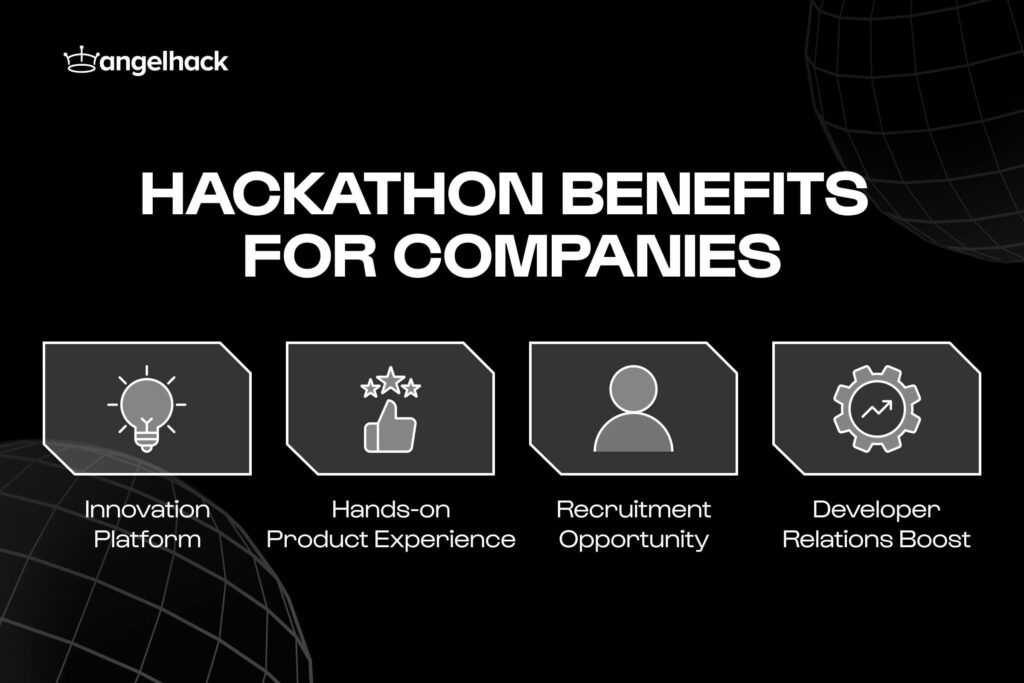
Here’s the short answer: hackathons work. They’re one of the few event formats that generate real outputs – working prototypes, fresh talent leads, stronger developer relationships – in a matter of days.
- They drive innovation by giving people dedicated time and space to pursue ideas they’d never get to in a normal work week.
- They attract top talent by offering a hands-on, real-world challenge, which is far more revealing than any interview.
- They strengthen developer relations by building genuine engagement with your developer community, not just awareness.
- They accelerate product development by letting diverse teams rapidly test ideas that might otherwise sit in a backlog for months.
💡Key Takeaways from Running 500+ Hackathons
- Start promoting early: Events that begin promotion 10 or more weeks out attract more than twice the registrations of events that launch within four weeks of the date.
- Attendance runs lower than registration: Plan for 60 to 75% attendance at in-person events, and 40 to 55% for free virtual ones. Build that gap into your headcount and catering from day one.
- Teams of 3 to 4 people produce the strongest submissions: Smaller teams often lack bandwidth; larger ones spend too much time coordinating instead of building.
- Hold training sessions and keep judges and mentors involved throughout: Pre-event workshops boost participant confidence and productivity. Engaging judges and mentors from the start, not just on the day, directly improves the quality of submissions.
- Don’t do it alone: Hosting a hackathon takes months of preparation. Collaborate with sponsors and partners for extra resources, or consider working with a specialist.
- Have a solid contingency plan: Every hackathon hits at least one unexpected problem. Anticipate issues like power cuts, internet failures, or team conflicts, and have backup resources ready to go.
- Don’t underestimate the follow-up: More than 60% of organizations run a second hackathon within 18 months of their first. The organizers who stay engaged after the event, sharing highlights, following up on winning projects, and keeping the community warm, are the ones who see the best results the second time around.
Hackathon Types and Formats
There are two main types of hackathons: internal and external. Internal hackathons focus on nurturing in-house talent and driving internal innovation. External hackathons bring in diverse perspectives, broaden technical expertise, and enhance brand visibility.
Internal Hackathons
Internal Hackathons are limited to a company’s employees. They give people dedicated time to work on ideas outside their usual roles, strengthen cross-team collaboration, and help leadership spot emerging talent and creative problem-solvers from within.
External Hackathons
External Hackathons are open to employees, industry experts, partner companies, students, startups, and freelance innovators. They bring in fresh perspectives, expand your technical talent pool, and serve as a powerful recruitment and brand-building tool.
Hackathons can also run in two formats: online and offline.
Online Hackathons
Online Hackathons use digital platforms to bring participants together from anywhere in the world. They’re cost-effective and accessible, but they require strong communication tools and creative approaches to keep participants engaged and connected.
Offline Hackathons
Offline Hackathons offer richer collaboration, stronger networking, and an immersive, high-energy environment. The trade-off is more logistical complexity and geographic limitations on who can attend.
Choosing the Right Type and Format
For Hackathon Type:
- If you want to encourage internal innovation, upskill employees, and develop in-house talent, an internal hackathon is ideal.
- If your goal is to leverage external perspectives to foster innovation and expand your network with industry experts and new talents, an external hackathon is preferable.
- Assess available resources, including budget, technical support, and mentorship opportunities, to determine the best type of hackathon for your organization.
For Hackathon Format:
- If fostering deep team interactions, partnerships and project submission quality is crucial, an offline event may be preferable.
If inclusivity, scalability, and cost efficiency are priorities, an online format is ideal.
Consider budget, logistics, and outcomes before making a final decision.
While rare, a hybrid approach that combines elements of both types and formats can also be considered. This could include a mix of internal and external participants, or an event that blends online and offline experiences to maximize reach and engagement.
Not sure what format is right for you? These hackathon examples show how companies across industries have structured their events, from 24-hour sprints to multi-week virtual programs.
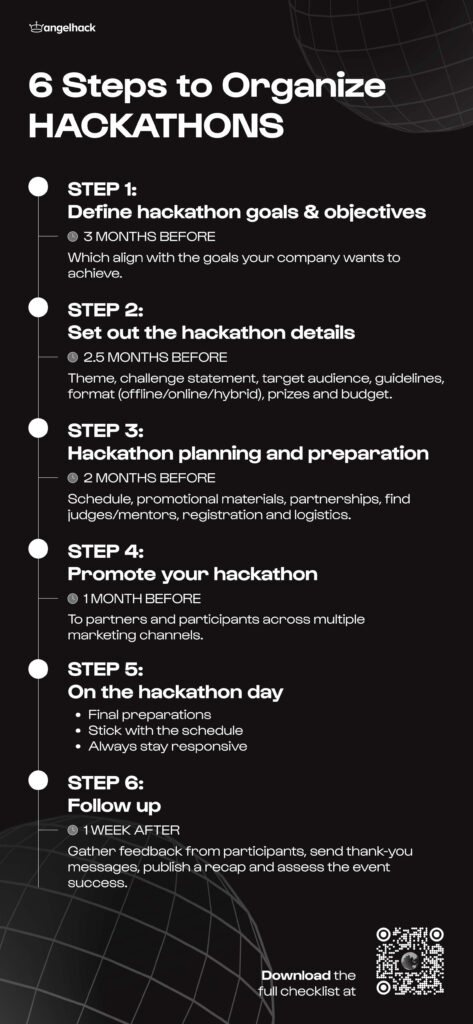
6 Steps to Organize a Successful Hackathon
Step 1: Define Hackathon Goals & Objectives
The first step is getting clear on why you’re running this hackathon.
- Determine the primary purpose: innovation, community building, talent acquisition, or brand awareness.
- Identify the specific problems you want participants to solve and what outcomes you’re hoping to see.
- Set concrete metrics to measure success, such as number of participants, number of projects submitted, or quality of solutions.
- Get internal alignment and budget approval before moving to the details.
Step 2: Set Out the Hackathon Details
Theme and Challenge Statement: Start by choosing a theme that aligns with the specific goal that your company wants to achieve, be it adopting new technologies, incubating new applications, or solving societal issues. Create a clear narrative to guide event branding, marketing, and discussions. Furthermore, formulate achievable challenge statements that cater to diverse skill levels and areas of expertise.
💡 Explore more: 12 Hackathon Themes to Innovate Your Business
Need some inspiration? Discover the hackathon themes of these global companies:
🌟 Databricks Generative AI World Cup: Focused on leveraging generative AI for data-driven innovations, challenging data professionals to develop AI-powered solutions.
🌟 IBM Master the Mainframe: Aimed at helping developers gain hands-on experience with enterprise computing and mainframe technologies.
🌟 P&G Impactful Solutions Hackathon: Encouraged teams to explore innovative solutions with real-world impact, particularly in consumer goods and sustainability.
Target Audience: Define the demographic that will be interested in your hackathon’s themes and benefits. For example, for students, the focus can be on educational challenges and mentorship. Similarly, for developers, the hackathon can center around in-demand technologies.
Guidelines: Establish clear rules and guidelines to ensure a fairly organized hackathon. This consists of key deliverables, judging criteria, and intellectual property terms. A code of conduct detailing acceptable behavior, harassment policies, and technical standards is also needed to maintain a respectful competing environment.
Event Format: Choose the format that best aligns with your goals. In-person events have better networking opportunities but require more budgeting resources. On the other hand, virtual hackathons are more accessible and cost-effective but may face collaboration challenges. Alternatively, a hybrid format combines both benefits but needs careful planning and execution.
Prizes and Incentives: Rewards can be monetary, such as cash prizes or cryptocurrency, or non-monetary, such as mentorship opportunities, product credits, fast-track job interviews, or exclusive networking with industry leaders. Also, consider offering tiered awards for different categories like ‘Most Innovative Solution’, ‘Best Use of Technology’, ‘Best Design’, or ‘Audience Favorite’ to recognize a variety of strengths and contributions.
Budget: Estimate the total costs you will need for the venue (or platform if organized online), supplies, technology, marketing, prizes, and staff. You can seek funding from partners, sponsors, ticket sales, or fundraising campaigns. Lastly, don’t forget a contingency plan for unexpected expenses to smooth out any operational risks.
Step 3: Hackathon planning and preparation
✅ Select the Right Venue or Platform:
- For virtual hackathons, choose reliable platforms that support communication, collaboration, and submissions.
- Prepare backup plans in case of technical issues to avoid disruptions.
- For offline hackathons, select a venue that fits your expected attendance, provides necessary infrastructure, and enhances the creative atmosphere.
✅ Plan Schedule and Activities for Engagement and Structure:
- Create a detailed schedule starting with an engaging opening ceremony to set the tone and energize participants.
- Include workshops, coding sessions, networking events, and a closing ceremony to provide value and encourage collaboration.
- For virtual or hybrid formats, integrate online presentation and collaboration tools to ensure smooth communication.
- Offer a variety of activities to ensure participants have a meaningful and enriching experience while catering to different interests.
✅ Create Promotional Materials to Build Awareness and Excitement:
- Develop a unique logo, color scheme, and tagline to create a strong brand identity for the hackathon.
- Use these assets to design social media graphics, flyers, and email templates that capture attention.
- Build a comprehensive, mobile-friendly website to clearly communicate all hackathon details and streamline registrations.
✅ Explore Partnerships and Sponsorships to Enhance Resources and Credibility:
- Seek partnerships with organizations that align with your goals to add credibility and amplify reach.
Highlight benefits like branding, networking, and database access to attract valuable partners.
Leverage these partnerships to provide additional resources, mentorship, prizes, and expert guidance for participants.
✅ Find Judges and Mentors to Ensure Quality and Participant Support:
- Recruit experts with relevant experience in your chosen theme or challenge areas to ensure qualified judging.
- Provide judges with clear criteria and evaluation guidelines to maintain fairness.
- Ensure mentors are prepared to offer constructive feedback and ongoing support, helping teams improve their solutions.
✅ Set Up Registration to Attract the Right Participants:
- Clearly outline eligibility criteria and application deadlines to set expectations upfront.
- Offer early-bird discounts or other incentives to encourage early sign-ups and gauge interest.
- Use the registration process to collect key participant information, ensuring you attract the right audience for your hackathon’s goals.
✅ Manage All Event Operations:
- Plan for infrastructure, decorations, catering, security, and supplies, ensuring every detail is covered.
- Test all technical equipment, power supply, and internet connectivity ahead of time.
- Coordinate with on-the-ground staff to manage setup, check-in, and provide real-time support to participants, mentors, and judges.
“The early stages of hackathon organization can feel like navigating a complex maze, where every step in logistics and promotion might distract you from the core creative mission. So it’s our job to swiftly guide clients through that maze, so that they can solely concentrate on designing the best challenge statements and mentoring the next wave of innovators.”
Justin Ng, Head of Ecosystem at AngelHack
Setting Judging Criteria
Clear judging criteria do three things: they tell participants what you value, help mentors guide teams in the right direction, and prevent disputes after results are announced. Share them before the event starts.
We recommend a five-dimension rubric, with each area scored out of 5 points for a maximum of 25 points per project:
| Dimension | Points | What to assess |
|---|---|---|
| Innovation and Originality | 5 | Does the solution bring a genuinely fresh approach, or is it applying an existing template? |
| Technical Execution | 5 | Is the prototype working and demonstrable within the time given? |
| Real-World Impact | 5 | Does the solution tackle a real problem, and is there a clear path to putting it into practice? |
| User Experience and Design | 5 | How easy and pleasant is the interface to use? Good design is weighted just as seriously as good code. |
| Presentation and Clarity | 5 | Did the team explain the problem, show the solution, and run the demo clearly within the time allowed? |
Adjust the weight of each dimension to match your goals. If you’re running a product innovation hackathon, lean into Innovation and Technical Execution. If it’s a social impact event, prioritize Real-World Impact and Innovation. For talent identification, weight Technical Execution and Presentation more heavily.
💡A pro tip: Share the full rubric with participants at the opening ceremony, not just with the judges. Teams that know how they’ll be scored consistently produce better work.
Step 4: Promote Your Hackathon
Promotion is key to attracting participants and third parties such as sponsors and industry stakeholders. Like any event, you need to build anticipation. If you want to attract third parties who might be interested in the outcome and willing to contribute resources, start promoting well in advance.
For participants, you can maximize visibility and engagement with a multi-layered approach using the channels and tactics as below:
Social Media Marketing
- Leverage platforms like Twitter, LinkedIn, and Discord to create buzz.
- Use targeted ads and hashtag campaigns to reach relevant audiences.
- Engage with developer communities and influencers for organic reach.
Email Marketing
- Send personalized invitations to past participants and industry contacts.
- Develop an email sequence with reminders, key event details, and incentives to register.
Developer and Industry Networks
- Partner with coding bootcamps, universities, and tech meetups to tap into their networks.
- List the hackathon on virtual platforms like StackUp or GitHub.
- A pro tip: Promote through AngelHack’s global community of 300,000+ developers!
Traditional and Paid Advertising
- Use Google Ads to reach targeted professionals and companies.
Create blog posts and press releases to attract media coverage.
Distribute flyers and posters at tech events and coworking spaces.
Your promotional content should clearly highlight the hackathon’s theme, prizes, key dates, and how to register. It should also emphasize other benefits of participating besides the prizes, such as networking, mentorship , and potential career opportunities. Featuring testimonials from past participants or success stories from previous hackathons can further boost credibility and engagement.
Step 5: On the Hackathon Day
The big day is here, and all that preparation is about to pay off. Here’s everything you need to nail the final countdown, run the day smoothly, manage format-specific logistics, and handle whatever gets thrown at you.
In the Days Before:
- Send participants a single briefing message 48 hours out with every link, credential, schedule, and FAQ they need.
- For in-person events, confirm the venue is fully set up: registration desks, tech equipment, catering, and signage.
- For virtual events, run final tests on all platforms. Have your backup submission channel live and announced before the event opens.
- Prepare a troubleshooting guide your team can act on quickly.
On the Day
- Follow your schedule, but stay flexible. Things will come up.
- Keep organizers, mentors, and judges highly visible and approachable throughout.
- Give participants regular time reminders, especially as submission deadlines approach.
- Activate your contingency plan at the first sign of a problem. Don’t wait to see if it resolves itself.
For offline hackathons:
- Staff your check-in desk with at least three people and use pre-printed badges. Peak arrival happens in the first 30 minutes.
- Keep a printed attendee list as backup in case the registration system fails.
- Ensure key resources like API documentation, sample datasets, and design templates are easy to find.
- Order 20% over expected headcount for every meal, and keep coffee running continuously for events over 24 hours.
- Set the submission deadline somewhere visible in the venue and give a verbal 30-minute warning before close.
For online/ virtual hackathons:
- Assign a dedicated moderator to the main communication channel from opening to close.
- Post recordings of sessions within two hours for participants in other time zones.
- Publish all times in UTC plus local equivalents. Timezone confusion is one of the most common reasons virtual participants miss key sessions.
- Set the submission deadline at the opening ceremony and remind participants at the halfway point and again 30 minutes before close.
Judging:
- For events with many teams, use a bracketed structure: teams present to individual judges first, and only finalists move to the full panel.
- Brief judges 48 hours in advance with the rubric and schedule. Don’t leave it until the day of the event.
Contingency Planning:
Every hackathon runs into at least one unexpected problem. Here are the most common scenarios and how to handle them:
- WiFi failure: Have 3 to 5 personal hotspot devices on your organizer team. Communicate with participants immediately. Silence makes it worse.
- Platform failure: The moment the primary platform goes down, post your backup link across every channel. Extend the affected session by the outage length.
- Submission portal down: Announce the backup submission channel at the opening ceremony so participants already know it. Extend the submission window by 15 to 30 minutes if needed.
- Judge or speaker cancels: Keep a confirmed shortlist of backup judges. Don’t announce a speaker as confirmed until they’ve accepted a calendar invite.
- Low team formation: Build a structured team formation session into the first 30 to 60 minutes. Pre-seed the event with two or three project leads ready to anchor teams.
- Code of conduct incident: Designate one person as the point of contact for reports before the event, not the head organizer. Have a private space ready and document everything in writing.
Below is a sample schedule for a 48-hour offline hackathon. Copy and adapt as you need:
🗓️ Offline Hackathon Sample Schedule
Day 1
- 9:00 AM — Registration and Breakfast
- 10:00 AM — Opening Ceremony & Keynote Speech
- 11:00 AM — Ice Breakers & Team Formation
- 12:00 PM — Hacking Begins
- 1:00 PM — Lunch Break
- 1:30 PM — Thematic Keynotes
- 3:00 PM — Mentor Rounds & Technical Workshops
- 5:30 PM — Submission Briefing
- 6:00 PM — Dinner & Networking
- 6:00–9:00 PM — Mentor Hours Continue
- 9:00 PM onwards — Overnight Hacking & Progress Reviews
Day 2
- 8:00 AM — Breakfast & Final Coding Stretch
- 11:00 AM — Code Freeze & Submission Deadline
- 11:30 AM — Lunch Break
- 12:30 PM — Project Demos & Qualifier Judging
- 2:30 PM — Finalists Announcement
- 3:30 PM — Live Pitch Competition
- 6:00 PM — Tabulate Scores & Sponsor Remarks
- 6:30 PM — Closing Ceremony & Awards
Step 6: Follow up
Congratulations! You’ve made it through your hackathon, but the work doesn’t end here. It’s crucial to follow up with everyone involved. After the hackathon, follow-up tasks are essential to maintaining engagement and measuring success:
- Collect Feedback: Send post-event surveys to participants, mentors, and judges to evaluate the hackathon experience and gather insights for improvement.
- Show Appreciation: Send personalized thank-you notes to sponsors, speakers, mentors, volunteers, and participants to acknowledge their contributions.
- Summarize and Report: Create a detailed post-event report highlighting participant numbers, project outcomes, media coverage, and key takeaways.
- Share Event Highlights: Publish blog posts, social media updates, and newsletters showcasing winning projects, participant testimonials, and event achievements.
- Engage the Community: Keep attendees engaged by updating them on the progress of winning projects, upcoming events, and opportunities for collaboration.
- Plan for Future Hackathons: Use the collected data and feedback to refine and enhance future hackathons, ensuring continuous improvement and sustained participation.
Your 12-Week Hackathon Workback Schedule
We recommend starting at least 8 to 12 weeks before your event. The schedule below maps every key task to the six steps of the planning process, working backwards from event day. Smaller internal events can compress the early phases, but large external events with multiple sponsors should stick to the full timeline.
Weeks 12 to 10 – Step 1: Define goals and objectives
- Lock in the primary hackathon goal: innovation, talent acquisition, developer marketing, or community engagement
- Define success metrics and get internal budget approved
- Choose internal vs. external and online vs. offline format
- Identify internal stakeholders and assign an organizing team internally or hire a hackathon agency
- Set a provisional event date and check for conflicts with major industry events
Weeks 9 to 8 – Step 2: Set hackathon details
- Finalize theme and write challenge statements
- Define target audience, eligibility criteria, and team size rules
- Set judging criteria and calibrate rubric to your goals (see judging section above)
- Decide prize structure and award categories
- Draft rules, code of conduct, and IP terms. Have legal review before publishing.
Weeks 7 to 3 – Step 3: Planning and preparation
- Book venue or configure online platform; complete tech dry-run
- Open sponsor and partnership outreach. Allow time for multiple follow-up rounds.
- Identify and invite judges and mentors; confirm in writing
- Build hackathon website and registration form
- Create branding assets: logo, color scheme, social graphics, email templates
- Draft event schedule and set up submission portal with end-to-end testing
- Configure and test backup submission channel
Weeks 7 to 3 – Step 4: Promote the hackathon
- Launch registration and make the public announcement
- Activate social media, email, and community channels
- Send partner and sponsor activation briefs
- Begin weekly participant communication cadence
- Close early-bird incentive deadline at Week 5
- Monitor registrations weekly; escalate promotion if tracking below target
Weeks 3 to 1 – Step 5 (pre-event): Final preparations
- Send confirmed-participants briefing pack with all links, credentials, and FAQ
- Conduct full tech rehearsal: video conferencing, submission portal, A/V
- Brief all volunteers and on-site staff on roles and contingency procedures
- Distribute judging scorecards digitally or in print
- Finalize catering order at 20% over expected headcount
- Prepare post-event survey form ready to deploy immediately after the closing ceremony
Event day – Step 5: Hackathon day
Follow the schedule you have prepared. Keep organizers, mentors, and judges visible and easy to find throughout the event. Give participants regular time reminders, and activate your contingency plan at the first sign of a problem. Do not wait to see if it resolves itself.
Weeks 1 to 3 post-event – Step 6: Follow up and measure
- Deploy post-event survey within 24 hours of the closing ceremony
- Send personalized thank-you notes to judges, mentors, sponsors, and participants
- Publish event recap blog post and social highlights within one week
- Compile final metrics report against the goals defined in Week 16
- Brief winning teams on next steps and prize distribution timeline
- Document lessons learned and update your planning playbook for the next event
Overall Dos and Don’ts
After 500+ hackathons, these are the mistakes and best practices that come up again and again.
✅ Do:
- Start promoting at least 10 weeks out. The difference in registration numbers is significant.
- Hold pre-event training sessions. Participants who attend workshops beforehand produce better work during the event.
- Share your judging rubric with participants before the event starts, not just with judges.
- Keep your submission channel backed up. Announce the backup at the opening ceremony so participants already know it exists.
- Give participants regular time reminders throughout the event, especially in the final hours.
- Follow up within 24 hours. The survey response rate drops fast after that window.
❌ Don’t:
- Try to do it alone. Hosting a hackathon takes months of preparation. Bring in sponsors, partners, or a specialist. Here’s how to choose the right hackathon agency.
- Wait to see if a problem resolves itself. Whether it’s a WiFi failure, a platform crash, or a team conflict – activate your contingency plan immediately.
- Announce a speaker as confirmed until they’ve accepted a calendar invite.
Leave judges unbriefed until the day of the event. Brief them 48 hours in advance with the rubric and schedule. - Ignore the code of conduct. Designate a point of contact for reports before the event starts and make sure it’s not the head organizer.
- Let the event end without capturing feedback. A post-event survey sent within 24 hours gives you the honest data you need to improve.
Frequently Asked Questions About Organizing a Hackathon
How long does it take to organize a hackathon?
Plan for 12 to 16 weeks for most events. Smaller internal hackathons can be done in 6 to 8 weeks with an experienced team. Sponsor outreach and venue booking almost always take longer than first-time organizers expect.
How much does it cost to organize a hackathon?
A small virtual event typically costs between $3,000 and $10,000. A mid-scale in-person event runs $30,000 to $80,000. A large branded event can reach $80,000 to $250,000 or more. Sponsorships can offset 30 to 80% of total costs.
How many participants should a hackathon have?
It depends on your goals. If you want 30 competing projects, plan for 100 to 150 registered participants. Always account for a 20 to 30% drop-off between the number who register and the number who actually show up.
Is ChatGPT and AI allowed at hackathons?
Yes. AI tools are permitted at most hackathons. As an organizer, define what teams must have built themselves. Require that participants can explain every part of their solution, and document any restrictions before registration opens.
What is the best format for a hackathon?
In-person 24 to 48 hour events work best for internal innovation. Virtual formats are a better fit for developer marketing and global reach. In-person events with structured evaluation work well for talent recruitment. For most corporate hackathons, 48 hours is the right length.
How do you attract participants to a hackathon?
The best registrations come from developer community partnerships, outreach to past participants, and listing platforms like Devpost or AngelHack’s platform. Paid social advertising needs 4 to 6 weeks of runway to work well. A strong challenge statement and prize structure drive more registrations than most organizers expect.
What should participants submit at a hackathon?
A standard submission includes a working demo, a short description of the problem and solution, a 2 to 3 minute pitch, and a link to the code repository. Keep submission requirements proportional to the length of your event and focused on what a judge can fairly evaluate in a 5 to 7 minute slot.
Do hackathon winners own their intellectual property?
It depends on your published terms. Participants keep full ownership of their IP in most external hackathons, and this is considered best practice. If IP acquisition is part of your business case, disclose that clearly before registration opens and have legal review the terms first.
Host a Hackathon with AngelHack
AngelHack offers an end-to-end hackathon hosting service, leveraging 14 years of experience organizing global events that drive innovation, in partnership with tech leaders such as Google, IBM, Microsoft, AWS and NASA. With a strong network of industry leaders, and 300,000+ developers worldwide, we ensure your hackathon reaches the right audience and delivers impactful results. Our service includes:
- End-to-End Hackathon Organization: Full support from planning to execution, ensuring a seamless and impactful event.
- Program Design: Custom challenge statements and engaging workshops aligned with your vision to inspire innovation.
- Marketing & Outreach: Extensive promotion through our network of 300,000+ developers and 140+ community partners to attract top talent.
- Event Management: Complete logistics handling, including venue selection, event planning, and on-site management for a hassle-free experience.
- Hackathon Platform: Host your hackathon on StackUp, a robust platform with 160,000+ developers, providing collaboration and project management tools.
- Event Setup: Seamless in-person hackathon experience, including venue selection, branding, tech integration, and catering management.
So whether you’re looking to foster internal innovation, attract top talent, or engage a developer community, AngelHack’s expertise, experience and ecosystem will make your hackathon a success. And don’t just hear it from us – hear from our satisfied customers and their thriving hackathons!
Final words
Now that we have covered the A to Z of hackathon organization, hopefully, you are excited to start one of your own! And to make things even easier for you, we have compacted all the essential knowledge, steps and details into one checklist that you can download and refer back to anytime.
👉 Download the hackathon guide here
And if you need any advice or support in making your event a smashing success, see what AngelHack has to offer and book a consultation session right away!