
Whether you’re a startup founder who keeps hearing “run a hackathon” and still isn’t sure what that actually means, a developer curious about joining one, or a company ready to build a program around real outcomes, you’re in the right place.
“Hackathon” is one of those terms that gets thrown around a lot. This guide cuts through the noise. You’ll learn what a hackathon actually is, what makes one worth running, and how to tell the difference between a program that delivers and one that just fills a weekend.
What Is a Hackathon?
A hackathon is a time-boxed event where teams come together to build and pitch solutions to real problems, typically within 24 to 48 hours. Participants form teams, pick a challenge, and race to turn an idea into a working prototype. At the end, teams present their builds to a panel of judges to identify the strongest solutions and recognize the builders behind them.
Mentors, organizers, and subject-matter experts are there throughout to keep teams unblocked and moving forward.
Hackathons have moved well beyond coding sprints. Today’s programs cover AI, data engineering, product design, and business strategy, with challenges that reflect real business problems companies are actively working on. Cross-functional teams mixing developers, designers, product managers, and domain experts are the norm now, bringing the range of skills that good solutions actually need. That’s what makes the format deliver value for developer relations, enterprise innovation, and talent recruitment all at once.
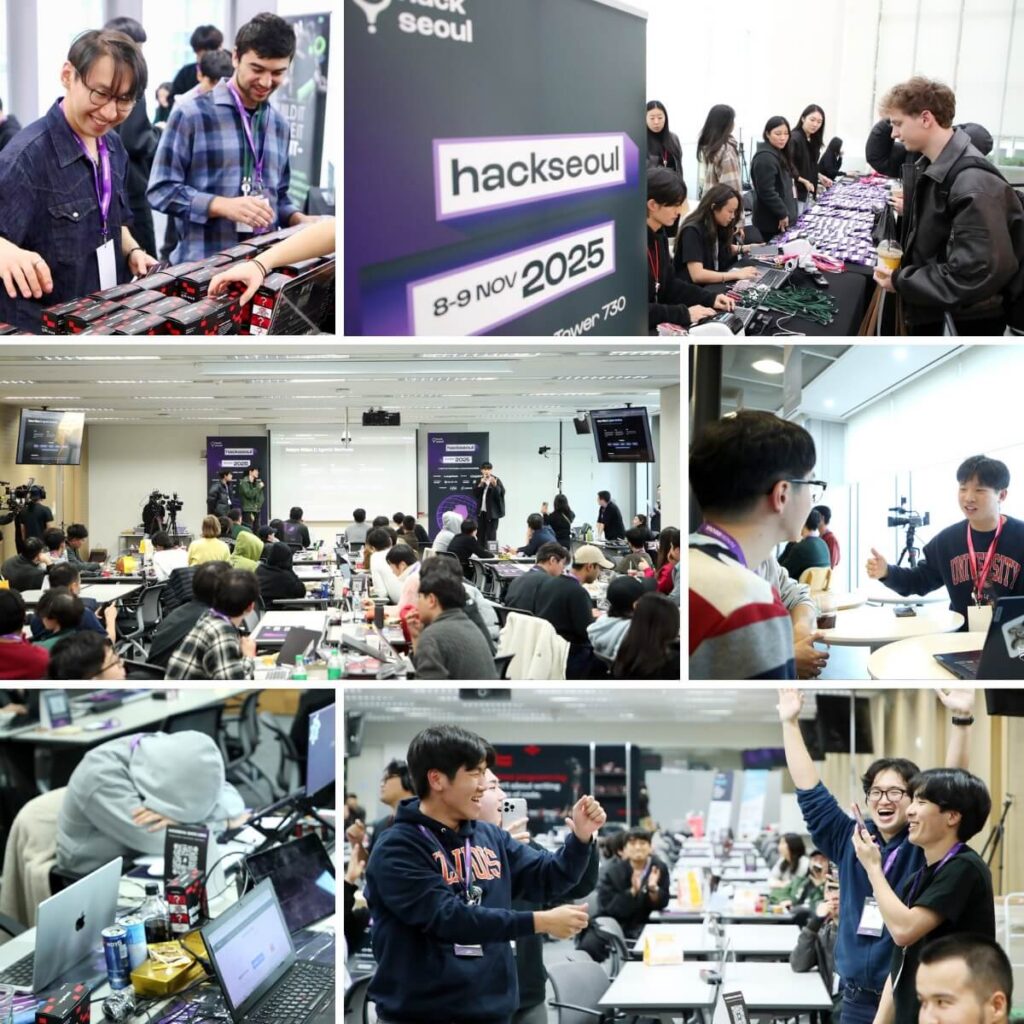
Here’s a look inside the hackseoul hackathon, organized by AngelHack and Coupang.
Hackathon Types, Formats, and Participants
The right format comes down to your goal, your audience, and the outcomes you need. Choosing based on budget or convenience is the first mistake most programs make. Here is how to go about it
By Type
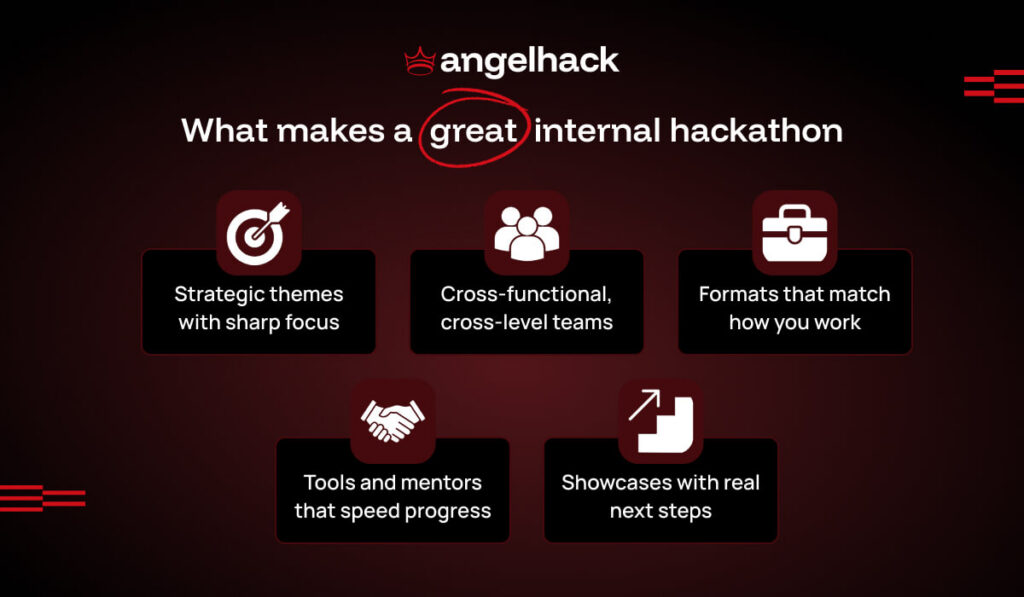
External hackathons are open to the public or a defined developer community, making them a strong choice for product adoption, ecosystem growth, and community building. Internal hackathons are limited to employees and work well for driving innovation output, building culture, and sparking cross-functional collaboration.
By Format
- Virtual hackathons: maximum global reach with lower logistical complexity. The right choice for large or distributed developer communities.
- In-person hackathons: deeper collaboration, stronger community bonds, higher energy. Best when culture and relationship-building are primary goals.
- Hybrid hackathons: the best of both worlds, though the most complex to run well. Worth it when you need the broadest possible outcomes pipeline.
Who Are Hackathon Participants?
Getting the right mix of participants is one of the most underrated decisions in program design. It determines the quality of solutions before a single line of code is written.
- Developers and engineers: the core builders of any hackathon team. They write the code, deploy smart contracts, build APIs, and turn ideas into something that actually runs by demo time.
- Students and early-career talent: they bring fresh energy, a willingness to learn fast, and a drive to prove what they can do under pressure. Often the most committed people in the room.
- Domain experts, designers, and business professionals: they keep teams grounded in reality. They know the market, the user, and the constraints, helping technical teams build something that solves the right problem.
Who Benefits from a Hackathon?
For Participants
Builders get the kind of compressed, high-stakes skill development that no tutorial can match. They leave with mentorship from real practitioners, portfolio-ready working prototypes, prizes ranging from cash and ecosystem grants to investor introductions and pilot opportunities, and direct access to sponsors and potential employers.
For early-career developers, that exposure can redirect a career. For senior builders, it’s a chance to prototype something they’d never have time to try at work.
For Organizers
- Developer adoption: get your technology actively used, tested, and built on by real developers, with the metrics to show for it.
- Talent recruitment: see candidates perform under real conditions and identify top talent faster than any traditional hiring process.
- Innovation: source fresh, crowdsourced solutions to real business challenges, and collect working prototypes worth building on.
- Community growth: build visibility among builders, bring new members into your ecosystem, and create a lasting pipeline of engaged contributors for future programs.
For the Ecosystem
Hackathons create value well beyond the companies running them. Participants go on to contribute to open-source projects, developer communities, and partner networks long after the event ends, seeding new tools, integrations, and use cases that push the broader developer ecosystem forward.
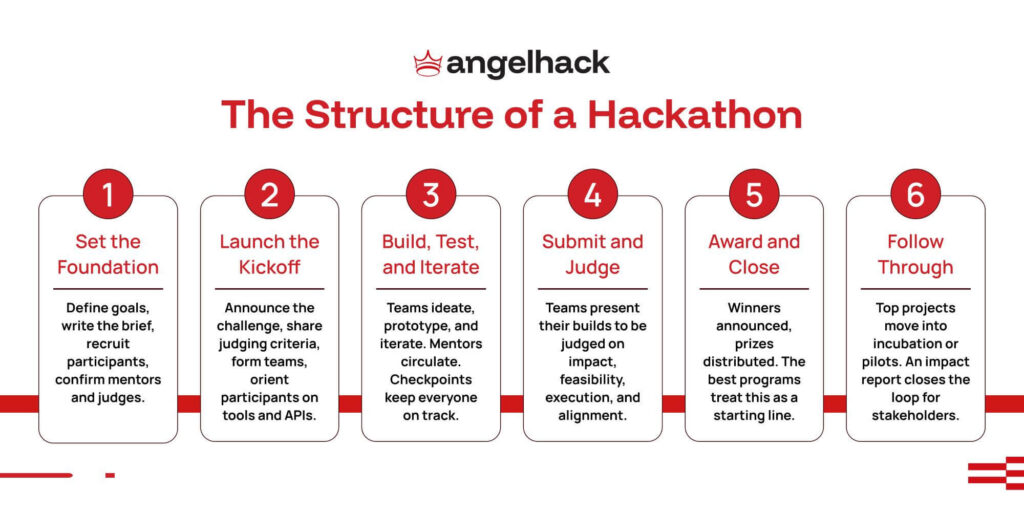
How a Hackathon Program Is Structured
Most people see the 48-hour build window. What they don’t see is the six-phase program that makes or breaks it.
- The foundation (8 to 12 weeks out): goals set, brief written, participants recruited, mentors and judges confirmed, platform or venue prepared. This phase sets the ceiling for everything that follows.
- Kickoff: the challenge goes live, registration opens, judging criteria are shared, teams form, and participants get the training materials they need to hit the ground running.
- Build phase: teams ideate, prototype, and iterate. Mentors circulate. Checkpoints keep everyone on track.
- Submission and judging: teams present against predefined criteria: impact, feasibility, technical execution, and ecosystem alignment.
- Awards and closing: winners announced, prizes distributed, community recognized. The best programs treat this as a starting line, not a finish line.
- Post-event: top projects move into incubation, pilot partnerships, or continued bounties. Participants re-engaged. Impact report compiled for stakeholders.
Factors that Make a Great Hackathon
Real outcomes don’t happen by accident. They come from getting six specific decisions right, consistently, before and after the event.
The brief
The brief sets the ceiling for what’s possible. It needs to be specific enough to guide teams toward a real problem, but open enough to leave room for creative solutions. A weak brief produces weak submissions regardless of everything else. Most organizers write it too late and test it too little. Get external eyes on it before the event opens.
For DSTA’s BrainHack, AngelHack co-designed the TIL-AI competition with four progressive AI challenge tasks simulating real national security scenarios, driving 800 registrations and 32 teams to the live finals.
The mentor network
The mentor network raises the quality of every submission. Mentors surface the strongest ideas early, help teams cut scope to something shippable, and separate high-output programs from forgettable ones. The best mentors are briefed on the challenge in advance and matched to teams by relevant expertise, not availability.
For the Hedera Beyond Blockchain Incubator, mentors from Google Cloud, Fireblocks, Swirlds Labs, and more guided the top 7 projects from prototype to investor showcase, as part of a program that engaged 5,000+ developers overall.
Promotion and reach
Promotion and reach determine participation quality before the event opens. Targeted outreach across the right communities brings in committed builders. Broad, untargeted promotion fills the room with the wrong people. Define your ideal participant profile before you promote, and let that profile drive every channel and message.
For Databricks’ Generative AI World Cup, AngelHack ran a selective vetting process alongside targeted outreach, attracting 1,500 verified data professionals and AI engineers from 18 countries.
Program management and execution
Program management and execution are what participants remember, and what brings them back. Smooth logistics and clear communication at every stage signal that the organizer respects participants’ time. When execution breaks down, it doesn’t just frustrate builders, but damages the brand running the program.
For UBS Innovate, AngelHack coordinated five simultaneous hackathons across New York, London, Zurich, Singapore, and Hong Kong, connecting 500+ employees in real time, with winning teams pitching directly to UBS executives for funding.
Prizes and incentives
Prizes and incentives need to match what your audience actually values. The wrong incentive structure selects for the wrong participants. Cash works for some. Ecosystem grants, pilot opportunities, and investor introductions land better with builders who are in it for the long term.
For Polkadot’s dotSocial series, ecosystem-aligned incentives brought in 3,000+ participants across three regional hackathons and 700+ attendees at live events across New York, Paris, and Seoul.
Post-event follow-through
Post-event follow-through is where ROI is won or lost. Without a clear path forward for winning projects, momentum dies the moment judging ends. Define what happens to the top three projects before the event opens, not after the ceremony wraps.
For the hackglobal Grand Finals, Lyf used the program to source real hospitality innovation from 30 teams across 7 countries. The winning project, GreenGO!, was shortlisted as a live pilot within Lyf properties for carbon footprint tracking.
How to Plan a Hackathon That Delivers
Start with the goal, not the format
Define what success looks like before anything else: developer adoption, talent pipeline, community growth, or innovation output. Every decision flows from this. Without a clear goal, format becomes a guess and measurement becomes an afterthought.
Craft the brief carefully
It sets the ceiling for what the program can produce. Test it on someone outside the room. If they cannot tell you what to build within 60 seconds, rewrite it. The best briefs name a real problem, define the constraints, and leave enough room for teams to surprise you.
Choose the right format
Virtual for scale and global reach, in-person for depth and community, hybrid for both. Let the objective drive the format, not the budget. The right format gets the right people in the room. The wrong one filters them out even before registration.
Build the support structure early
Lock in mentors and judges well in advance. Quality of guidance directly determines quality of output. The earlier mentors are briefed on the challenge, the more guidance they can provide for participants.
Design the full participant journey upfront
Pre-event recruitment and onboarding, build phase with mentor check-ins, and a post-event plan for project follow-up and impact reporting. Every gap in the journey is a point where momentum drops and participants disengage.
Set KPIs before the event opens
Track registrations, active participants, and submission quality at the baseline. Go deeper with innovation metrics: prototypes built, projects greenlit for pilot, solutions approved for commercial deployment, and teams funded after the event closes.
Following the best practices above is what keeps the common pitfalls at bay: vague briefs, prizes misaligned with the audience, no post-event plan, and mentor matching treated as an afterthought.
How AngelHack Runs These Programs
Running a hackathon is a lot to manage. We’ve been doing it since 2011, across 450+ programs in 100+ cities, so you don’t have to figure it out from scratch.
Here’s what we bring to the table:
- A global developer community of 500,000+, ready to engage from day one.
- Consultative approach: we understand your goals first, then design a program built specifically around them, not adapting a template to fit.
- Flexibility: We can run the hackathon end to end, or plug into the parts you need most. You decide how we fit in.
- Incubator and accelerator programs to take the strongest hackathon projects further. 200+ projects incubated and $470M+ raised by teams.
Ready to figure out if a hackathon is the right move?
Book a 30-minute session at angelhack.com/contact and we’ll show you what a hackathon built around your goals would deliver.
Schedule Your CallFAQs
How long does it take to plan a hackathon?
Most programs need 12 to 16 weeks of preparation from brief to kickoff. Shorter timelines are possible for virtual programs with an existing community, but rushing the brief and mentor phase creates problems you spend the whole event managing. Plan for 8 weeks minimum if you want outcomes, not just activity.
How much does a hackathon cost?
Budget ranges widely depending on format, geography, participant count, and prize pool. A focused virtual program can run lean. A global multi-city series with an incubation track requires a different investment. We do not publish standard pricing because programs built around generic budgets produce generic outcomes. Tell us your goal and we will tell you what a program built around it actually costs.
Virtual or in-person: which produces better results?
Neither produces better results on its own. The right format depends on your goal. Virtual drives more participants and stronger adoption metrics. In-person builds deeper community ties and higher builder engagement. Hybrid produces both at the cost of complexity. Define your primary outcome first, then let the format follow.
How do we measure ROI from a hackathon?
Define your metrics before the event opens. For developer adoption programs, track API calls, smart contracts deployed, wallets created, and sandbox accounts activated. For talent programs, track applications from participants and time-to-hire compared to your standard pipeline. For innovation programs, track working prototypes produced and projects that progress to pilot. A post-event impact report closes the loop for stakeholders.
Can AngelHack run internal hackathons for employees?
Yes. Internal programs serve a different objective: innovation output, employee engagement, and cross-functional collaboration rather than product adoption or community growth. The structure differs accordingly. We have run internal programs for organizations including UBS across five global offices simultaneously. Internal and external programs use different playbooks. We will tell you which one fits your goal.