
The right hackathon platform doesn’t just run an event. It builds a community that compounds with every program you run. To choose the right one, you need to understand two essential layers: the management layer that makes your event run, and the engagement layer that makes developers come back. This guide walks you through the features that actually move the needle, a four-step process for selecting and piloting a platform, and how to plan ahead for the challenges that derail most programs before they scale.
Whether you are organizing your first internal hackathon or scaling a global developer program, the platform you choose shapes everything. Pick the right one and you have a system that surfaces great ideas, builds a real community, and proves its value to leadership. Pick the wrong one and you are managing chaos in a spreadsheet while your participants quietly lose faith in the process.
This guide is for organizers who need events to run smoothly, developer marketers who need to show reach and activation, and DevRel professionals building ecosystems that grow over time. Wherever you are starting from, there is something here for you. Let’s get into it.
What Is a Hackathon Platform?
Think of a hackathon platform as the operating system for your entire event. From the moment someone clicks “register” right through to the post-event report on your leadership’s desk – registration, team formation, submissions, judging, rewards, analytics – it all lives in one place. That matters more than it sounds, because every tool you bolt on separately is another handoff where things can go wrong.
Fortune 500 companies are using hackathons to reap ROI that includes talent retention, product roadmap acceleration, and prototyping – and the practice has spread well beyond tech. With AI-themed events driving a surge in corporate participation, hackathons have become a mainstream tool for organizations that need to move fast and build at scale. The platforms powering that growth all operate across two core layers, and understanding both will help you evaluate any option much more clearly.
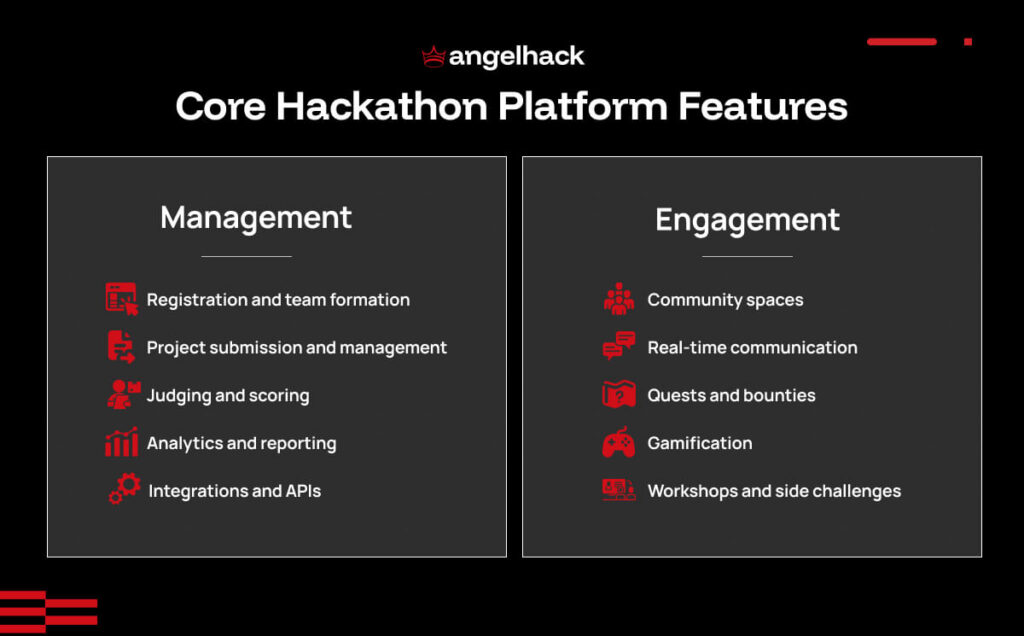
The Management Layer
This is the operational backbone – the part that keeps everything running cleanly. It covers registration, submissions, judging, reward distribution, and reporting dashboards. For enterprise teams it also needs to handle security, compliance, SSO, and audit trails. If this layer wobbles, no prize pool or great content will rescue your event.
The Engagement Layer
This is the participation experience – the part that makes developers genuinely want to show up. Quests, community forums, gamification, bounties, mentorship, and workshops all live here. A strong engagement layer is what separates a forgettable one-off event from a community that keeps growing with every program you run.
Now that you know how a platform is structured, let’s look at the specific features that make the biggest difference in practice.
Core Hackathon Platform Features: What Actually Matters
Not all platforms are built the same, and not every feature will matter equally for your program. Here is a practical breakdown of what to evaluate across both layers – what each feature does, why it matters, and how real programs have used it.
Management Features
- Registration and team formation. Your front door. A smooth flow means more people show up, and smart team-matching tools help you build the cross-functional groups that produce the strongest ideas. In practice, Databricks used platform-level vetting at registration to ensure only qualified data professionals entered their Generative AI World Cup – raising the bar on every submission across 18 countries.
- Project submission and management. How participants hand in their work. A solid submission system handles file uploads, version control, and a clean review queue so judges are not hunting through email threads. It keeps you in control and gives participants confidence their work will actually be seen and evaluated fairly.
- Judging and scoring. A good judging module lets you set your own criteria, gives judges a simple and clear interface, and produces transparent scores you can share with every team – sliced by category, region, or challenge track if needed.
- Analytics and reporting. This is how you prove the program worked. Engagement metrics, submission throughput, and performance dashboards give you real data to report upward and sharpen the next event. Without it, your post-event conversation is just impressions.
- Integrations and APIs. Your developers live in GitHub, Slack, and Figma. Your team runs on CRM and email tools. A platform that connects to all of these removes friction on both sides and means you are not rebuilding your workflow from scratch every time.
Engagement Features
- Community spaces. Forums, virtual rooms, and networking channels where participants can collaborate and support each other. For example, when NASA and AWS ran the Open Source Rover Challenge, the platform community became a genuine knowledge hub – nearly 3,000 developers from 85 countries working through a technically demanding problem together.
- Real-time communication. In-platform chat and video so participants, mentors, and organizers stay connected throughout the event. This is especially important for virtual and hybrid formats where you cannot rely on the energy of a shared physical space to keep things moving.
- Quests and bounties. Structured micro-challenges that run alongside or between your main hackathons, keeping the community active and skills growing in the gaps. This is what Hedera did – they used a phased learn-and-earn campaign, hackathon, and top-7 incubator to take 5,000+ developers all the way from first contact through to real application deployment.
- Gamification. Leaderboards, badges, and reward tiers that give participants a reason to push harder and come back next time. For instance, IBM’s Master the Mainframe used gamified coding challenges to sustain 20,000+ participants yearly across 150+ countries – year after year.
- Workshops and side challenges. Live learning sessions and themed coding sprints that deepen skills and raise the overall quality of submissions. They also help less experienced participants feel supported enough to stay in the event.
Now that you know what to look for, here is how to find the platform that delivers it for your specific situation.
How to Choose and Roll Out a Hackathon Platform
Resist the temptation to start with a feature list or a platform comparison. The right platform depends on your goals, your team, and the developers you are trying to reach. Start there and everything else becomes much clearer.
Step 1: Define Your Goals and Format
Before you look at a single demo, get clear on what you are actually trying to achieve. This one step will save you weeks of evaluation and prevent a lot of expensive regret.
- Clarify your primary goal: talent sourcing, developer adoption, product innovation, community growth, or brand awareness.
- Choose your format: virtual for global reach, in-person for culture and connection, or hybrid for both.
- Set your baseline KPIs upfront: participation targets, submission quality, engagement rates, and post-event hire rate.
Step 2: Map Feature Requirements to Your Goals
Be honest about what you actually need rather than what looks impressive in a demo.
- Enterprise-first: security, compliance, data privacy, SSO, and audit trails come first.
- Community-first: quests, forums, mentorship, and gamification are your priorities.
- Full-stack: you need both layers working together – clean operations and strong engagement mechanics.
Step 3: Choose Your Platform
Here is an honest look at the main options and where each one fits best.
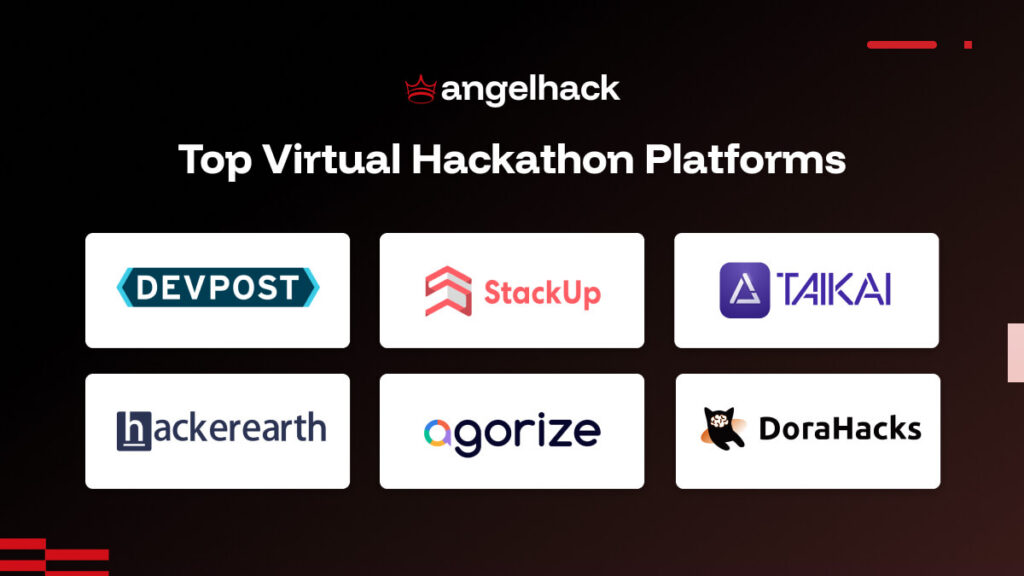
- Devpost is a well-established platform trusted by large enterprise organizations for reliable submission management and broad global developer reach. A strong choice when running a high-visibility event cleanly at scale.
- HackerEarth combines coding assessments and hackathon management in one place – especially useful when you want to identify top performers and move them directly into a hiring pipeline.
- StackUp (now part of AngelHack) is a developer-first platform with an all-in-one organizer interface, built-in quests and bounties, reward distribution, and detailed analytics. A community of 200,000+ developers and full-service support covering program design, marketing, and content make it a strong fit for organizations of any size.
- Taikai is built specifically for Web3 and blockchain hackathons. Decentralized voting and crypto-based rewards make it the natural home for events targeting DeFi and blockchain communities.
- DoraHacks has deep roots in crypto and decentralized tech, with 200,000+ developers in its community and support for DAO integrations and token incentives.
- Agorize connects enterprises with a global network of innovators across students, startups, and professionals – well-suited to open innovation and corporate-to-student programs.
If you want a platform that handles both management and long-term ecosystem building, StackUp brings 200,000+ developers, built-in quests and bounties, and the full-service support of AngelHack’s 300,000+ developer network. For teams that want a genuine partner rather than just a tool, it is the most complete option available.
Step 4: Test, Then Launch
No demo replaces actually running an event. Start small, learn fast, and build from there.
- Run a scoped pilot (a few days, internal team only) with clear success criteria defined before the event starts.
- Gather feedback from both participants and organizers, and use your analytics to identify where people dropped off.
- Once your core management workflows are stable, layer in additional engagement mechanics – quests, bounties, and community features – to deepen participation.
- Build a multi-event calendar so the impact compounds over time rather than resetting after each program.
Overcoming Common Hackathon Platform Challenges
Most of the challenges you will face are completely predictable – which means you can build the fix into your plan before they become problems. Here are the five that come up most often.
Onboarding friction
When sign-up is clunky or the platform feels unfamiliar, people drop off quietly before the event even starts. Streamline your registration flow, add a short orientation guide, and use pre-event learning quests to get participants comfortable before the hack begins.
Security and compliance
For enterprise events, data privacy and access controls are not optional. Build your governance framework and SSO integration in from day one, and confirm the platform meets your compliance requirements well before launch.
Engagement fatigue
Participation drops sharply between events when there is nothing holding the community together. Quests and bounties are your best tool here – they keep developers engaged in the gaps and mean the community is already warm when your next event launches.
Platform fragmentation
If your platform does not connect to the tools developers already use – GitHub, Slack, Figma – you are adding friction for every single participant. Make solid API support and pre-built connectors a non-negotiable in your evaluation.
Proving ROI to leadership
Set your baseline metrics before the pilot runs, track both immediate and longer-term outcomes, and you will have a real story to tell – not just a vibe.
Final Words
A hackathon platform is not just event software. The right one becomes the infrastructure for a developer community that keeps growing long after the hackathons are done.
Successful hackathons are the ones that combine management infrastructure with engagement mechanics that bring developers back between events. The platform you choose makes both possible.
Organize a Virtual Hackathon That Lasts
From planning to final pitch, AngelHack runs virtual hackathons that drive real developer engagement
FAQ: Hackathon Platform
What is a hackathon platform and do I need one?
It is software that manages the full event lifecycle: registration, team formation, submissions, judging, rewards, and analytics. If you are planning to run more than a handful of participants or want to repeat the program, you need one. Spreadsheets do not scale and they create a poor experience for everyone involved.
What is the difference between a hackathon platform and hackathon management software?
Hackathon management software covers the operational side: registration, submissions, judging. A hackathon platform adds engagement mechanics like quests, community spaces, and gamification on top. For a one-off event, management software might be enough. For programs building a developer ecosystem, you need the full platform.
How do we ensure participant data is secure on a hackathon platform?
Look for SSO support, role-based access controls, and clear data handling policies. For enterprise events, confirm compliance requirements before signing. Ask vendors directly about data residency and audit trail capabilities – those conversations go better before the event than after.
Can a hackathon platform support virtual and hybrid events?
Yes, and most modern platforms are built for exactly that. You need solid async communication tools, a virtual ideation space, and synchronous kickoffs and demo days to maintain energy. With the right setup, a fully virtual event can match the quality of an in-person one.
How do I measure the ROI of a hackathon platform?
Track immediate metrics – participation rate, submission quality – and longer-term outcomes like ideas progressing to pilot, hires from participants, and revenue influenced. Set your baseline KPIs before the pilot so you have real numbers to report against, not just a feeling that it went well.